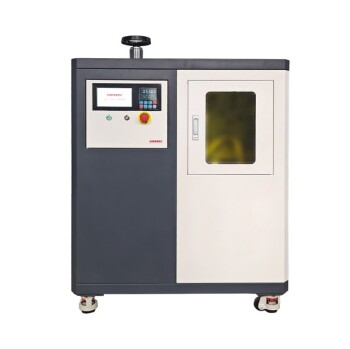
The primary function of a hot press in all-solid-state battery assembly is to apply simultaneous heat and pressure to the electrolyte-cathode stack. By operating at specific temperatures (such as 100°C), this process softens the material interfaces to effectively eliminate microscopic gaps that pressure alone might not resolve.
Core Takeaway Solid-state batteries struggle with high resistance at the points where layers meet. Hot pressing solves this by merging these layers into a unified, dense structure, significantly lowering interfacial resistance and unlocking higher discharge capacity and better cycling stability.
The Challenge: The Solid-Solid Interface
The "Gap" Problem
In liquid batteries, the electrolyte flows into pores, ensuring perfect contact. In solid-state batteries, the electrolyte and cathode are both rigid solids.
When these layers are stacked, microscopic voids and gaps naturally remain between them. These gaps act as barriers, preventing ions from moving efficiently between the cathode and the electrolyte.
The Limits of Cold Pressure
While standard hydraulic pressing (often at high pressures like 360 MPa) creates contact, it may not fully eliminate porosity at the interface. Relying solely on mechanical force often leaves residual gaps that impede performance.
How Hot Pressing Solves the Problem
Eliminating Voids Through Heat and Force
The hot press introduces a thermal element to the assembly process. By heating the stack to a controlled temperature (e.g., 100°C) while applying pressure, the materials become slightly more compliant.
This combination allows the electrolyte and cathode materials to deform and flow into one another more effectively than they would at room temperature. This eliminates the gaps between layers, creating a seamless, fully dense physical connection.
Reducing Interfacial Resistance
The direct result of eliminating these physical gaps is a drastic reduction in interfacial resistance.
When the layers are in intimate contact, ions experience less friction as they travel across the interface. This optimization is the primary driver for the improved discharge capacity observed in hot-pressed cells.
Improving Long-Term Stability
Beyond immediate power output, this dense interface is crucial for longevity. The enhanced physical contact prevents the layers from delaminating or separating over time, directly contributing to superior cycling stability.
Understanding the Trade-offs
Process Precision vs. Material Integrity
While heat is beneficial, it must be carefully controlled. The process aims to densify the interface without degrading the chemical structure of the battery components.
The primary reference notes a specific operating temperature (e.g., 100°C) for assembly. This is distinct from higher temperatures (e.g., 200°C) used for creating theoretical glass reference samples. Deviating from the optimal temperature window could either fail to close gaps (too cold) or potentially damage the battery stack (too hot).
The Necessity of Secondary Processing
Hot pressing adds a secondary step to the manufacturing line, increasing complexity compared to simple cold assembly. However, this trade-off is generally accepted because the performance gains—specifically in capacity and cycle life—are necessary for the battery to function commercially.
Making the Right Choice for Your Project
The decision to implement hot pressing depends on the specific performance metrics you are trying to maximize.
- If your primary focus is Discharge Capacity: Use hot pressing to minimize interfacial resistance, ensuring the maximum amount of energy can be extracted from the cell.
- If your primary focus is Cycle Life: Rely on hot pressing to create a robust, dense interface that maintains structural integrity over repeated charge and discharge cycles.
Ultimately, treating the interface with a hot press is the difference between a battery that merely functions and one that delivers high-efficiency, lasting performance.
Summary Table:
| Feature | Impact of Hot Pressing | Benefit to Battery Performance |
|---|---|---|
| Interfacial Contact | Eliminates microscopic voids and gaps | Faster ion transport between layers |
| Material Density | Merges layers into a unified, dense structure | Reduced internal resistance (ASR) |
| Mechanical Bond | Prevents delamination during cycling | Enhanced long-term cycling stability |
| Energy Output | Optimizes contact at 100°C+ | Higher discharge capacity |
| Structural Integrity | Compensates for the limits of cold pressure | Superior physical connection and longevity |
Revolutionize Your Battery Research with KINTEK Precision
Overcome the challenges of solid-solid interfacial resistance with KINTEK’s advanced laboratory solutions. Whether you are developing next-generation all-solid-state batteries or high-performance energy storage, our specialized hydraulic presses (pellet, hot, and isostatic) and high-temperature furnaces provide the thermal and mechanical precision required for a seamless electrolyte-cathode interface.
From battery research tools and high-pressure reactors to essential crucibles and ceramics, KINTEK delivers the comprehensive equipment portfolio needed to ensure your materials reach their theoretical density and stability.
Ready to scale your lab's efficiency and battery performance? Contact KINTEK today to find the perfect pressing solution!
Related Products
- Manual High Temperature Heated Hydraulic Press Machine with Heated Plates for Lab
- Automatic Heated Hydraulic Press Machine with Heated Plates for Laboratory Hot Press
- Touchscreen Automatic Vacuum Heat Press
- Automatic Heated Hydraulic Press Machine with Heated Plates for Laboratory Hot Press 25T 30T 50T
- Heated Hydraulic Press Machine with Heated Plates for Vacuum Box Laboratory Hot Press
People Also Ask
- What is a hot hydraulic press? Harness Heat and Pressure for Advanced Manufacturing
- What is a heated hydraulic press used for? Essential Tool for Curing, Molding, and Laminating
- Why is a heated hydraulic press used for warm pressing NASICON green tapes? Optimize Your Solid Electrolyte Density
- What does a hydraulic heat press do? Achieve Industrial-Scale, Consistent Pressure for High-Volume Production
- Why is a heated laboratory hydraulic press necessary for composite laminates? Achieve Void-Free Structural Integrity