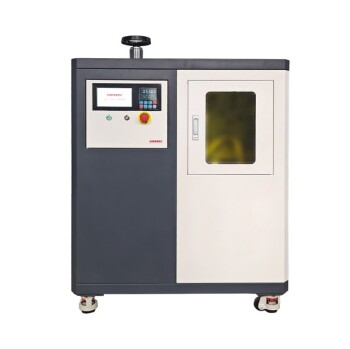
In the fabrication of solid electrolytes, the laboratory hydraulic press serves as the definitive tool for structural formation. It applies powerful, uniform axial pressure to ball-milled Lithium Aluminum Titanium Phosphate (LATP) powder. This compression transforms the loose raw material into a cohesive "green body," establishing the mechanical stability and particle proximity required before high-temperature sintering can occur.
The core function of the hydraulic press is to maximize the packing density of the LATP powder. By minimizing voids at this stage, the press ensures the subsequent sintering process yields a dense, high-performance ceramic with continuous ion-conducting channels.
The Role of Pressure in LATP Fabrication
Creating a Dense "Green Body"
The primary outcome of the molding phase is the creation of a green body. This is the compacted, unsintered pellet that serves as the precursor to the final ceramic.
The hydraulic press exerts force to pack ball-milled LATP particles tightly together. This reduces the interstitial space between particles, directly influencing the density of the final product.
Ensuring Mechanical Integrity
Without sufficient compression, the molded pellet would lack the cohesion to be handled or transferred to a furnace.
The press provides the necessary mechanical strength to maintain the pellet's geometric shape. This structural integrity is a non-negotiable prerequisite for the thermal processing that follows.
The Foundation for Sintering
Sintering is a densification process, but it relies heavily on the initial state of the material.
If the powder particles are not sufficiently packed during the pressing stage, the sintering process will fail to fully densify the ceramic. The hydraulic press establishes the physical foundation that allows high-temperature sintering to successfully create a high-density ceramic.
Critical Technical Outcomes
Controlling Porosity
Porosity is the enemy of ionic conductivity in solid electrolytes.
By applying significant uniaxial pressure (often ranging from 10 MPa to significantly higher depending on the specific protocol), the press minimizes the volume of voids. This reduction in porosity is essential for ensuring the electrolyte acts as an effective barrier and conductor.
Uniform Axial Pressure
Consistency across the pellet is vital for performance.
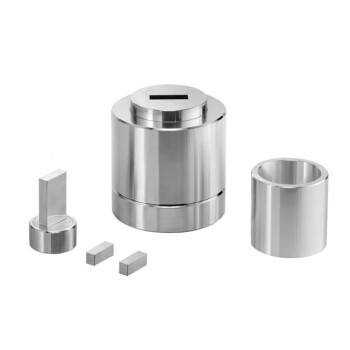
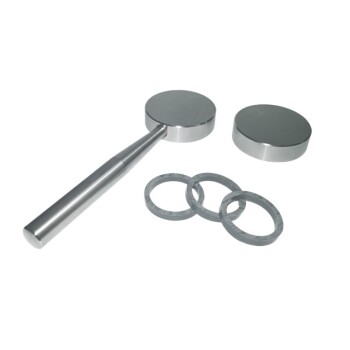
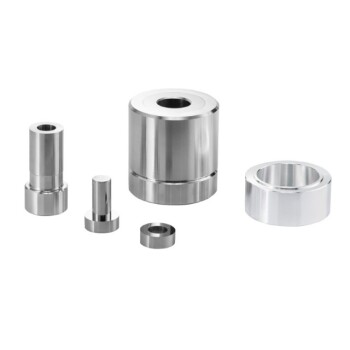
A laboratory hydraulic press, used with specialized dies, ensures the pressure is applied uniformly across the axial direction. This prevents density gradients that could lead to warping or cracking during the heating phase.
Establishing Ion Transport Networks
For an electrolyte to function, lithium ions must move through a continuous pathway.
The densification achieved by the press forces particles into tight contact. This contact creates the initial connectivity required to form continuous ion-conducting channels once the material is sintered.
Understanding the Trade-offs
The Risk of Pressure Gradients
While hydraulic presses aim for uniformity, friction between the powder and the die wall can create pressure gradients.
If the pressure is not truly uniform, the pellet may exhibit density variations from the center to the edge. This can result in differential shrinkage during sintering, leading to distorted or defective ceramics.
Balancing Density and Defect Formation
There is a limit to how much pressure yields beneficial results.
Excessive pressure can occasionally lead to lamination or micro-cracking within the green body. It is critical to find the specific pressure window that maximizes density without introducing structural stress that leads to failure.
Making the Right Choice for Your Goal
The selection of pressure parameters and tooling directly dictates the quality of your LATP electrolyte.
- If your primary focus is Ionic Conductivity: Prioritize higher pressures to maximize initial packing density, ensuring the shortest possible pathways for ion transport after sintering.
- If your primary focus is Geometric Consistency: Focus on using high-precision dies and moderate, controlled pressure to ensure uniform shrinkage and prevent warping.
The laboratory hydraulic press is not merely a shaping tool; it is the gatekeeper of density that determines whether your LATP powder becomes a high-performance solid electrolyte.
Summary Table:
| Stage of LATP Process | Role of Hydraulic Press | Key Technical Outcome |
|---|---|---|
| Powder Compaction | Applies uniform axial pressure | Formation of a cohesive "green body" |
| Structural Formation | Minimizes interstitial voids | Maximizes packing density and minimizes porosity |
| Pre-Sintering Preparation | Establishes particle proximity | Enables the formation of continuous ion-conducting channels |
| Quality Control | Provides mechanical strength | Prevents warping or cracking during thermal processing |
Elevate Your Battery Research with KINTEK Precision
Maximize the performance of your solid-state electrolytes with KINTEK’s advanced laboratory hydraulic presses. Whether you require manual pellet presses for rapid testing or high-tonnage isostatic systems for superior density, our equipment is designed to ensure the mechanical integrity and ion-conducting efficiency of your LATP ceramics.
Our comprehensive laboratory portfolio includes:
- Hydraulic Presses: Pellet, hot, and isostatic presses for optimal green body formation.
- High-Temperature Furnaces: Muffle, tube, and vacuum furnaces for precise sintering.
- Milling & Crushing: High-efficiency systems for uniform powder preparation.
- Specialized Consumables: High-purity ceramics, crucibles, and PTFE products.
Don't let porosity compromise your research. Contact KINTEK today to find the perfect pressing and sintering solution for your lab!
Related Products
- kbr pellet press 2t
- Laboratory Hydraulic Pellet Press for XRF KBR FTIR Lab Applications
- Automatic Laboratory Hydraulic Pellet Press Machine for Lab Use
- Laboratory Manual Hydraulic Pellet Press for Lab Use
- Laboratory Hydraulic Press Split Electric Lab Pellet Press
People Also Ask
- How do you prepare samples for IR spectroscopy? A Step-by-Step Guide for Solids, Liquids, and Gases
- What measurement methods are commonly used for powder samples in infrared spectroscopy? Optimize Your FTIR Analysis
- Why KBr is used in IR spectrophotometry? A Key to Transparent Sample Analysis
- How are a KBr pellet press and mortar utilized in FTIR analysis of activated carbon? Expert Sample Prep Guide
- How do you prepare KBr pellets for FTIR analysis? Master the Technique for High-Quality IR Spectra