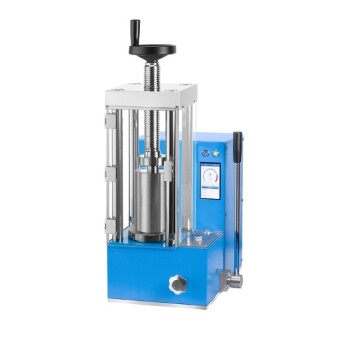
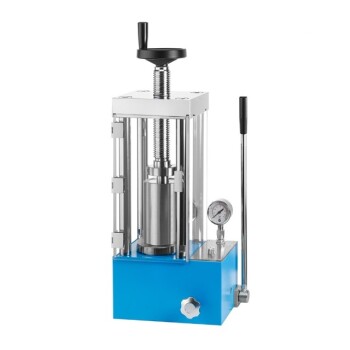
The primary function of a laboratory hydraulic press in this context is to transform loose diamond and aluminum powder mixtures into a solid, manageable form known as a "green compact" or "green body." This cold pressing step creates a cohesive unit with specific strength and shape, facilitating the safe transfer of the material into sintering molds while establishing the necessary density for the subsequent heating process.
Core Takeaway Cold pressing is not merely about shaping; it is a critical density-management step. By mechanically locking particles together and expelling air prior to sintering, the hydraulic press minimizes unpredictable shrinkage and structural defects, serving as the essential bridge between loose raw materials and a high-quality composite.
Establishing the "Green Body"
The immediate output of the hydraulic press is a compacted sample that holds its shape without heat. This physical transformation addresses the logistical challenges of working with loose powders.
Creating Physical Integrity
Loose diamond and aluminum powders lack structural cohesion. The press applies force to interlock these particles, creating a green compact with sufficient mechanical strength to be handled.
Facilitating Material Handling
Without this pre-compression, transferring loose powder into a hot-pressing mold is prone to spillage and inconsistency. The pressed compact ensures the sample can be loaded efficiently and maintains its geometry during storage and transport.
Optimizing the Sintering Foundation
The deep need for cold pressing lies in preparing the internal microstructure of the material for the vacuum hot pressing sintering process.
Maximizing Packing Density
The press significantly increases the initial packing density of the powder mixture. By forcing particles closer together mechanically, the process reduces the distance atoms must diffuse during sintering, providing a solid foundation for final densification.
Expelling Trapped Air
Loose powders contain significant amounts of air within the gaps between particles. Cold pressing expels this air, which is critical for reducing voids. Removing air early prevents it from becoming trapped during high-temperature processing, which could otherwise lead to porous, weak composites.
Ensuring Structural Uniformity
Beyond simple density, the hydraulic press ensures that the internal structure of the final diamond/aluminum composite is consistent throughout.
Controlling Volume Shrinkage
When loose powder is sintered, it shrinks distinctively. By pre-densifying the material, the hydraulic press significantly reduces volume shrinkage during the hot pressing stage, making the final dimensions more predictable.
Preventing Structural Defects
A pre-pressed compact helps prevent common metallurgical defects. It ensures particle rearrangement is uniform, which prevents the material from delaminating (layer separation) or overflowing the mold when pressure and heat are later applied simultaneously.
Critical Process Variables
While the hydraulic press is essential, its effectiveness relies on precise application. It is not simply about applying maximum force, but applying the correct force.
The Importance of Specific Pressure
The process requires applying a specific pre-pressure (examples in similar contexts range from 2 MPa to 10 MPa depending on the material). This precision is vital; the pressure must be high enough to consolidate the powder into a robust shape, but controlled enough to ensure uniform density distribution.
Dimensional Stability Risks
If the initial pressing is inadequate, the green body may lack the strength to survive handling or may collapse during the initial stages of sintering. The hydraulic system provides the control necessary to ensure the green body possesses the exact shape and dimensional stability required for the final application.
Making the Right Choice for Your Goal
When integrating a hydraulic press into your powder metallurgy workflow, consider your specific objectives to determine the pressing parameters.
- If your primary focus is Process Efficiency: Prioritize cold pressing to create robust green bodies that simplify loading and reduce cycle times by preventing powder spillage and mold overflow.
- If your primary focus is Material Quality: Focus on maximizing initial packing density to expel air and minimize voids, which is the single biggest factor in achieving a high-density, pore-free final composite.
Ultimately, the laboratory hydraulic press acts as a quality control gate, ensuring that only structurally sound, high-density compacts proceed to the costly sintering phase.
Summary Table:
| Feature | Benefit of Cold Pressing | Impact on Final Composite |
|---|---|---|
| Material Form | Creates a "Green Body" | Enhances handling and reduces spillage |
| Density | Increases initial packing density | Provides solid foundation for final densification |
| Air Content | Expels trapped air | Minimizes voids and porosity in the structure |
| Shrinkage | Pre-densifies material | Ensures predictable final dimensions and volume |
| Integrity | Interlocks particles | Prevents delamination and structural defects |
Elevate Your Material Research with KINTEK Precision
Maximize your powder metallurgy success with KINTEK’s industry-leading laboratory hydraulic presses. Whether you are working on diamond/aluminum composites or advanced ceramics, our high-precision pellet, hot, and isostatic presses ensure the perfect green body every time.
From high-temperature furnaces to crushing and milling systems, KINTEK provides the comprehensive tools your lab needs for superior material synthesis and analysis.
Ready to eliminate structural defects and optimize your sintering workflow? Contact our experts today to find the right equipment for your application!
Related Products
- Assemble Square Lab Press Mold for Laboratory Applications
- Anti-Cracking Press Mold for Lab Use
- Electric Lab Cold Isostatic Press CIP Machine for Cold Isostatic Pressing
- Cylindrical Press Mold with Scale for Lab
- Laboratory Manual Hydraulic Pellet Press for Lab Use
People Also Ask
- How to use a press mold? Master the Art of Creating Consistent Ceramic Forms
- What is a laboratory press? Achieve Precise Sample Preparation for Reliable Analysis
- How does a laboratory press contribute to the initial forming of a porous copper wick? Optimize Wick Pore Architecture
- What is the press mould method? A Guide to Consistent, Detailed Ceramic Forms
- What is the process of mold press? A Step-by-Step Guide to Compression Molding