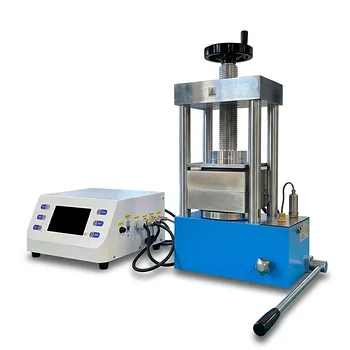
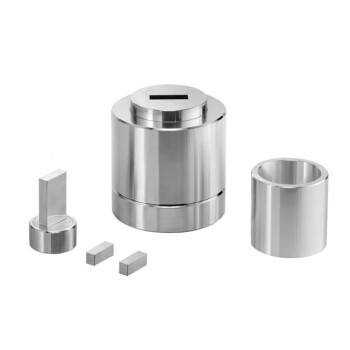
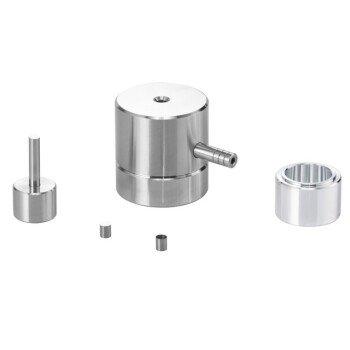
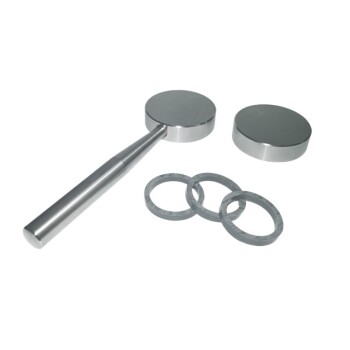
A laboratory hydraulic press serves as the critical bridge between loose LiFePO4 powder and high-density compaction. Its primary function is to apply uniaxial pressure to transform free-flowing powder into a semi-solid "green body." This step provides the material with the necessary structural integrity and defined geometric shape to be successfully encapsulated in rubber molds for the subsequent Cold Isostatic Pressing (CIP) process.
Core Takeaway Loose powders cannot be effectively processed in a Cold Isostatic Press (CIP) without first being stabilized. The laboratory hydraulic press consolidates LiFePO4 powder into a cohesive unit—known as a green body—allowing it to be handled, bagged, and subjected to higher isotropic pressures without losing its form.
The Mechanics of Pre-Forming
Establishing Structural Integrity
Loose LiFePO4 powder lacks the cohesion required for handling. The hydraulic press applies mechanical force to lock particles together, creating a "green body."
This compact is solid enough to be picked up and moved without crumbling. It provides the operational integrity required for the manufacturing workflow to proceed.
Defining Preliminary Geometry
The hydraulic press shapes the powder into a specific form, typically a cylinder or rectangle.
This geometric standardization is essential for the next stage of processing. It ensures the material fits precisely into the rubber molds used during isostatic pressing.
Why Pre-Forming is Prerequisite to CIP
Enabling Encapsulation
Cold Isostatic Pressing involves submerging a sample in a fluid medium to apply pressure from all sides. To do this, the sample must be sealed inside a flexible rubber mold.
You cannot easily seal loose powder into these molds without significant deformation or air pockets. The hydraulic press creates a solid shape that slides easily into the protective rubber barrier.
Air Expulsion and Initial Packing
Applying initial uniaxial pressure forces air out of the interstitial spaces between powder particles.
This increases the initial packing density of the material. By removing air early, you reduce the risk of defects and volume shrinkage during later densification stages.
Understanding the Limitations
The Density Gradient Issue
While the hydraulic press is excellent for shaping, it applies pressure from only one direction (uniaxial).
This often creates density gradients within the sample, where the edges or surfaces are denser than the center. This unevenness is the primary reason why hydraulic pressing alone is insufficient for high-performance LiFePO4 components.
The Role of Secondary Processing
Because of these gradients, the hydraulic press is rarely the final step for critical components.
It is a preparatory tool. It sets the stage for the Cold Isostatic Press, which applies uniform (isotropic) pressure to eliminate those gradients and achieve maximum, uniform density.
Optimizing Your Powder Processing Strategy
To ensure high-quality LiFePO4 ceramic electrolytes or cathodes, you must view these machines as complementary, not interchangeable.
- If your primary focus is Material Handling: Rely on the hydraulic press to convert loose powder into stable, transportable green bodies.
- If your primary focus is Final Density: Use the hydraulic press only for shaping, and rely on the Cold Isostatic Press to eliminate internal porosity and microscopic defects.
The hydraulic press provides the necessary form, while the subsequent isostatic press delivers the ultimate structural uniformity.
Summary Table:
| Feature | Laboratory Hydraulic Press (Pre-forming) | Cold Isostatic Press (Secondary) |
|---|---|---|
| Pressure Direction | Uniaxial (One direction) | Isotropic (All directions) |
| Primary Goal | Create stable "green body" shape | Achieve maximum, uniform density |
| Material State | Loose powder to semi-solid | Semi-solid to high-density compact |
| Advantage | Enables handling and encapsulation | Eliminates density gradients & porosity |
| Output Form | Preliminary geometry (cylinder/disc) | Uniformly dense final component |
Elevate Your Battery Research with KINTEK Precision
Maximize the performance of your LiFePO4 cathodes and electrolytes by optimizing your powder compaction workflow. KINTEK specializes in high-performance laboratory equipment designed for rigorous material science, including our precision hydraulic pellet presses (manual, electric, and heated) and cold isostatic presses (CIP).
Whether you need to create stable green bodies or achieve ultimate structural uniformity, our team provides the technical expertise and robust tools—from crushing and milling systems to high-temperature furnaces—to ensure your research yields consistent, high-density results.
Ready to refine your material processing? Contact KINTEK today to find the perfect pressing solution for your lab!
Related Products
- Ball Press Mold for Lab
- Laboratory Manual Hydraulic Pellet Press for Lab Use
- Manual Lab Heat Press
- Laboratory Manual Hydraulic Pellet Press for Lab Use
- Automatic Laboratory Hydraulic Pellet Press Machine for Lab Use
People Also Ask
- What are the advantages of using a laboratory hydraulic press for hot pressing? Achieve Peak Nano-Composite Density
- How to use a press mold? Master the Art of Creating Consistent Ceramic Forms
- What is the press mould method? A Guide to Consistent, Detailed Ceramic Forms
- What is the purpose of specialized pressure devices in sulfide solid-state batteries? Ensure Chemo-Mechanical Stability
- Why are pressure molds with non-conductive resin inner walls required for battery testing? Ensure Data Accuracy