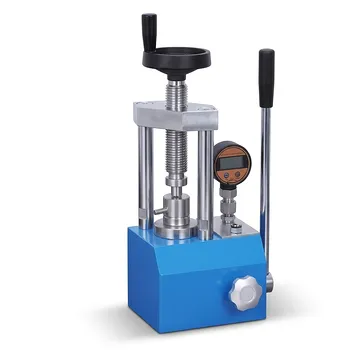
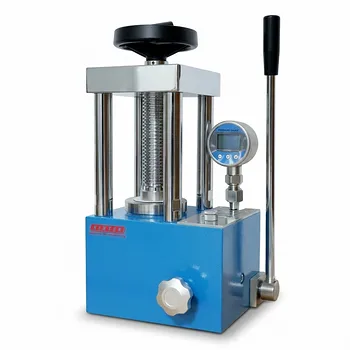
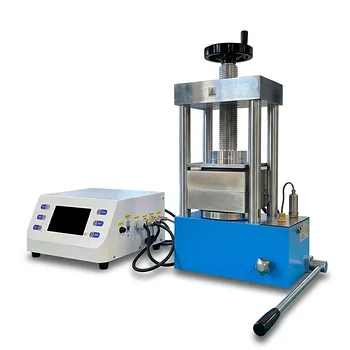
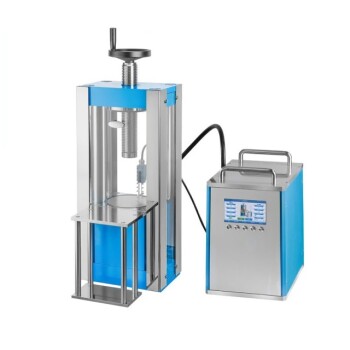
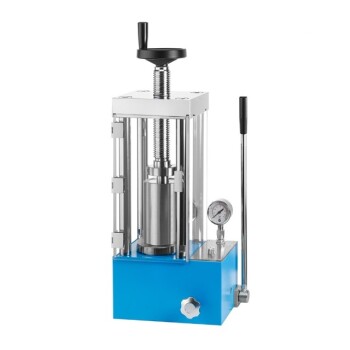
The laboratory manual hydraulic press is used to convert loose carbonized C-(MOF-5/PANI) powder into a dense, solid pellet for accurate conductivity testing. By applying high pressure—often reaching 255 MPa—the press eliminates air voids and significantly reduces contact resistance between individual particles. This ensures that the resulting measurements reflect the material’s intrinsic electronic transmission capability rather than the air gaps or loose packing of the powder.
Core Takeaway: The hydraulic press creates a dense, uniform percolation network within the composite material, allowing researchers to measure the "true" bulk conductivity by removing the interference of particle-to-particle contact resistance.
Eliminating Contact Resistance and Voids
Establishing a Continuous Percolation Network
Loose carbonized powders are inherently resistive because electrons must jump across air gaps or poor contact points between particles. The hydraulic press forces these particles together, establishing a stable and continuous percolation network throughout the specimen.
Reducing Air Interference
Manual pressing causes micron or nano-sized particles to undergo plastic deformation and pack closely together. This physical molding effectively excludes air from the matrix, preventing atmospheric resistance from skewing the final data.
Focusing on Intrinsic Properties
Without pelletization, conductivity data would merely describe the "bulk packing state" of the powder. High-pressure compression ensures the measurement reveals the intrinsic physical properties of the carbonized MOF/PANI composite itself.
Ensuring Geometric and Density Uniformity
Standardizing Physical Parameters
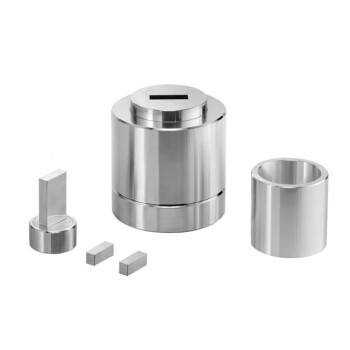
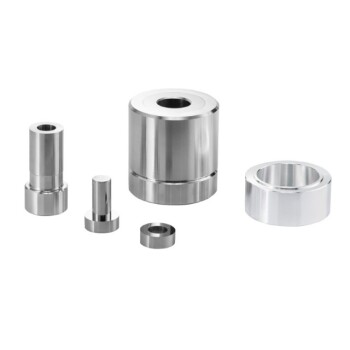
A hydraulic press allows for the creation of pellets with fixed geometric dimensions, such as a specific thickness and diameter. These precise dimensions are critical for calculating volume resistivity and bulk density accurately across different samples.
Maintaining Consistent Sample Density
Precise pressure control ensures that every test sample has a uniform density baseline. This consistency is vital for repeatability, allowing researchers to compare different formulations or carbonization temperatures without density being a hidden variable.
Facilitating Reliable Measurement Techniques
Dense, cylindrical pellets are required for standard testing methods, such as the four-probe conductivity measurement. The solid form ensures stable electrode contact, which is impossible to achieve reliably with loose, shifting powders.
Understanding the Trade-offs
The Risk of Over-Compression
Applying excessive pressure can lead to the structural collapse of delicate MOF frameworks or unintended plastic deformation. If the pressure is too high, it may alter the material's morphology, leading to conductivity readings that do not represent the material's intended application state.
Material Rebound and Fragility
Some carbonized composites may exhibit "spring-back" or brittle fracturing after the pressure is released. This can introduce micro-cracks that increase resistance, potentially negating the benefits of the initial pelletization if the sample is handled roughly.
Pressure Calibration Limits
Manual presses require careful monitoring to ensure pressure is held constant. Fluctuations during the pressing cycle can lead to internal density gradients, where the top and bottom of the pellet have different conductive properties.
How to Apply This to Your Research
Successful pelletization requires balancing the need for density with the preservation of the material’s structural integrity.
- If your primary focus is determining bulk resistivity: Use a high-precision die to ensure fixed geometric dimensions for every sample.
- If your primary focus is comparing different material loadings: Maintain a strictly consistent pressure (e.g., 255 MPa) across all samples to ensure density is not a variable.
- If your primary focus is preserving MOF structure: Conduct a pressure-sensitivity study to find the minimum pressure required to stabilize the percolation network without collapsing the pores.
By utilizing a hydraulic press to standardize the physical state of C-(MOF-5/PANI) composites, researchers can transition from inconsistent powder data to scientific, reproducible conductivity benchmarks.
Summary Table:
| Feature | Function in Pelletization | Impact on Conductivity Testing |
|---|---|---|
| High Pressure (255 MPa) | Eliminates air voids and gaps | Reduces contact resistance for intrinsic measurements |
| Compression Force | Creates a continuous percolation network | Ensures stable and reliable electronic transmission |
| Geometric Precision | Produces pellets with fixed dimensions | Enables accurate calculation of volume resistivity |
| Density Control | Maintains consistent sample density | Ensures repeatability across different material batches |
Elevate Your Research Precision with KINTEK
Achieve scientific excellence in your conductivity testing and material synthesis with KINTEK’s high-performance laboratory equipment. We specialize in providing the precision tools necessary to transform raw powders into reliable data, ensuring your research reflects the true intrinsic properties of your materials.
Our comprehensive portfolio is designed to support every stage of your workflow:
- Hydraulic Presses: Precision pellet, hot, and isostatic presses for uniform sample preparation.
- Thermal Processing: High-temperature furnaces (muffle, tube, vacuum, CVD, and PECVD) for advanced carbonization.
- Material Synthesis: High-pressure reactors, autoclaves, and electrolytic cells.
- Sample Preparation: Crushing, milling, and sieving systems to achieve ideal particle size.
- Lab Essentials: Essential consumables including PTFE products, ceramics, and crucibles.
Whether you are a researcher focusing on MOF composites or a lab manager streamlining operations, KINTEK provides the reliability and technical support you need.
Contact us today to find the perfect equipment for your lab!
References
- Marjetka Savić, Gordana Ćirić‐Marjanović. Carbonization of MOF-5/Polyaniline Composites to N,O-Doped Carbon/ZnO/ZnS and N,O-Doped Carbon/ZnO Composites with High Specific Capacitance, Specific Surface Area and Electrical Conductivity. DOI: 10.3390/ma16031018
This article is also based on technical information from Kintek Solution Knowledge Base .
Related Products
- Laboratory Manual Hydraulic Pellet Press for Lab Use
- Laboratory Manual Hydraulic Pellet Press for Lab Use
- Automatic Laboratory Hydraulic Pellet Press Machine for Lab Use
- Automatic Laboratory Hydraulic Press for XRF & KBR Pellet Press
- kbr pellet press 2t
People Also Ask
- What is the role of a laboratory hydraulic pellet press and stainless steel molds in the fabrication of RuO2/NbC anodes?
- How does a laboratory hydraulic pellet press contribute to SiCw/2024 aluminum composite preforms? Optimize Densification
- What is the significance of applying 200 MPa of pressure with a laboratory hydraulic pellet press for composite ceramics?
- What is the necessity of using a laboratory hydraulic pellet press in the preparation of biomass fuel pellets? Guide
- What key role does a laboratory pellet press play in FTIR analysis? Master KBr Sample Preparation Excellence