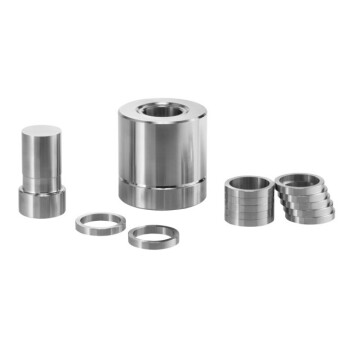
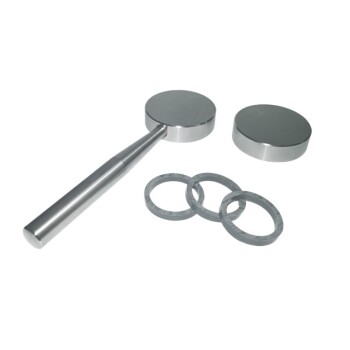
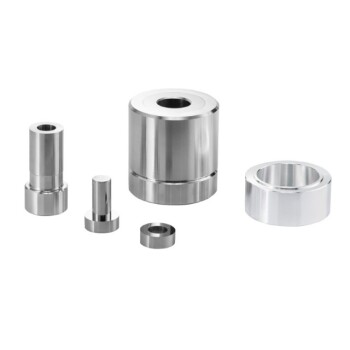
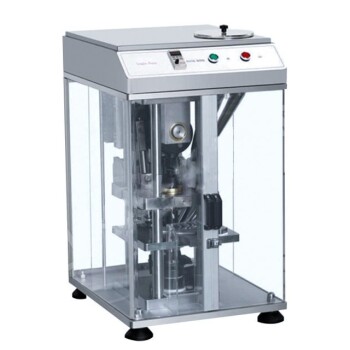
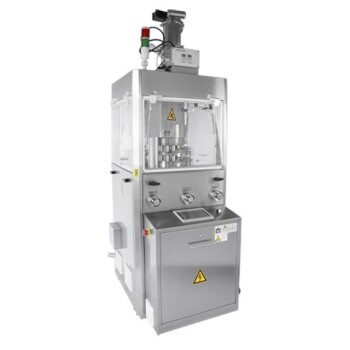
To measure the contact resistance of a Gas Diffusion Layer (GDL) accurately, a laboratory pellet press and a high-precision digital multimeter work in tandem to replicate real-world operating conditions. By applying specific, controllable compressive stress—typically around 1 MPa—the pellet press simulates the physical environment of a fuel cell stack, while the multimeter captures the resulting voltage drop to calculate electrical efficiency under load.
The primary purpose of this dual-instrument setup is to quantify how GDL conductivity responds to mechanical pressure, allowing researchers to evaluate both bulk and interfacial resistance under conditions that mirror a functioning fuel cell.
Simulating the Fuel Cell Environment
Replicating Stack Pressure
The electrical performance of a GDL is highly dependent on compressive stress. In an operational fuel cell stack, components are tightly compressed to ensure gas-tight seals and robust electrical paths.
Controllable Stress Application
A laboratory pellet press provides the repeatable and precise load necessary to mimic these "actual working pressures." Without this controlled pressure, resistance measurements would be inconsistent and fail to reflect how the material performs in a real-world assembly.
Evaluating Carbon Materials
This setup is a core indicator for evaluating the electrical conductivity of new carbon materials. It allows developers to determine if a material can maintain low resistance even when subjected to the high-pressure demands of a stack.
Precision in Electrical Measurement
Detecting Minute Voltage Drops
Because GDLs are designed to be highly conductive, the resistance values are often extremely small. A high-precision digital multimeter is essential to detect the tiny voltage drops across the sample with the required sensitivity.
The Role of Gold-Plated Electrodes
To ensure the measurement focuses solely on the GDL, the setup utilizes gold-plated electrodes. Gold minimizes the electrode's own resistance and prevents surface oxidation, ensuring that the captured data reflects the material's true properties.
Differentiating Resistance Types
This methodology helps researchers distinguish between bulk resistance (resistance through the material itself) and interfacial contact resistance (resistance at the boundary where the GDL meets other components). Both factors are critical for optimizing fuel cell efficiency.
Understanding the Trade-offs and Pitfalls
Uniformity of Pressure
While the pellet press applies force, it is critical that the force is distributed evenly across the entire surface of the GDL. Non-uniform stress distribution can lead to "hot spots" where resistance appears lower than it actually is, skewing the overall data.
Sensitivity to Surface Contamination
Even with gold-plated electrodes, the presence of microscopic contaminants or oils can significantly increase contact resistance. Rigorous cleaning protocols for both the electrodes and the GDL samples are necessary to maintain data integrity.
Equipment Calibration
The accuracy of the results depends entirely on the synchronization and calibration of both the press and the multimeter. If the pressure sensor or the voltage reader is out of spec, the resulting conductivity curve will be fundamentally flawed.
Applying This Methodology to Your Project
To get the most out of your resistance measurements, tailor your approach based on your specific research or production goals:
- If your primary focus is material benchmarking: Use a standardized compressive load (like 1 MPa) across all samples to ensure a "level playing field" for comparing different carbon formulations.
- If your primary focus is fuel cell stack design: Vary the pressure applied by the pellet press to create a resistance-vs-pressure curve, helping you identify the "sweet spot" for stack compression.
- If your primary focus is quality control: Prioritize the use of high-precision multimeters with data-logging capabilities to detect subtle batch-to-batch variations in GDL conductivity.
By precisely controlling mechanical load and electrical measurement, you can ensure your carbon materials are optimized for peak performance in hydrogen energy applications.
Summary Table:
| Component | Primary Function | Key Benefit for GDL Testing |
|---|---|---|
| Laboratory Pellet Press | Applies precise compressive stress (e.g., 1 MPa) | Replicates real-world fuel cell stack environments |
| High-Precision Multimeter | Detects minute voltage drops across the material | Accurately calculates bulk and interfacial resistance |
| Gold-Plated Electrodes | Provides low-resistance electrical contact | Prevents oxidation and ensures data reflects GDL properties |
| Controlled Loading | Ensures repeatable mechanical pressure | Enables consistent benchmarking of new carbon materials |
Elevate Your Fuel Cell Research with KINTEK Precision
Accurate GDL characterization requires equipment that can withstand rigorous testing while delivering repeatable results. KINTEK specializes in high-performance laboratory solutions designed for advanced material science. Our range includes:
- Hydraulic Pellet Presses: Manual and automatic systems for precise, repeatable compressive stress application.
- Battery Research Tools: Specialized equipment and consumables for electrochemical testing.
- High-Temperature Solutions: Muffle, tube, and vacuum furnaces for carbon material synthesis.
- Precision Consumables: High-quality ceramics, crucibles, and PTFE products to maintain sample integrity.
Whether you are benchmarking carbon formulations or optimizing stack designs, KINTEK provides the reliability your data demands. Contact our technical team today to discuss your specific application and find the perfect equipment setup for your lab!
References
- D.P. Leonard, Rodney L. Borup. Natural fiber-derived gas diffusion layers for high performance, lower cost PEM fuel cells. DOI: 10.1016/j.jpowsour.2022.232619
This article is also based on technical information from Kintek Solution Knowledge Base .
Related Products
- kbr pellet press 2t
- Laboratory Hydraulic Pellet Press for XRF KBR FTIR Lab Applications
- Automatic Laboratory Hydraulic Pellet Press Machine for Lab Use
- Laboratory Manual Hydraulic Pellet Press for Lab Use
- Automatic Laboratory Hydraulic Press for XRF & KBR Pellet Press
People Also Ask
- How do you prepare samples for IR spectroscopy? A Step-by-Step Guide for Solids, Liquids, and Gases
- What measurement methods are commonly used for powder samples in infrared spectroscopy? Optimize Your FTIR Analysis
- Why KBr is used in IR spectrophotometry? A Key to Transparent Sample Analysis
- How are a KBr pellet press and mortar utilized in FTIR analysis of activated carbon? Expert Sample Prep Guide
- How do you prepare KBr pellets for FTIR analysis? Master the Technique for High-Quality IR Spectra