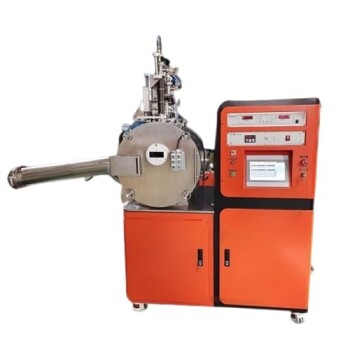
The primary necessity of a plasma-enhanced chemical vapor deposition (PECVD) system lies in its ability to decouple chemical reactivity from thermal energy. By utilizing a high-frequency power source to generate plasma at low temperatures, the system can effectively dissociate complex liquid precursors like hexamethyldisiloxane and gases such as methane. This capability is essential for depositing uniform, dense silicon-doped diamond-like carbon (Si-DLC) coatings on sensitive substrates without compromising their physical structure.
PECVD is the definitive method for coating temperature-sensitive or porous materials because it achieves high-energy chemical dissociation in a low-temperature environment. This results in a highly hydrophobic, chemically stable, and amorphous carbon-silicon film that enhances performance while strictly preserving the integrity of the underlying substrate.
The Mechanics of Low-Temperature Deposition
High-Frequency Plasma Generation
The core advantage of PECVD is its use of a high-frequency power source. This energy creates a plasma state where electrons are highly energetic, but the overall gas temperature remains relatively low.
Efficient Precursor Dissociation
This high-energy plasma effectively breaks down (dissociates) stable precursors. The process handles a mix of gases like methane and argon, alongside liquid precursors such as hexamethyldisiloxane.
Substrate Preservation
Because the process operates at low temperatures, it is ideal for delicate materials. It allows for the coating of porous metal membrane substrates without melting, warping, or altering their original physical structure.
Critical Advantages for Film Quality
Superior Film Uniformity
The PECVD process ensures the deposition is not just surface-level but creates a uniform and dense thin film. This density is crucial for creating an effective barrier against environmental factors.
Enhanced Material Properties
The resulting Si-DLC coating transforms the surface properties of the substrate. The film provides excellent heat resistance and chemical stability, extending the lifespan of the component.
Hydrophobicity and Structure
The specific use of silicon doping via PECVD creates an amorphous carbon-silicon thin film. This structure renders the surface highly hydrophobic, which is particularly valuable for filtration or protective applications where liquid repulsion is necessary.
Understanding the Trade-offs
Process Complexity
While PECVD offers superior coating quality, managing the precursor mix is complex. Introducing liquid precursors like hexamethyldisiloxane requires precise vaporization and flow control compared to simple gas-only systems.
Equipment Dependencies
The requirement for high-frequency power sources and vacuum conditions increases the system's operational footprint. Achieving the precise nanocrystalline or amorphous structures described requires rigorous control over power inputs and gas ratios.
Making the Right Choice for Your Application
To determine if PECVD is the correct solution for your specific engineering challenge, consider your substrate limitations and performance goals:
- If your primary focus is substrate integrity: Choose PECVD for its ability to coat porous or heat-sensitive metals without altering their physical geometry or structural strength.
- If your primary focus is surface performance: Rely on this method to generate highly hydrophobic, chemically stable surfaces that require dense, uniform coverage.
PECVD transforms the challenge of coating sensitive materials into an opportunity for creating high-performance, chemically resistant interfaces.
Summary Table:
| Feature | PECVD for Si-DLC Coatings | Benefits |
|---|---|---|
| Deposition Temp | Low Temperature | Protects heat-sensitive & porous substrates |
| Precursor Type | Gas & Liquid (HMDSO) | Versatile chemical composition for doping |
| Film Structure | Dense & Amorphous | High chemical stability & durability |
| Surface Property | Highly Hydrophobic | Superior liquid repulsion & protection |
| Film Uniformity | High-energy Plasma | Consistent coverage on complex geometries |
Elevate Your Thin-Film Research with KINTEK
Unlock the full potential of your materials with KINTEK’s advanced PECVD and CVD systems. Whether you are developing silicon-doped diamond-like carbon (Si-DLC) coatings or exploring novel nanocrystalline structures, our precision-engineered laboratory equipment ensures superior film uniformity and substrate integrity.
Why choose KINTEK?
- Comprehensive Range: From high-temperature furnaces and vacuum systems to PECVD, MPCVD, and thermal CVD solutions.
- Tailored for Labs: Specialized tools for battery research, crushing, milling, and high-pressure reactors.
- Total Support: High-quality consumables including PTFE, ceramics, and crucibles to maintain your workflow.
Ready to enhance your lab's efficiency and achieve high-performance coating results? Contact KINTEK today to discuss your application!
References
- Sara Claramunt, Roland Dittmeyer. Fabrication and Characterization of Hydrophobic Porous Metallic Membranes for High Temperature Applications. DOI: 10.3390/pr9050809
This article is also based on technical information from Kintek Solution Knowledge Base .
Related Products
- RF PECVD System Radio Frequency Plasma-Enhanced Chemical Vapor Deposition RF PECVD
- Chemical Vapor Deposition CVD Equipment System Chamber Slide PECVD Tube Furnace with Liquid Gasifier PECVD Machine
- Inclined Rotary Plasma Enhanced Chemical Vapor Deposition PECVD Equipment Tube Furnace Machine
- Inclined Rotary Plasma Enhanced Chemical Vapor Deposition PECVD Equipment Tube Furnace Machine
- 915MHz MPCVD Diamond Machine Microwave Plasma Chemical Vapor Deposition System Reactor
People Also Ask
- What is plasma enhanced chemical vapour deposition PECVD used for? Enable Low-Temp Thin Films for Electronics & Solar
- What is an example of PECVD? RF-PECVD for High-Quality Thin Film Deposition
- What is the role of RF-PECVD in VFG preparation? Mastering Vertical Growth and Surface Functionality
- What is plasma enhanced chemical Vapour deposition process used for fabrication of? A Guide to Low-Temperature Thin Films
- What is plasma chemical vapor deposition? A Low-Temperature Thin Film Coating Solution