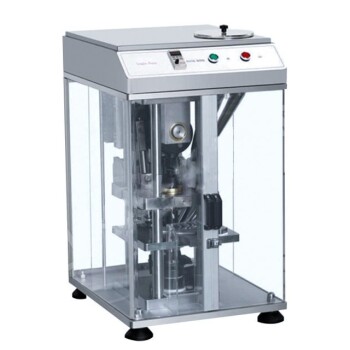
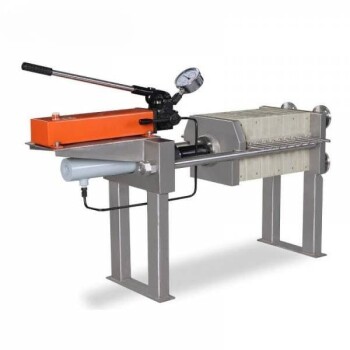
The primary role of a powder hydraulic press in the carbothermic reduction of magnesium is to maximize reaction efficiency by forcing solid reactants into intimate contact. By compressing mixed powders into dense pellets at specific pressures (commonly around 10 MPa), the press minimizes the physical distance between particles, accelerates diffusion, and ensures the material remains stable within the vacuum furnace environment.
Core Takeaway Carbothermic reduction relies on solid-solid interactions that are inefficient in loose powder form. Hydraulic pressing solves this by densifying the material, creating the necessary contact points for chemical reactions to occur while preventing material loss during vacuum processing.
Optimizing Reaction Kinetics
To understand the necessity of the press, one must look at the microscopic requirements of the chemical reaction.
Enhancing Particle Contact
In a loose powder mixture, particles are separated by air gaps and voids.
A hydraulic press eliminates these voids, forcing the reactants into close physical contact. This "intimate contact" is the prerequisite for the reaction to initiate efficiently.
Shortening Diffusion Distances
Chemical reactions in solids are governed by diffusion. Atoms must physically move across boundaries to react.
Compression significantly reduces the distance these atoms must travel. By shortening the diffusion path, the press facilitates faster and more complete solid-solid interface reactions once high temperatures are applied.
Ensuring Process Stability
Beyond chemical kinetics, pelletizing is essential for the physical stability of the manufacturing process.
Preventing Vacuum Dispersion
Magnesium reduction processes typically operate under vacuum conditions to lower the reaction temperature.
If loose powder were used, the vacuum pumping system would likely suck the fine particles out of the reaction zone. Compressing the powder into a solid pellet prevents this dispersion, ensuring the reactants stay where they are needed.
Reducing Spattering Risks
High-temperature reactions can be volatile.
Loose powders are prone to spattering or becoming airborne during the reaction process. A compacted pellet maintains its structural integrity, minimizing material loss and preventing contamination of the furnace equipment.
The Mechanics of Densification
While the primary reference highlights the reaction benefits, understanding the mechanics of the press clarifies why it works.
Air Expulsion
Before the particles can bond, the air between them must be removed.
The initial application of pressure expels air trapped within the bulk powder. This removal is critical for achieving a consistent density and preventing voids that could hinder thermal conductivity.
Creating "Green Strength"
The press creates a "green compact"—a solid object that holds its shape before sintering or reacting.
Through plastic and elastic deformation, the powder grains interlock and bond. This mechanical strength ensures the pellet does not fall apart during handling or when being loaded into the reactor.
Understanding the Trade-offs
While pressing is beneficial, applying pressure requires precision to avoid processing issues.
The Balance of Pressure
Applying pressure is not simply about "more is better."
You must target a specific pressure (e.g., 10-12 MPa) to achieve the right density. If the pressure is too low, the pellet will lack the strength to survive handling or the vacuum force.
Density vs. Permeability
While high density improves contact, the pellet must not be impermeable.
The reduction process produces gas/vapor. If a pellet is over-compressed to the point of being non-porous, evolution of gases could potentially compromise the structural integrity of the pellet during the reaction.
Making the Right Choice for Your Goal
When configuring your hydraulic press parameters for magnesium production, consider your specific operational targets.
- If your primary focus is Reaction Speed: Prioritize higher compression pressures to maximize particle contact and minimize diffusion distances.
- If your primary focus is Process Yield: Focus on achieving sufficient "green strength" to ensure zero material is lost to vacuum dispersion or spattering.
- If your primary focus is Equipment Longevity: Ensure pellets are compacted enough to prevent loose dust from contaminating vacuum pumps and heating elements.
By controlling the density of your reactants, you transform a chaotic mixture into a controlled, high-efficiency chemical system.
Summary Table:
| Feature | Impact on Carbothermic Reduction | Benefit for Magnesium Production |
|---|---|---|
| Particle Contact | Eliminates air gaps and voids | Maximizes solid-solid interface reactions |
| Diffusion Path | Significantly shortens atomic travel distance | Accelerates reaction speed and completeness |
| Pellet Density | Creates structural "green strength" | Prevents material dispersion in vacuum systems |
| Pressure Control | Targeted compression (e.g., 10-12 MPa) | Balances thermal conductivity with gas permeability |
| Material Integrity | Reduces spattering and airborne dust | Protects furnace equipment and improves yield |
Maximize Your Lab’s Production Efficiency with KINTEK
Achieving the perfect pellet density is critical for successful carbothermic reduction and high-temperature material research. KINTEK specializes in precision laboratory equipment, offering a robust range of manual and automated hydraulic presses (pellet, hot, and isostatic) designed to meet your exact pressure requirements.
Our comprehensive portfolio supports every stage of your workflow, from crushing and milling systems to high-temperature vacuum furnaces and PTFE or ceramic consumables. Whether you are focused on battery research, metallurgy, or advanced ceramics, our experts are ready to provide the tools that ensure consistent results and equipment longevity.
Ready to optimize your reaction kinetics? Contact KINTEK today to find the perfect pressing solution for your application!
Related Products
- Ball Press Mold for Lab
- Laboratory Hydraulic Press Lab Pellet Press Machine for Glove Box
- Laboratory Hydraulic Press Split Electric Lab Pellet Press
- Laboratory Manual Hydraulic Pellet Press for Lab Use
- Laboratory Hydraulic Pellet Press for XRF KBR FTIR Lab Applications
People Also Ask
- What are the advantages of using a laboratory hydraulic press for hot pressing? Achieve Peak Nano-Composite Density
- How to use a press mold? Master the Art of Creating Consistent Ceramic Forms
- What is the press mould method? A Guide to Consistent, Detailed Ceramic Forms
- What is the purpose of specialized pressure devices in sulfide solid-state batteries? Ensure Chemo-Mechanical Stability
- Why are pressure molds with non-conductive resin inner walls required for battery testing? Ensure Data Accuracy