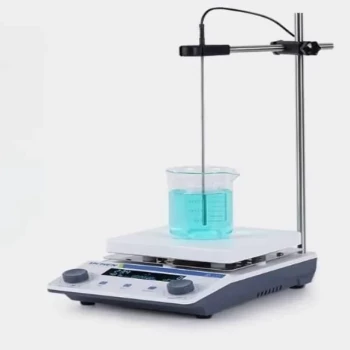
Precision temperature control is the functional backbone of efficient hydrolysis. A precision laboratory heater acts as the primary source of thermal energy required to rupture the strong beta-1,4-glycosidic bonds that hold cellulose polymers together in waste paper. By maintaining a strictly controlled temperature—specifically within ranges such as 25±2°C—the heater accelerates the reaction rate, allowing acid catalysts to convert cellulose into glucose in approximately 1.5 hours.
While the acid serves as the chemical agent of change, the precision heater is the kinetic driver. It ensures the thermal environment is exact enough to break down complex molecular structures efficiently without unpredictable fluctuations.
The Mechanics of Breaking Cellulose
Targeting the Beta-1,4-Glycosidic Bond
Cellulose is a robust polymer found in waste paper, structured by beta-1,4-glycosidic bonds. These bonds are chemically stable and resistant to breaking under ambient conditions.
A precision heater supplies the necessary thermal energy to destabilize these specific bonds. This energy input is the prerequisite for the acid catalyst to effectively attack the polymer chain.
Accelerating Reaction Kinetics
Chemical reactions involving complex polymers are naturally slow without kinetic assistance. The laboratory heater increases the kinetic energy of the solution.
This thermal boost accelerates the interaction between the acid and the cellulose. Consequently, what might take days or be incomplete occurs within a compressed timeframe of roughly 1.5 hours.
The Role of Stability in Conversion
Maintaining Precise Thermal Conditions
The reference emphasizes the necessity of maintaining the reaction solution at a specific point, such as 25±2°C.
This level of precision is critical because chemical conversion rates are highly sensitive to temperature variances. A standard heater without precision controls may allow the temperature to drift, leading to inconsistent results.
Efficient Glucose Yield
The ultimate goal of this process is the conversion of waste material into usable glucose.
By accurately holding the temperature, the heater ensures the acid catalyst operates at peak efficiency throughout the entire 1.5-hour duration. This creates a reliable, reproducible pathway for generating glucose from waste paper.
Common Pitfalls in Temperature Control
The Cost of Thermal Fluctuation
The primary trade-off in this process is the dependency on equipment accuracy. Using a heater with a wide variance (e.g., ±5°C or more) introduces a significant variable into the experiment.
If the temperature drops below the optimal range, the energy required to break the glycosidic bonds becomes insufficient, stalling the reaction. Conversely, inconsistent heating prevents the process from meeting the 1.5-hour efficiency benchmark.
Optimizing Your Hydrolysis Process
To achieve high conversion rates of waste paper to glucose, you must view the heater as a critical component of the reaction system, not just an accessory.
- If your primary focus is process speed: Select a heater capable of rapidly reaching the target setpoint to maximize the active reaction time within the 1.5-hour window.
- If your primary focus is reproducibility: Prioritize a device with a tight tolerance (±2°C) to ensure that every batch yields the same amount of glucose under identical conditions.
Accurate thermal management transforms the hydrolysis of waste paper from a theoretical concept into a viable, efficient method for glucose production.
Summary Table:
| Parameter | Influence on Hydrolysis | Importance for Cellulose Conversion |
|---|---|---|
| Temperature Target | 25±2°C | Ensures efficient breaking of beta-1,4-glycosidic bonds. |
| Thermal Stability | Minimal Drift | Maintains peak kinetic efficiency for acid catalysts. |
| Reaction Time | ~1.5 Hours | Accelerated kinetics enable high-speed glucose production. |
| Control Accuracy | High Precision | Prevents stalled reactions and ensures batch reproducibility. |
Elevate Your Laboratory Research with KINTEK Precision Solutions
Unlock maximum efficiency in your chemical processes with KINTEK’s advanced thermal management systems. Whether you are performing acid-catalyzed hydrolysis, battery research, or complex material synthesis, our precision laboratory heaters and high-temperature furnaces provide the exact kinetic environment required for success.
From high-pressure reactors and autoclaves to high-temperature dental furnaces and crushing systems, KINTEK specializes in delivering the robust equipment and essential consumables (like PTFE and ceramics) that modern labs demand.
Ready to achieve superior reproducibility and faster conversion rates? Contact us today to find the perfect equipment for your application!
References
- M.A. Salam, M. A. Islam. Conversion of Cellulosic waste into fermentable sugar: Process optimization. DOI: 10.3329/jce.v28i1.18107
This article is also based on technical information from Kintek Solution Knowledge Base .
Related Products
- Laboratory Small Constant Temperature Heated Magnetic Stirrer Heater and Stirrer
- Automatic Heated Hydraulic Press Machine with Heated Plates for Laboratory Hot Press
- Automatic Heated Hydraulic Press Machine with Heated Plates for Laboratory Hot Press 25T 30T 50T
- 30T 40T Split Automatic Heated Hydraulic Press Machine with Heated Plates for Laboratory Hot Press
- Manual Heated Hydraulic Press Machine with Heated Plates for Laboratory Hot Press
People Also Ask
- What role does a magnetic stirrer with heating play in ZnO nanoparticle synthesis? Precision Control for Quality Results
- What role does a constant temperature heating magnetic stirrer play in MFC-HAp synthesis? Achieve Material Homogeneity
- What is the function of a laboratory magnetic stirrer in Ni–Cr–P electrodeposition? Optimize Ion Transport & Coating
- Why is a laboratory magnetic stirrer required for benzoic acid esters? Boost Reaction Speed & Yield with High RPM
- What role does a laboratory magnetic stirrer play in TiO2 and TiO2-Ag sol preparation? Master Chemical Kinetics