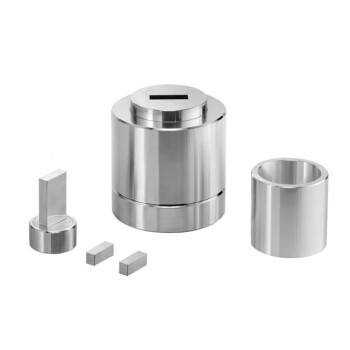
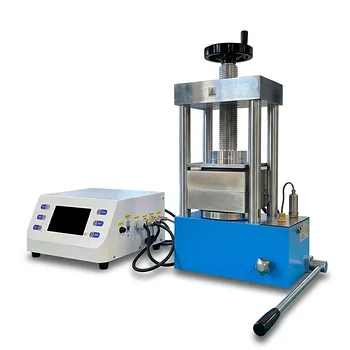
The precision laboratory hydraulic press is the foundational tool for converting high-purity molybdenum powder into viable manufacturing components. Its primary function is to compress loose powder into "green body" disks with exact diameters and thicknesses, establishing the necessary structural integrity for the material to survive subsequent processing steps.
Core Insight: The success of a final molybdenum target is determined before heat is ever applied. By controlling compaction pressure with extreme precision, the hydraulic press ensures tight particle packing and uniform density, preventing the cracks and geometric deformities that inevitably result from unevenly compressed green bodies.
The Critical Role of Compaction Pressure
Achieving Uniform Initial Density
The most significant challenge in powder metallurgy is avoiding density gradients. A precision hydraulic press applies force uniformly, forcing molybdenum particles to rearrange and pack densely. This minimizes density variations within the green body, which are the primary cause of structural failure later in the process.
Ensuring Tight Particle Packing
Loose powder lacks the connectivity required for a high-performance metal target. The press forces particles into tight contact, minimizing voids. This physical proximity provides the necessary mechanical strength for the disk to be handled without crumbling.
Preparing for High-Temperature Sintering
Preventing Structural Defects
The green body is a precursor to the final product; any defect present now will be amplified later. If the initial density is uneven, the stress of high-temperature sintering will cause the molybdenum to warp, develop micro-cracks, or suffer complete structural failure. The press acts as a stabilizer, ensuring the geometry remains regular during thermal processing.
Facilitating Atomic Diffusion
High density in the green body stage is crucial for the physics of sintering. By minimizing the voids between particles, the press shortens the atomic diffusion distance. This promotes effective grain growth and pore elimination, ensuring the final molybdenum target achieves maximum density.
Understanding the Trade-offs
The Risk of Pressure Imbalance
While high pressure is necessary, it must be applied with specific control. Excessive pressure can lead to "capping" or lamination cracks due to trapped air or elastic rebound. Conversely, insufficient pressure results in a weak green body that cannot support its own weight or maintain shape during handling.
Die Friction and Homogeneity
Even with a precision press, friction between the powder and the die wall can create density gradients. While the press provides the force, the quality of the lubrication and the die design are equally critical variables that must be managed to ensure true uniformity across the entire disk.
Optimizing Your Manufacturing Process
To maximize the quality of your molybdenum targets, align your equipment usage with your specific processing goals:
- If your primary focus is Geometric Accuracy: Prioritize a press with rigid alignment controls to ensure the green body disk maintains precise diameter and thickness tolerances.
- If your primary focus is Defect Prevention: Concentrate on the pressure ramp-up and dwell time to ensure uniform density distribution, which is the best defense against sintering cracks.
The precision hydraulic press is not merely a shaping tool; it is the gatekeeper that determines whether a loose powder can successfully transform into a high-performance molybdenum target.
Summary Table:
| Key Requirement | Role in Molybdenum Green Body Production | Impact on Final Target Quality |
|---|---|---|
| Uniform Pressure | Eliminates density gradients during powder compaction | Prevents warping and micro-cracks during sintering |
| Precise Force Control | Ensures tight particle packing and connectivity | Maximizes mechanical strength and handling durability |
| Geometric Stability | Maintains exact disk diameter and thickness | Ensures dimensional accuracy of the finished metal target |
| Void Minimization | Shortens atomic diffusion distances | Facilitates effective grain growth and pore elimination |
Elevate Your Powder Metallurgy with KINTEK Precision Solutions
High-performance molybdenum targets demand absolute precision from the very first press. At KINTEK, we specialize in providing advanced laboratory hydraulic presses (pellet, hot, and isostatic) designed to deliver the uniform density and structural integrity your research and manufacturing require.
Beyond compaction, our comprehensive portfolio supports your entire workflow with:
- High-temperature furnaces and sintering systems
- Crushing, milling, and sieving equipment
- Specialized ceramics and crucibles
Don't let density gradients compromise your results. Contact KINTEK today to find the perfect hydraulic press for your lab and ensure the success of your material synthesis.
References
- Izabela Cieszykowska, Grażyna Birnbaum. Studies on electrochemical dissolution of sintered molybdenum discs as a potential method for targets dissolution in 99mTc production. DOI: 10.1007/s10967-021-08155-3
This article is also based on technical information from Kintek Solution Knowledge Base .
Related Products
- Automatic Laboratory Hydraulic Press for XRF & KBR Pellet Press
- Assemble Square Lab Press Mold for Laboratory Applications
- Laboratory Hydraulic Pellet Press for XRF KBR FTIR Lab Applications
- Ball Press Mold for Lab
- Automatic Laboratory Hydraulic Pellet Press Machine for Lab Use
People Also Ask
- What is the significance of applying 200 MPa of pressure with a laboratory hydraulic pellet press for composite ceramics?
- What is the role of a laboratory hydraulic pellet press and stainless steel molds in the fabrication of RuO2/NbC anodes?
- What is the necessity of using a laboratory hydraulic pellet press in the preparation of biomass fuel pellets? Guide
- How does a laboratory hydraulic pellet press contribute to SiCw/2024 aluminum composite preforms? Optimize Densification
- What role does a laboratory hydraulic pellet press play in fly ash utilization? Enhancing Adsorption and Flow Control