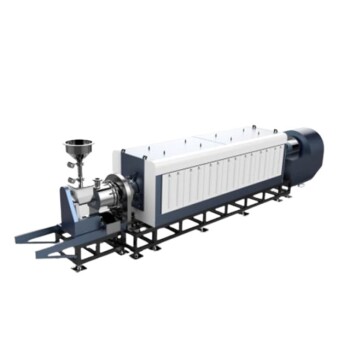
A quartz material tube reactor is primarily selected for its exceptional chemical inertness and thermal stability. In high-temperature steam cracking experiments, quartz allows researchers to operate at temperatures up to 950°C without the reactor walls participating in the reaction, ensuring that the results reflect only the behavior of the sample being tested.
Core Takeaway: The fundamental purpose of using quartz is variable isolation. By preventing the reactor vessel itself from acting as a catalyst, you ensure that all observed carbon deposition (coking) occurs exclusively on the target alloy sample, thereby guaranteeing the integrity of kinetic measurements.
The Critical Role of Chemical Inertness
Eliminating Catalytic Interference
In steam cracking, the material of the reactor wall can significantly alter the outcome. Metal walls often participate in the reaction.
Quartz is chosen because it is chemically inert. It does not catalyze side reactions with hydrocarbons or steam, even under intense heat.
Ensuring Data Purity
The goal of these experiments is often to measure "coking" (carbon deposition) on a specific alloy specimen.
Because the quartz inner wall does not contribute background carbon, researchers can be certain that any mass gain measured is purely a result of interactions on the alloy sample surface.
Thermal Performance Capabilities
Stability at High Temperatures
Steam cracking requires aggressive thermal environments. Quartz maintains its structural and chemical integrity at temperatures reaching 950°C.
This allows for realistic simulation of industrial cracking conditions without the risk of the reactor degrading or contaminating the process.
Resistance to Thermal Shock
Experimental protocols often involve temperature fluctuations. Quartz possesses excellent thermal shock resistance.
This property ensures the reactor tube remains stable during rapid heating or cooling cycles, preventing fractures that could compromise the experiment's safety or atmosphere.
Additional Experimental Advantages
Visual Monitoring
Unlike opaque ceramic or metal reactors, quartz is transparent.
This transparency allows researchers to visually observe the interior of the furnace, ensuring the experiment proceeds under stable conditions and allowing for real-time monitoring of the sample.
Inert Support Systems
The inert nature of quartz extends to the accessories used within the tube.
Quartz fiber is often used to fix the sample position or support gas flow paths. Like the tube itself, these fibers do not participate in the cracking reaction, preserving the accuracy of the mass data.
Understanding the Trade-offs
Temperature Limits
While quartz is stable up to 950°C, it is not suitable for experiments exceeding this threshold.
Pushing quartz beyond this limit can lead to softening or devitrification. For ultra-high-temperature applications (>1000°C), alternative ceramics like alumina might be required, despite their potential lack of transparency.
Mechanical Fragility
Despite its thermal robustness, quartz is a brittle material.
It lacks the impact resistance of metal alloys. Operators must handle the reactor tubes with extreme care during setup and cleaning to avoid micro-fractures that could fail under pressure or heat.
Making the Right Choice for Your Goal
To determine if quartz is the correct material for your specific experimental setup, consider your primary objectives:
- If your primary focus is Kinetic Accuracy: Select quartz to eliminate catalytic wall effects and ensure coking data is derived solely from the specimen.
- If your primary focus is Process Visibility: Select quartz to utilize its transparency for direct visual observation of the reaction environment.
- If your primary focus is Extreme Heat (>950°C): You must look for alternative high-performance ceramics, as quartz may lose structural integrity.
Ultimately, quartz is the standard choice when the purity of the chemical environment is as critical as the temperature it must withstand.
Summary Table:
| Feature | Quartz Material Performance | Benefit for Steam Cracking |
|---|---|---|
| Chemical Inertness | Non-catalytic surface | Eliminates background carbon/coking interference |
| Thermal Stability | Resists up to 950°C | Reliable simulation of industrial cracking conditions |
| Transparency | Clear optical properties | Enables real-time visual monitoring of the sample |
| Thermal Shock | High resistance | Prevents fractures during rapid heating/cooling cycles |
| Accessory Compatibility | Use with quartz fibers | Maintains inert environment for sample support |
Elevate Your Research Precision with KINTEK
Don’t let reactor interference compromise your experimental integrity. KINTEK specializes in providing high-performance laboratory equipment tailored for demanding thermal processes. From quartz tube reactors and high-temperature furnaces (muffle, vacuum, and CVD) to advanced crushing and milling systems, we provide the tools necessary for variable isolation and data purity.
Whether you are conducting steam cracking, battery research, or material synthesis, our comprehensive portfolio—including high-pressure reactors, electrolytic cells, and precision consumables like crucibles and PTFE products—ensures your lab achieves repeatable, industry-leading results.
Ready to optimize your high-temperature setup? Contact our technical experts today to find the perfect solution for your specific application!
References
- Hamed Mohamadzadeh Shirazi, Kevin M. Van Geem. Carburization of High-Temperature Alloys during Steam Cracking: The Impact of Alloy Composition and Temperature. DOI: 10.1021/acs.iecr.2c03599
This article is also based on technical information from Kintek Solution Knowledge Base .
Related Products
- Laboratory Rapid Thermal Processing (RTP) Quartz Tube Furnace
- 1200℃ Split Tube Furnace with Quartz Tube Laboratory Tubular Furnace
- Visual High-Pressure Reactor for In-Situ Observation
- Customer Made Versatile CVD Tube Furnace Chemical Vapor Deposition Chamber System Equipment
- Multi Heating Zones CVD Tube Furnace Machine Chemical Vapor Deposition Chamber System Equipment
People Also Ask
- What technical advantages does an RTP tube furnace offer for photoelectrodes? Achieve Precision & High Phase Purity
- What is the temperature of a quartz tube furnace? Master the Limits for Safe, High-Temp Operation
- How does a quartz tube furnace facilitate the synthesis of rGO? Optimize Your Cathode Matrix with Precise Pyrolysis
- What are the advantages of using an electric heating furnace with a quartz tube for liquid bismuth corrosion control?
- What is the maximum temperature for a quartz tube furnace? Key Limits for Safe & Efficient Operation