Knowledge Why is a sealed corundum crucible structure necessary during the solid carburizing treatment of aluminum coatings?
Author avatar

Tech Team · Kintek Solution

Updated 10 hours ago

Why is a sealed corundum crucible structure necessary during the solid carburizing treatment of aluminum coatings?


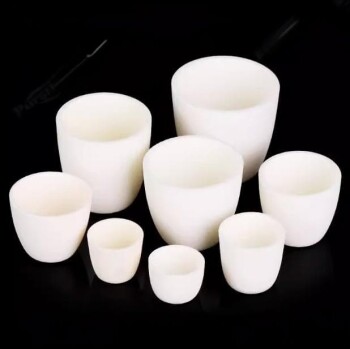
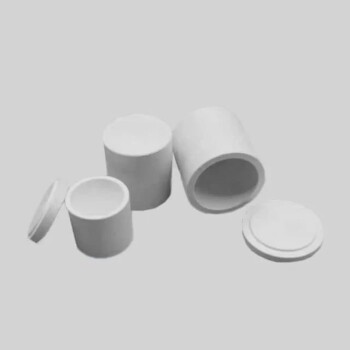
The integrity of the crucible seal is the deciding factor in the success of solid carburizing. At high temperatures (1050 °C), the sealed corundum structure—secured with lids and sealants like silica sol—is necessary to trap the carburizing atmosphere. This prevents the loss of active carbon, ensuring the environment remains chemically aggressive enough to modify the aluminum coating.

The primary function of the sealed structure is to maintain a high carbon potential around the workpiece. Without this containment, the carbon atoms lack the necessary concentration gradient to diffuse into the aluminum layer and form critical reinforcing phases.

The Mechanics of Carbon Potential

Trapping the Atmosphere

Solid carburizing relies on generating a carbon-rich gas from solid packing materials.

By using a sealed corundum crucible with lids and silica sol, you create a closed reactor system. This prevents the carbonaceous gases generated at 1050 °C from escaping into the wider furnace chamber.

Driving Diffusion

The containment of these gases maintains a high carbon potential (concentration of active carbon) directly next to the coating surface.

This high potential creates a strong chemical driving force. It compels carbon atoms to migrate (diffuse) effectively from the atmosphere into the solid aluminum layer.

Resulting Material Enhancements

Creation of Composite Phases

The ultimate goal of this seal is to enable specific chemical reactions that would otherwise fail.

Because the seal facilitates the effective diffusion of carbon, it allows for the formation of composite reinforcing phases. Specifically, the reference highlights the formation of TiC (Titanium Carbide) and Ti3AlC.

These phases are critical for enhancing the mechanical properties of the coating.

Risks of Improper Sealing

Incomplete Phase Transformation

The trade-off in this process is its sensitivity to the quality of the seal.

If the silica sol or lid fails to create an airtight environment, the carbon potential will drop rapidly.

Without sufficient carbon pressure, the diffusion of carbon atoms into the aluminum layer will be insufficient. This leads to a failure in forming the necessary TiC and Ti3AlC phases, resulting in a coating that lacks the intended reinforcement and structural integrity.

Making the Right Choice for Your Process

To ensure the formation of a robust composite coating, focus on the integrity of your containment system:

  • If your primary focus is Process Repeatability: Standardize the application of silica sol to ensure a consistent, airtight seal for every batch at 1050 °C.
  • If your primary focus is Material Hardness: Verify the presence of TiC and Ti3AlC phases post-treatment as a direct indicator that the seal maintained the necessary carbon potential.

The seal is not just a lid; it is a fundamental control mechanism that dictates the chemical composition and performance of your final coating.

Summary Table:

Feature Function in Solid Carburizing
Crucible Material Corundum (Al2O3) for high-temperature stability at 1050 °C
Sealant Method Lids secured with silica sol to prevent gas leakage
Atmosphere Control Traps active carbon to maintain high carbon potential
Diffusion Driver Creates concentration gradients for carbon migration
Key Outcome Formation of reinforcing phases like TiC and Ti3AlC

Maximize Your Material Performance with KINTEK

Precision in high-temperature processes requires equipment that never compromises. KINTEK specializes in advanced laboratory solutions, providing the high-quality corundum crucibles, high-temperature furnaces, and ceramic consumables essential for successful solid carburizing and coating reinforcement.

Whether you are developing titanium-carbide composites or optimizing aluminum coatings, our team offers the technical expertise and robust hardware—from muffle and vacuum furnaces to precision crushing systems—to ensure your research yields consistent, high-performance results.

Ready to elevate your lab's capabilities? Contact KINTEK today for expert guidance and premium equipment!

References

  1. Jiayi Wang, Faguo Li. A Study on the High-Temperature Molten Salt Corrosion Resistance of Hot-Dip Aluminum/Carburizing Composite Coating on Ti65 Titanium Alloy. DOI: 10.3390/coatings13091516

This article is also based on technical information from Kintek Solution Knowledge Base .

Related Products

People Also Ask

Related Products

Alumina Al2O3 Ceramic Crucible Semicircle Boat with Lid for Engineering Advanced Fine Ceramics

Alumina Al2O3 Ceramic Crucible Semicircle Boat with Lid for Engineering Advanced Fine Ceramics

Crucibles are containers widely used for melting and processing various materials, and semicircular boat-shaped crucibles are suitable for special smelting and processing requirements. Their types and uses vary by material and shape.

Arc-Shaped Alumina Ceramic Crucible High Temperature Resistant for Engineering Advanced Fine Ceramics

Arc-Shaped Alumina Ceramic Crucible High Temperature Resistant for Engineering Advanced Fine Ceramics

In the journey of scientific exploration and industrial production, every detail is crucial. Our arc-shaped alumina ceramic crucibles, with their excellent high temperature resistance and stable chemical properties, have become a powerful assistant in laboratories and industrial fields. They are made of high-purity alumina materials and manufactured through precision processes to ensure excellent performance in extreme environments.

Engineering Advanced Fine Alumina Al2O3 Ceramic Crucible for Laboratory Muffle Furnace

Engineering Advanced Fine Alumina Al2O3 Ceramic Crucible for Laboratory Muffle Furnace

Alumina ceramic crucibles are used in some materials and metal melting tools, and flat-bottomed crucibles are suitable for melting and processing larger batches of materials with better stability and uniformity.

Engineering Advanced Fine Ceramics Alumina Crucibles (Al2O3) for Thermal Analysis TGA DTA

Engineering Advanced Fine Ceramics Alumina Crucibles (Al2O3) for Thermal Analysis TGA DTA

TGA/DTA thermal analysis vessels are made of aluminum oxide (corundum or aluminum oxide). It can withstand high temperature and is suitable for analyzing materials that require high temperature testing.

Electron Beam Evaporation Coating Tungsten Crucible and Molybdenum Crucible for High Temperature Applications

Electron Beam Evaporation Coating Tungsten Crucible and Molybdenum Crucible for High Temperature Applications

Tungsten and molybdenum crucibles are commonly used in electron beam evaporation processes due to their excellent thermal and mechanical properties.

Custom Machined and Molded PTFE Teflon Parts Manufacturer with PTFE Crucible and Lid

Custom Machined and Molded PTFE Teflon Parts Manufacturer with PTFE Crucible and Lid

PTFE crucibles, made from pure Teflon, offer chemical inertness and resistance from -196°C to 280°C, ensuring compatibility with a wide range of temperatures and chemicals. These crucibles feature machine-finished surfaces for easy cleaning and prevention of contamination, making them ideal for precise laboratory applications.

Boron Nitride (BN) Crucible for Phosphorous Powder Sintered

Boron Nitride (BN) Crucible for Phosphorous Powder Sintered

Phosphorus powder sintered boron nitride (BN) crucible has a smooth surface, dense, pollution-free and long service life.

Evaporation Crucible for Organic Matter

Evaporation Crucible for Organic Matter

An evaporation crucible for organic matter, referred to as an evaporation crucible, is a container for evaporating organic solvents in a laboratory environment.

Electron Beam Evaporation Coating Gold Plating Tungsten Molybdenum Crucible for Evaporation

Electron Beam Evaporation Coating Gold Plating Tungsten Molybdenum Crucible for Evaporation

These crucibles act as containers for the gold material evaporated by the electron evaporation beam while precisely directing the electron beam for precise deposition.

Electron Beam Evaporation Coating Oxygen-Free Copper Crucible and Evaporation Boat

Electron Beam Evaporation Coating Oxygen-Free Copper Crucible and Evaporation Boat

Electron Beam Evaporation Coating Oxygen-Free Copper Crucible enables precise co-deposition of various materials. Its controlled temperature and water-cooled design ensure pure and efficient thin film deposition.

Electron Beam Evaporation Coating Conductive Boron Nitride Crucible BN Crucible

Electron Beam Evaporation Coating Conductive Boron Nitride Crucible BN Crucible

High-purity and smooth conductive boron nitride crucible for electron beam evaporation coating, with high temperature and thermal cycling performance.

Laboratory Oscillating Orbital Shaker

Laboratory Oscillating Orbital Shaker

Mixer-OT orbital shaker uses brushless motor, which can run for a long time. It is suitable for vibration tasks of culture dishes, flasks and beakers.

Molybdenum Disilicide (MoSi2) Thermal Elements Electric Furnace Heating Element

Molybdenum Disilicide (MoSi2) Thermal Elements Electric Furnace Heating Element

Discover the power of Molybdenum Disilicide (MoSi2) Heating Element for high-temperature resistance. Unique oxidation resistance with stable resistance value. Learn more about its benefits now!

Engineering Advanced Fine Alumina (Al₂O₃) Ceramic Positioning Pin Straight Bevel for Precision Applications

Engineering Advanced Fine Alumina (Al₂O₃) Ceramic Positioning Pin Straight Bevel for Precision Applications

Alumina ceramic positioning pin has the characteristics of high hardness, wear resistance and high temperature resistance.

Silicon Carbide (SIC) Ceramic Sheet Wear-Resistant Engineering Advanced Fine Ceramics

Silicon Carbide (SIC) Ceramic Sheet Wear-Resistant Engineering Advanced Fine Ceramics

Silicon carbide (sic) ceramic sheet is composed of high-purity silicon carbide and ultra-fine powder, which is formed by vibration molding and high-temperature sintering.

Twin Screw Extruder Plastic Granulation Machine

Twin Screw Extruder Plastic Granulation Machine

Twin screw extruder plastic granulation machine is designed for the mixing and processing experiments of engineering plastics, modified plastics, waste plastics and masterbatches.

Precision Machined Zirconia Ceramic Ball for Engineering Advanced Fine Ceramics

Precision Machined Zirconia Ceramic Ball for Engineering Advanced Fine Ceramics

zirconia ceramic ball have the characteristics of high strength, high hardness, PPM wear level, high fracture toughness, good wear resistance, and high specific gravity.

Precision Machined Yttrium Stabilized Zirconia Ceramic Rod for Engineering Advanced Fine Ceramics

Precision Machined Yttrium Stabilized Zirconia Ceramic Rod for Engineering Advanced Fine Ceramics

Zirconia ceramic rods are prepared by isostatic pressing, and a uniform, dense and smooth ceramic layer and transition layer are formed at high temperature and high speed.

Platinum Auxiliary Electrode for Laboratory Use

Platinum Auxiliary Electrode for Laboratory Use

Optimize your electrochemical experiments with our Platinum Auxiliary Electrode. Our high-quality, customizable models are safe and durable. Upgrade today!

Custom PTFE Teflon Parts Manufacturer for PTFE Measuring Cylinder 10/50/100ml

Custom PTFE Teflon Parts Manufacturer for PTFE Measuring Cylinder 10/50/100ml

PTFE measuring cylinder are a rugged alternative to traditional glass cylinders. They are chemically inert over a wide temperature range (up to 260º C), have excellent corrosion resistance and maintain a low coefficient of friction, ensuring ease of use and cleaning.


Leave Your Message