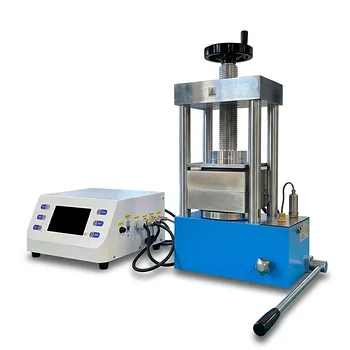
A uniaxial hydraulic press is the critical manufacturing bridge between raw chemical synthesis and functional ceramic performance.
It is utilized to transform loose calcined Lithium Lanthanum Zirconium Tantalum Oxide (LLZTO) powder into solid, shaped units known as "green pellets." By applying precise, unidirectional pressure—ranging from low pre-forming pressures (3-5 bar) to significantly higher compaction forces (up to 300 MPa)—the press eliminates air voids and mechanically locks particles together, creating the structural foundation necessary for the material to survive and densify during subsequent high-temperature processing.
Core Takeaway The hydraulic press does not merely shape the powder; it defines the material's future potential. By maximizing particle-to-particle contact in the "green" state, the press lowers the energy barrier for atomic diffusion, ensuring the final LLZTO ceramic achieves the high density and structural integrity required for peak performance.
The Mechanics of Densification
The primary goal of using a hydraulic press is to manipulate the physical state of the LLZTO powder to prepare it for thermal treatment.
Increasing Particle Contact
Loose calcined powder consists of individual particles separated by air. The press forces these particles into intimate physical contact.
This mechanical proximity is vital because it increases the solid-solid contact interface. Without this initial compaction, the particles would remain too distant to bond effectively.
Reducing Porosity
Air pockets (porosity) within the powder are detrimental to the material's final properties.
The hydraulic press applies force to collapse these voids, significantly reducing the inter-particle porosity. This creates a "green compact" with a much higher initial density than the loose powder.
Shortening Diffusion Distances
For LLZTO to become a dense ceramic, atoms must move (diffuse) across particle boundaries during sintering.
By compressing the material into a dense pellet, the press significantly shortens the diffusion distance between reactant particles. This proximity accelerates chemical reaction kinetics and phase transformations during the subsequent heat treatment.
Preconditioning for Sintering
The work done by the hydraulic press is less about the immediate shape and more about ensuring the success of the sintering process (high-temperature firing).
Establishing Green Strength
The pellet must be robust enough to be handled and loaded into a furnace without crumbling.
The compaction process provides the necessary green strength (mechanical integrity of the unfired part). This allows the pellet to maintain its geometry and uniformity before the chemical bonding of sintering takes over.
Driving Final Density
There is a direct correlation between the density of the green pellet and the density of the final ceramic.
Achieving a high green density—often aiming for a final relative density of over 90% of the theoretical maximum—is critical. If the initial compaction is insufficient, the final material will likely remain porous and mechanically weak.
Critical Considerations and Trade-offs
While the uniaxial hydraulic press is essential, the process involves specific variables that must be managed to avoid defects.
Uniaxial Pressure Limits
Uniaxial presses apply force from a single direction (top and bottom).
This can sometimes lead to density gradients, where the center of the pellet is less dense than the surfaces contacting the press rams. This inhomogeneity can cause warping or uneven shrinkage during sintering.
Controlling Shrinkage Rates
The pressure applied determines the particle packing density, which in turn dictates how much the material will shrink when fired.
Precise pressure control is required to predict and manage this shrinkage. Inconsistent pressure leads to unpredictable final dimensions, which is unacceptable for applications requiring tight tolerances, such as maintaining precise gaps in layered assemblies.
Making the Right Choice for Your Goal
When configuring your hydraulic press process for LLZTO, align your parameters with your specific objective.
- If your primary focus is Chemical Purity and Phase Formation: Prioritize uniform particle contact to ensure atomic diffusion paths are short, facilitating a complete reaction into the target crystal structure.
- If your primary focus is Mechanical Strength and Density: Prioritize high-pressure compaction (e.g., 300 MPa) to maximize green density, as this is the primary variable that dictates the final relative density and grain bonding of the ceramic.
The press provides the physical discipline required to turn a loose chemical powder into a high-performance engineering material.
Summary Table:
| Process Variable | Role in LLZTO Processing | Impact on Final Ceramic |
|---|---|---|
| Particle Contact | Increases solid-solid interface | Accelerates diffusion and sintering kinetics |
| Porosity Reduction | Collapses air voids in powder | Enhances final relative density (>90%) |
| Green Strength | Provides mechanical integrity | Ensures handling stability before firing |
| Pressure Control | Manages particle packing | Controls shrinkage rates and dimensional accuracy |
Elevate Your Battery Research with KINTEK Precision
Transform your LLZTO and advanced materials from loose powders into high-performance ceramics with KINTEK’s industry-leading hydraulic presses. Whether you require manual pellet presses for rapid sampling or automated isostatic systems for uniform density, our equipment is designed to meet the rigorous demands of laboratory research and material science.
Our laboratory portfolio includes:
- Hydraulic Presses: Pellet, hot, and isostatic presses for superior green density.
- High-Temperature Furnaces: Muffle, tube, and vacuum furnaces for precise sintering.
- Crushing & Milling: High-efficiency systems for perfect powder preparation.
- Specialized Consumables: High-purity ceramics, crucibles, and PTFE products.
Ready to achieve 90%+ theoretical density in your solid-state electrolytes? Contact KINTEK today to find the perfect equipment solution and leverage our expertise in material compaction and thermal processing.
Related Products
- Automatic Laboratory Hydraulic Pellet Press Machine for Lab Use
- Laboratory Manual Hydraulic Pellet Press for Lab Use
- Laboratory Hydraulic Press Lab Pellet Press Machine for Glove Box
- Laboratory Hydraulic Press Split Electric Lab Pellet Press
- Laboratory Manual Hydraulic Pellet Press for Lab Use
People Also Ask
- What is the role of a laboratory hydraulic pellet press and stainless steel molds in the fabrication of RuO2/NbC anodes?
- What role does a laboratory pellet press play in the enhancement of biomass energy products? Optimize Fuel Efficiency
- What is the purpose of using a laboratory pellet press when evaluating the electronic conductivity of carbon powders? Guide
- How does a laboratory hydraulic pellet press contribute to SiCw/2024 aluminum composite preforms? Optimize Densification
- What is the significance of applying 200 MPa of pressure with a laboratory hydraulic pellet press for composite ceramics?