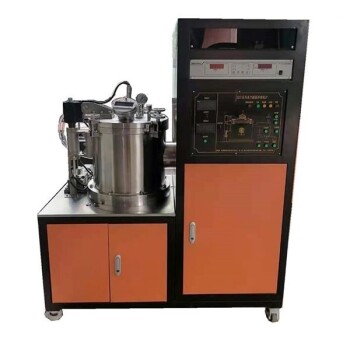
High-temperature degassing in a vacuum furnace is the critical preparatory step required to strip Al-4Cu alloy powders of surface contaminants, specifically process control agents like stearic acid and their decomposition products. By heating the powder to approximately 400°C in a vacuum environment, these volatile impurities are removed before the material is consolidated.
Core Insight: The integrity of a vacuum hot-pressed alloy is determined before pressure is ever applied. If you fail to remove volatile organics and adsorbed gases during the degassing phase, they will become trapped as gas pores during consolidation, permanently compromising the material's density and mechanical strength.
The Critical Role of Surface Purification
Removing Process Control Agents
During the powder manufacturing process, substances like stearic acid are often used as process control agents (PCAs). While useful during milling, these agents become contaminants during consolidation.
Eliminating Decomposition Products
The vacuum furnace heats the powder to temperatures (typically 400°C) sufficient to decompose these organic residues. The vacuum environment then evacuates the resulting decomposition byproducts, leaving the metal surface clean.
Preventing Porosity
If these volatiles remain on the powder surface during the subsequent hot pressing stage, they will turn into gas bubbles. This leads to porosity defects, which prevent the material from achieving a fully dense structure.
The Mechanics of the Vacuum Environment
Enhancing Diffusion and Bonding
For Al-4Cu alloys to achieve high density (greater than 99% of theoretical value), particles must bond tightly. A clean surface, free of organic films and adsorbed moisture, allows for intimate metal-to-metal contact and plastic flow during pressing.
Preventing Oxidation
Aluminum is highly reactive and prone to forming oxide layers. Similar to the processing of Titanium alloys, a high-vacuum environment is essential to lower the partial pressure of oxygen.
Avoiding Impurity Introduction
By maintaining a controlled vacuum, the furnace prevents the re-adsorption of atmospheric gases or moisture. This ensures that the purity achieved during degassing is maintained right up to the moment of consolidation.
Understanding the Trade-offs
Temperature Management
There is a delicate balance in thermal management. The degassing temperature (400°C) must be high enough to vaporize contaminants but must be carefully controlled to avoid premature sintering or grain growth before the pressure is applied.
Process Efficiency vs. Material Quality
Degassing adds time and energy costs to the production cycle. However, skipping this step results in a "garbage in, garbage out" scenario where the final billet suffers from low fracture toughness and structural weakness due to internal voids.
Making the Right Choice for Your Goal
When designing your powder metallurgy workflow for Al-4Cu alloys, consider these priorities:
- If your primary focus is Maximum Density: Ensure the degassing cycle reaches sufficient temperature (approx. 400°C) to fully vaporize stearic acid residues before applying pressure.
- If your primary focus is Mechanical Reliability: Prioritize a high-vacuum environment to strip adsorbed moisture and oxygen, preventing the formation of brittle oxide films that weaken particle boundaries.
- If your primary focus is Microstructural Control: Monitor the degassing duration to ensure the powder is cleaned without inducing excessive thermal stress or grain coarsening prior to the 250°C hot pressing stage.
Effective degassing is not just a cleaning step; it is the prerequisite for achieving the structural integrity required in high-performance alloys.
Summary Table:
| Process Phase | Primary Function | Key Outcome |
|---|---|---|
| Thermal Degassing (~400°C) | Decomposes process control agents (stearic acid) | Removes volatile organic impurities |
| High-Vacuum Environment | Evacuates decomposition byproducts & lowers O2 | Prevents oxidation and pore formation |
| Surface Purification | Cleans powder surfaces for metal-to-metal contact | Enhances particle bonding and diffusion |
| Pre-Consolidation | Prepares material for vacuum hot pressing | Achieves >99% theoretical density |
Achieve Superior Material Integrity with KINTEK
Don't let impurities compromise your alloy performance. KINTEK specializes in high-precision laboratory equipment, offering a comprehensive range of high-temperature vacuum furnaces and hydraulic hot presses designed for critical degassing and consolidation workflows.
Whether you are working with Al-4Cu powders or advanced ceramics, our portfolio—including muffle, tube, and atmosphere furnaces, as well as isostatic presses and high-pressure reactors—provides the controlled environments necessary for maximum density and structural reliability.
Contact KINTEK today to optimize your powder metallurgy process!
Related Products
- Vacuum Hot Press Furnace Heated Vacuum Press Machine Tube Furnace
- 600T Vacuum Induction Hot Press Furnace for Heat Treat and Sintering
- Vacuum Hot Press Furnace Machine Heated Vacuum Press
- Vacuum Heat Treat Furnace and Levitation Induction Melting Furnace
- 2200 ℃ Tungsten Vacuum Heat Treat and Sintering Furnace
People Also Ask
- What advantages does a vacuum hot press furnace provide for LSLBO ceramic electrolytes? Achieve 94% Relative Density
- What role does a Vacuum Hot Press (VHP) furnace play in the densification of austenitic stainless steel 316 composites?
- What are the advantages of using a vacuum hot pressing furnace? Superior Densification for 2024Al/Gr/SiC Composites
- What are the advantages of a vacuum hot press furnace for LTPO solid electrolytes? Boost Density and Conductivity
- What core processing conditions does a vacuum hot press furnace provide? Achieve High-Density Cu-SiC/Diamond Composites