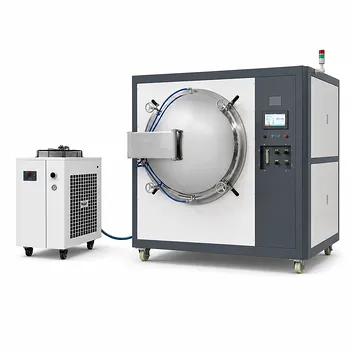
Vacuum hot pressing optimizes density by subjecting Ni-Co-Al superalloys to a precise combination of high thermal energy and mechanical force. Specifically, the process employs a temperature of 1260°C and applies an axial pressure of 20 MPa in a high-vacuum environment below 1.0×10^-2 Pa. This synchronized approach forces particle bonding, allowing the alloy to achieve a relative density of 97.6%.
By simultaneously applying heat and pressure, this method accelerates diffusion and plastic flow between particles. This dual-action approach actively eliminates internal pores that standard sintering methods often leave behind.
The Mechanics of Densification
The Role of Axial Pressure
The defining feature of this process is the application of 20 MPa of axial pressure.
Unlike standard sintering, which relies solely on surface energy reduction, this mechanical force physically pushes powder particles together.
This pressure induces plastic flow at the particle contacts, closing voids and accelerating the densification rate significantly.
Thermal Activation at 1260°C
High temperature is the catalyst for the sintering process.
At 1260°C, the Ni-Co-Al superalloy reaches a state where atomic diffusion is highly active.
This thermal energy reduces the yield strength of the material, making the applied axial pressure far more effective at deforming particles and filling gaps.
The Critical Vacuum Environment
The process is conducted in a vacuum environment maintained below 1.0×10^-2 Pa.
This low pressure is essential for removing trapped gases from within the powder compact.
By eliminating gas pockets before they can become trapped pores, the vacuum ensures the final material structure is continuous and solid.
Understanding the Trade-offs
Hot Pressing vs. Pressureless Sintering
The primary trade-off usually involves process complexity versus material quality.
Pressureless sintering is simpler but often fails to remove all internal pores, resulting in lower structural integrity.
Vacuum hot pressing requires specialized equipment to maintain the 20 MPa load and vacuum simultaneously, but the payoff is a density of 97.6%, which is unattainable via pressureless methods.
Efficiency and Speed
The combination of pressure and heat does more than just increase density; it improves process efficiency.
The mechanical force accelerates the kinetics of densification, achieving near-full density faster than thermal diffusion alone could.
However, this requires precise control over the synchronization of heat and pressure to avoid distorting the final geometry.
Making the Right Choice for Your Goal
To determine if vacuum hot pressing is the correct solution for your Ni-Co-Al application, consider your performance requirements.
- If your primary focus is Maximum Mechanical Strength: Utilize vacuum hot pressing at 1260°C and 20 MPa to eliminate porosity and achieve 97.6% density.
- If your primary focus is Complex Geometry without Post-Processing: Be aware that axial pressure limits shapes to simpler forms, whereas pressureless sintering allows for more complex "net-shape" components, albeit at lower density.
High-performance superalloys require the rigorous elimination of defects that only pressure-assisted vacuum sintering can guarantee.
Summary Table:
| Parameter | Specification | Impact on Material |
|---|---|---|
| Temperature | 1260°C | Activates atomic diffusion and reduces yield strength |
| Axial Pressure | 20 MPa | Induces plastic flow to close internal voids and pores |
| Vacuum Level | < 1.0×10^-2 Pa | Removes trapped gases to ensure a continuous solid structure |
| Final Density | 97.6% | Provides superior mechanical strength and structural integrity |
Elevate Your Material Performance with KINTEK
Precision engineering of Ni-Co-Al superalloys requires more than just heat; it demands the perfect synchronization of pressure and vacuum. KINTEK specializes in advanced laboratory equipment, including high-performance vacuum hot pressing systems and isostatic hydraulic presses, designed to help researchers and manufacturers achieve near-theoretical density in high-performance materials.
From high-temperature furnaces and CVD systems to precision crushing and milling, KINTEK provides the comprehensive tools necessary for cutting-edge battery research and metallurgical excellence. Don't settle for porosity—optimize your results today.
Contact KINTEK to find your custom thermal solution
Related Products
- Vacuum Hot Press Furnace Heated Vacuum Press Machine Tube Furnace
- 600T Vacuum Induction Hot Press Furnace for Heat Treat and Sintering
- Vacuum Hot Press Furnace Machine Heated Vacuum Press
- Vacuum Hot Press Furnace Machine for Lamination and Heating
- Vacuum Heat Treat and Pressure Sintering Furnace for High Temperature Applications
People Also Ask
- What advantages does a vacuum hot press furnace provide for LSLBO ceramic electrolytes? Achieve 94% Relative Density
- What role does a Vacuum Hot Press (VHP) furnace play in the densification of austenitic stainless steel 316 composites?
- What are the advantages of using a vacuum hot pressing furnace? Superior Densification for 2024Al/Gr/SiC Composites
- What are the advantages of a vacuum hot press furnace for LTPO solid electrolytes? Boost Density and Conductivity
- What core processing conditions does a vacuum hot press furnace provide? Achieve High-Density Cu-SiC/Diamond Composites