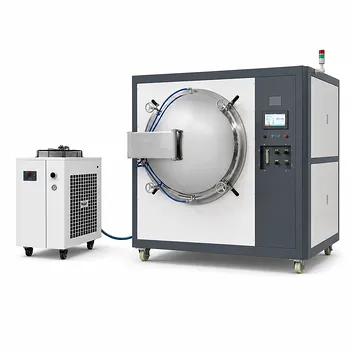
A vacuum hot press furnace is preferred for preparing bulk nano-tungsten because it decouples densification from extreme thermal energy. By applying immense mechanical pressure (up to 1 GPa) within a controlled vacuum, this technology achieves high-density consolidation at significantly lower temperatures (around 570°C) than conventional sintering. This capability is uniquely suited to tungsten, as it drives particle bonding while actively preventing the grain growth that typically destroys nano-structures during high-heat processing.
The Core Insight: Conventional sintering relies on high heat to bond particles, which inevitably causes nano-grains to coarsen and lose their unique properties. Vacuum hot pressing substitutes thermal energy with mechanical force, allowing you to achieve a dense bulk material while freezing the nano-structure in place.
The Mechanics of Low-Temperature Densification
To understand why this equipment is superior for nano-tungsten, you must look at how it overcomes the material's refractory nature without compromising its microstructure.
Replacing Thermal Energy with Mechanical Force
Tungsten is a refractory metal with an incredibly high melting point. In conventional sintering, you must heat the powder near its melting point to induce the atomic diffusion necessary for bonding.
A vacuum hot press furnace changes this equation. By applying extreme mechanical pressure—referenced as high as 1 GPa for specific nano-tungsten applications—the furnace forces particles together physically.
This mechanical driving force allows for densification at roughly 570°C. This is drastically lower than standard tungsten sintering temperatures, effectively bypassing the thermal threshold where rapid grain growth occurs.
Preserving the Nano-Scale Architecture
The defining characteristic of nano-tungsten is its grain size. If the grains grow during processing, the material reverts to standard tungsten, rendering the "nano" preparation useless.
High temperatures are the primary catalyst for grain coarsening. Because the vacuum hot press allows for sintering at lower temperatures and shorter timeframes, it inhibits grain boundary migration.
The result is a bulk material that retains the superior hardness and mechanical properties inherent to the nano-structure, rather than trading them off for density.
Eliminating Oxidation Barriers
Tungsten is sensitive to oxidation, and oxide layers act as a barrier to atomic diffusion.
The furnace operates in a high-vacuum environment (typically $10^{-4}$ to $10^{-3}$ Pa). This environment prevents the oxidation of the tungsten substrate and any reactive interlayers.
By maintaining a pristine interface, the vacuum ensures that the applied pressure leads to effective diffusion bonding rather than mechanical interlocking of oxidized surfaces.
Understanding the Trade-offs
While vacuum hot pressing is the technical standard for performance, it introduces specific operational constraints compared to conventional furnaces.
Geometric Limitations
The pressure in these furnaces is typically uniaxial (applied from one direction). This generally limits the production to simple shapes, such as discs or cylinders. Creating complex geometries often requires secondary machining or different processing methods.
Throughput and Scalability
This is inherently a batch process. The cycle times—which involve pulling a vacuum, heating, pressing, and cooling—are distinct for each load. Unlike continuous sintering furnaces used for mass production, vacuum hot pressing creates a bottleneck that prioritizes material quality over volume.
Making the Right Choice for Your Goal
Selecting the right furnace depends entirely on which material property is non-negotiable for your application.
- If your primary focus is preserving nano-scale properties: You must use a vacuum hot press. The ability to sinter at low temperatures (e.g., 570°C) via high pressure is the only reliable way to prevent grain growth.
- If your primary focus is material purity: The vacuum environment is critical. It removes porosity and prevents oxidation, ensuring high electrical conductivity and mechanical strength.
- If your primary focus is complex shaping: You may need to consider if the simple geometry limitations of uniaxial pressing are compatible with your final design requirements.
True bulk nano-tungsten is defined by the successful marriage of high density and small grain size, a balance that only vacuum hot pressing can mechanically enforce.
Summary Table:
| Feature | Vacuum Hot Pressing | Conventional Sintering |
|---|---|---|
| Driving Force | Mechanical Pressure (up to 1 GPa) + Heat | High Thermal Energy |
| Sintering Temp | ~570°C (for nano-tungsten) | Near melting point (High) |
| Grain Growth | Inhibited (Retains Nano-scale) | Rapid (Causes Coarsening) |
| Atmosphere | High Vacuum ($10^{-4}$ to $10^{-3}$ Pa) | Inert or Reducing Gas |
| Best Used For | High-performance nano-materials | Mass production of standard parts |
Elevate Your Material Research with KINTEK Precision
Don’t compromise your nano-structures with excessive heat. KINTEK specializes in advanced laboratory equipment, including high-performance vacuum hot press furnaces and hydraulic presses designed to achieve peak density while preserving critical microstructures. Whether you are developing bulk nano-tungsten or advanced alloys, our comprehensive range of high-temperature furnaces, autoclaves, and battery research tools provide the control you need.
Ready to optimize your sintering process? Contact our technical experts today to find the perfect solution for your lab's specific requirements.
Related Products
- Vacuum Hot Press Furnace Heated Vacuum Press Machine Tube Furnace
- 600T Vacuum Induction Hot Press Furnace for Heat Treat and Sintering
- Vacuum Hot Press Furnace Machine Heated Vacuum Press
- Vacuum Hot Press Furnace Machine for Lamination and Heating
- Vacuum Heat Treat and Pressure Sintering Furnace for High Temperature Applications
People Also Ask
- What advantages does a vacuum hot press furnace provide for LSLBO ceramic electrolytes? Achieve 94% Relative Density
- What role does a Vacuum Hot Press (VHP) furnace play in the densification of austenitic stainless steel 316 composites?
- What are the advantages of using a vacuum hot pressing furnace? Superior Densification for 2024Al/Gr/SiC Composites
- What are the advantages of a vacuum hot press furnace for LTPO solid electrolytes? Boost Density and Conductivity
- What core processing conditions does a vacuum hot press furnace provide? Achieve High-Density Cu-SiC/Diamond Composites