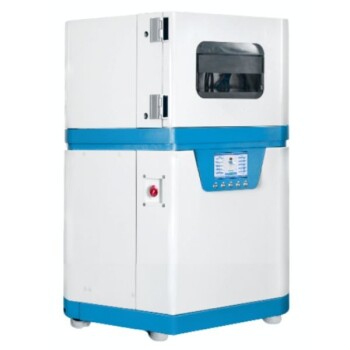
A vacuum hot press furnace provides the critical combination of high heat and mechanical pressure necessary to consolidate Fe-doped CoSb3. By applying significant pressure (such as 60 MPa) simultaneously with temperature, this method overcomes the natural resistance of skutterudite materials to densification, ensuring a structurally sound final product.
Skutterudite materials like Fe-doped CoSb3 are notoriously difficult to sinter using heat alone. The vacuum hot press furnace utilizes pressure-assisted sintering to force particle rearrangement, driving both high densification and the essential phase transformation into a single-phase structure.
Overcoming Sintering Challenges
The Role of Mechanical Pressure
Standard sintering methods often fail to consolidate skutterudite materials effectively. These materials are inherently difficult to sinter due to their specific physical properties.
To counter this, a vacuum hot press furnace applies substantial mechanical pressure, typically around 60 MPa. This external force is not merely supplementary; it is a primary driver of the consolidation process.
Promoting Particle Rearrangement
The simultaneous application of heat and pressure facilitates particle rearrangement.
Under these conditions, the powder particles are physically forced into closer proximity. This reduces void spaces more effectively than thermal diffusion alone, laying the groundwork for a solid bulk material.
Achieving Structural Integrity and Purity
Driving Phase Transformation
The consolidation process is not just about packing particles together; it is also chemical.
The starting materials for Fe-doped CoSb3 are often metastable powders. The thermal energy and pressure provided by the furnace drive the necessary phase transformation. This converts the metastable precursors into a stable, single-phase skutterudite structure.
Ensuring High Density
The ultimate goal of using this specific furnace is to achieve high density in the final sample.
By combining phase transformation with pressure-assisted densification, the process yields samples with superior structural integrity. This ensures the material is robust enough for practical application and testing.
Understanding the Process Criticality
The Pitfall of Heat-Only Sintering
It is critical to understand why simpler furnaces are insufficient for this material.
Attempting to consolidate Fe-doped CoSb3 without the added mechanical pressure generally leads to suboptimal results. The lack of force prevents adequate particle rearrangement, likely resulting in porous samples with lower structural integrity.
Balancing Pressure and Temperature
Success relies on the simultaneous application of these two factors.
High temperature alone drives the reaction, but pressure is required to remove porosity. This synergy is the defining advantage of the vacuum hot press furnace for this specific alloy.
Making the Right Choice for Your Goal
To maximize the quality of your Fe-doped CoSb3 samples, align your processing parameters with your specific structural requirements.
- If your primary focus is Structural Integrity: Ensure your process applies sufficient mechanical pressure (e.g., 60 MPa) to force particle rearrangement and eliminate porosity.
- If your primary focus is Phase Purity: Utilize the furnace's heating capabilities to drive the complete transformation from metastable powders to a single-phase skutterudite structure.
Leveraging pressure-assisted sintering is the definitive method for transforming difficult skutterudite powders into dense, high-performance materials.
Summary Table:
| Feature | Impact on Fe-doped CoSb3 Consolidation |
|---|---|
| Mechanical Pressure (60 MPa) | Drives particle rearrangement and overcomes sintering resistance. |
| Vacuum Environment | Prevents oxidation and ensures high purity of skutterudite phases. |
| Simultaneous Heat/Pressure | Facilitates rapid densification and phase transformation from metastable powders. |
| Structural Integrity | Eliminates porosity to create robust, high-performance bulk materials. |
Optimize Your Skutterudite Synthesis with KINTEK Precision
Don't let porosity compromise your material research. KINTEK specializes in advanced laboratory equipment designed for the most challenging material transformations. Our high-performance vacuum hot press furnaces provide the precise pressure-temperature synergy required to convert metastable powders into dense, single-phase Fe-doped CoSb3.
Whether you are working on thermoelectric materials, battery research, or advanced ceramics, our portfolio—including hydraulic hot presses, vacuum furnaces, and high-temperature high-pressure reactors—is engineered to deliver superior structural integrity and purity.
Ready to elevate your lab's capabilities? Contact our technical experts today to find the perfect sintering solution for your specific application requirements.
Related Products
- Vacuum Hot Press Furnace Heated Vacuum Press Machine Tube Furnace
- 600T Vacuum Induction Hot Press Furnace for Heat Treat and Sintering
- Vacuum Hot Press Furnace Machine Heated Vacuum Press
- Vacuum Hot Press Furnace Machine for Lamination and Heating
- Vacuum Heat Treat and Pressure Sintering Furnace for High Temperature Applications
People Also Ask
- What advantages does a vacuum hot press furnace provide for LSLBO ceramic electrolytes? Achieve 94% Relative Density
- What role does a Vacuum Hot Press (VHP) furnace play in the densification of austenitic stainless steel 316 composites?
- What are the advantages of using a vacuum hot pressing furnace? Superior Densification for 2024Al/Gr/SiC Composites
- What are the advantages of a vacuum hot press furnace for LTPO solid electrolytes? Boost Density and Conductivity
- What core processing conditions does a vacuum hot press furnace provide? Achieve High-Density Cu-SiC/Diamond Composites