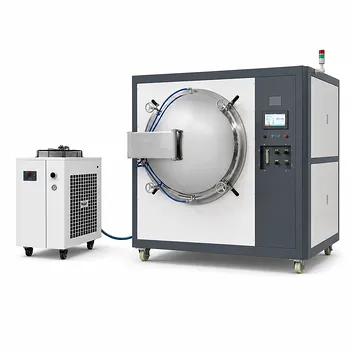
The preference for a vacuum hot press sintering furnace lies in its ability to combine mechanical pressure with a protective vacuum environment. Unlike atmospheric furnaces, this dual-action approach prevents the oxidation of sensitive materials like Boron Carbide (B4C) and Silicon (Si) while physically forcing particles together. This results in superior density (up to 99.8%) at significantly lower temperatures than conventional methods require.
Core Takeaway: Achieving high density in non-oxide ceramics like SiC/B4C is notoriously difficult due to strong covalent bonding. Vacuum hot pressing overcomes these kinetic barriers by adding mechanical force to thermal energy, ensuring near-theoretical density while the vacuum preserves chemical purity.
The Mechanics of Densification
Overcoming Kinetic Barriers
Conventional sintering relies almost exclusively on heat to bond particles. Vacuum hot pressing introduces a critical second variable: uniaxial mechanical pressure (e.g., 60 MPa). This acts as an external driving force that standard furnaces cannot provide.
Accelerating Particle Rearrangement
The applied pressure physically forces powder particles to slide past one another. This induces plastic flow and rearrangement, effectively closing voids and pores that thermal energy alone might fail to eliminate.
Lowering Thermal Requirements
Because mechanical pressure aids diffusion, the process requires lower temperatures than pressureless sintering. This allows the material to reach full density without being subjected to extreme thermal stress for prolonged periods.
Preserving Material Chemistry
Preventing High-Temperature Oxidation
At processing temperatures reaching 1850°C, non-oxide ceramics like Boron Carbide (B4C) and Silicon (Si) are highly susceptible to oxidation. A standard atmospheric furnace would degrade these materials. The vacuum environment eliminates oxygen, ensuring the chemical composition remains stable.
Managing Volatiles and Byproducts
Chemical reactions during the sintering of complex composites often generate gaseous byproducts. The vacuum environment actively facilitates the removal of these gases. If left trapped (as they might be in an atmospheric furnace), these gases would form pores, lowering the final density.
Controlling Microstructure and Quality
Inhibiting Grain Coarsening
High temperatures often cause ceramic grains to grow excessively large, which reduces mechanical strength. By enabling densification at lower temperatures, vacuum hot pressing maintains a fine, nanocrystalline microstructure.
Enhancing Phase Stability
The controlled environment promotes the formation of specific liquid phases necessary for binding the material. This ensures the integrity of the bonding between material layers without the interference of atmospheric contaminants.
Understanding the Trade-offs
Geometry Limitations
It is important to note that the mechanical pressure is typically applied uniaxially (from top and bottom). Consequently, this method is most effective for simple geometries like plates, discs, or cylinders, rather than complex, intricate shapes.
Process Intensity
While the results are superior, this is a batch process involving high-precision equipment. It is inherently more complex than continuous atmospheric sintering, justified primarily when material performance and density are non-negotiable.
Making the Right Choice for Your Goal
To determine if this process aligns with your specific production needs, consider the following priorities:
- If your primary focus is Maximum Density: The combination of 60 MPa pressure and heat is the most reliable path to achieving 99.8% relative density in SiC/B4C ceramics.
- If your primary focus is Material Purity: The vacuum environment is non-negotiable for preventing the oxidation of B4C and Si at temperatures above 1800°C.
- If your primary focus is Mechanical Strength: The ability to densify at lower temperatures inhibits grain growth, resulting in a harder, more durable fine-grained structure.
For high-performance SiC/B4C composites, vacuum hot pressing provides the essential combination of force and protection required to turn loose powder into a structural component.
Summary Table:
| Feature | Vacuum Hot Press Sintering | Conventional Atmospheric Sintering |
|---|---|---|
| Driving Force | Heat + Uniaxial Mechanical Pressure | Thermal Energy Only |
| Environment | Protective Vacuum (Prevents Oxidation) | Ambient/Inert Gas |
| Typical Density | Up to 99.8% (Near Theoretical) | Lower/Porous without additives |
| Microstructure | Fine/Nanocrystalline (Low Temp) | Coarser Grains (High Temp) |
| Material Purity | High (Volatiles removed via vacuum) | Potential for oxidation/contamination |
| Best Used For | High-performance non-oxide ceramics | Simpler, less demanding ceramic parts |
Elevate Your Material Performance with KINTEK
Are you struggling to achieve theoretical density in your SiC, B4C, or non-oxide ceramic composites? KINTEK specializes in advanced laboratory solutions designed to overcome the most challenging kinetic barriers. Our industry-leading vacuum hot press furnaces and isostatic presses provide the precise mechanical force and vacuum integrity required to produce high-purity, nanocrystalline materials with superior mechanical strength.
From high-temperature furnaces and crushing systems to high-pressure reactors and hydraulic pellet presses, KINTEK offers the complete ecosystem for your research and production needs. Don't settle for porous results—partner with the experts in laboratory equipment and consumables to optimize your sintering process today.
Contact our technical specialists at KINTEK for a custom quote
Related Products
- 600T Vacuum Induction Hot Press Furnace for Heat Treat and Sintering
- Vacuum Heat Treat and Sintering Furnace with 9MPa Air Pressure
- Vacuum Heat Treat and Pressure Sintering Furnace for High Temperature Applications
- 2200 ℃ Tungsten Vacuum Heat Treat and Sintering Furnace
- Vacuum Hot Press Furnace Heated Vacuum Press Machine Tube Furnace
People Also Ask
- What role does an induction vacuum hot pressing furnace play in sintering? Achieve 98% Density in Carbide Blocks
- What advantages does a vacuum hot press furnace provide for LSLBO ceramic electrolytes? Achieve 94% Relative Density
- What role does a Vacuum Hot Press (VHP) furnace play in the densification of austenitic stainless steel 316 composites?
- What are the advantages of a vacuum hot press furnace for W-50%Cu? Achieve 99.6% Density at Lower Temperatures
- What role does mechanical pressure play during the vacuum diffusion bonding of tungsten and copper? Keys to Solid Bonding