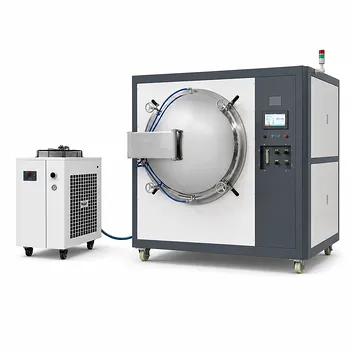
A vacuum hot press sintering furnace is essential for TiNiNb fabrication because it integrates mechanical pressure with thermal energy in a strictly controlled vacuum environment. While conventional sintering relies solely on thermal diffusion, this specialized equipment forces material densification while simultaneously neutralizing the high reactivity of Titanium.
The Core Insight Conventional pressureless sintering often results in porous, oxidized components when applied to reactive alloys. Vacuum hot pressing solves this by physically forcing particles together under vacuum, achieving near-theoretical density (up to 98.8%) and ensuring a clean, oxide-free microstructure.
Achieving Superior Density and Structure
The Power of Mechanical Pressure
Conventional sintering furnaces rely on time and temperature to bond powder particles. In contrast, a vacuum hot press applies significant mechanical pressure (e.g., 25 MPa) during the heating phase.
Promoting Plastic Flow
This external pressure forces particle rearrangement and induces plastic flow in the material. This physically closes the gaps between powder granules that thermal diffusion alone might leave behind.
Resulting Material Density
The combination of heat and force allows TiNiNb components to achieve high density (up to 98.8%). This creates a near-net-shape component with structural integrity that far exceeds materials processed via pressureless sintering.
Solving the Oxidation Challenge
Preventing High-Temperature Oxidation
Titanium (Ti) and Niobium (Nb) are highly reactive elements that readily form brittle oxides at sintering temperatures. A conventional furnace, even with inert gas shielding, may not provide the purity required for these sensitive alloys.
Eliminating Volatile Impurities
The vacuum environment actively removes volatile substances and degasses the powder surfaces before and during the heating cycle. This effectively prevents the formation of oxide scales and brittle interface reaction products.
Ensuring Microstructural Purity
By maintaining a low partial pressure of oxygen, the equipment promotes atomic diffusion without the interference of impurity layers. This results in a uniform microstructure free from the internal defects caused by trapped gases.
Optimizing Process Efficiency
Shortened Processing Cycles
The addition of mechanical pressure accelerates the densification kinetics significantly. This allows for a shortened holding time compared to conventional sintering, which can require long durations to achieve equilibrium.
Controlling Grain Growth
Because the process is faster and requires less time at peak temperature, it inhibits the excessive growth of matrix grains. This rapid densification produces a finer, more uniform microstructure, which directly correlates to superior mechanical properties.
Understanding the Trade-offs
While vacuum hot pressing offers superior material quality, it introduces specific constraints compared to conventional sintering.
Complexity and Cost
The equipment is significantly more complex, requiring hydraulic systems and high-vacuum pumps capable of maintaining pressures as low as 7.1 x 10^-3 Pa. This increases both capital investment and operational costs.
Geometric Limitations
The application of uniaxial mechanical pressure generally limits the process to simpler geometries or plates. While it produces near-net-shape parts, creating complex, undercut 3D shapes is more difficult than with conventional pressureless sintering or Metal Injection Molding (MIM).
Making the Right Choice for Your Goal
When deciding between vacuum hot pressing and conventional sintering for shape memory alloys, consider your performance requirements:
- If your primary focus is Maximum Density and Strength: Utilize vacuum hot pressing. The mechanical force is non-negotiable for eliminating porosity and achieving the 98%+ density required for high-performance structural applications.
- If your primary focus is Material Purity: Utilize vacuum hot pressing. The strict vacuum control is the only reliable way to prevent titanium oxidation and ensure the shape memory effect is not compromised by brittle oxides.
- If your primary focus is Complex Geometry: You may need to investigate alternative hybrid methods, as hot pressing typically favors simpler, flat, or cylindrical near-net shapes.
Vacuum hot pressing is the definitive choice for TiNiNb when structural integrity and microstructural purity cannot be compromised.
Summary Table:
| Feature | Vacuum Hot Press Sintering | Conventional Sintering |
|---|---|---|
| Mechanism | Simultaneous Thermal & Mechanical Force | Thermal Diffusion Only |
| Material Density | Up to 98.8% (Near-Theoretical) | Lower (Porous) |
| Oxidation Control | High-Vacuum (7.1 x 10^-3 Pa) | Inert Gas or Low Vacuum |
| Cycle Time | Shortened Holding Time | Long Durations |
| Grain Growth | Controlled (Finer Microstructure) | Risk of Excessive Growth |
| Geometric Capability | Simple/Near-Net Shapes | Complex Geometries |
Elevate Your Material Research with KINTEK Precision Engineering
Are you struggling with oxidation or porosity in your reactive alloy fabrication? KINTEK specializes in advanced laboratory equipment designed for the most demanding thermal processes. Our range of high-temperature vacuum hot press furnaces, muffle furnaces, and CVD systems provides the precise control needed to achieve superior material properties for TiNiNb and other shape memory alloys.
From high-pressure reactors to specialized battery research tools and crushing systems, KINTEK delivers the comprehensive solutions laboratory professionals trust. Don't compromise on your material's structural integrity—Contact us today to discover how our high-performance sintering systems can transform your lab's output!
Related Products
- 600T Vacuum Induction Hot Press Furnace for Heat Treat and Sintering
- Vacuum Heat Treat and Sintering Furnace with 9MPa Air Pressure
- Vacuum Heat Treat and Pressure Sintering Furnace for High Temperature Applications
- Vacuum Hot Press Furnace Heated Vacuum Press Machine Tube Furnace
- Vacuum Hot Press Furnace Machine Heated Vacuum Press
People Also Ask
- What role does an induction vacuum hot pressing furnace play in sintering? Achieve 98% Density in Carbide Blocks
- What advantages does a vacuum hot press furnace provide for LSLBO ceramic electrolytes? Achieve 94% Relative Density
- What role does a Vacuum Hot Press (VHP) furnace play in the densification of austenitic stainless steel 316 composites?
- What role does mechanical pressure play during the vacuum diffusion bonding of tungsten and copper? Keys to Solid Bonding
- What are the advantages of a vacuum hot press furnace for W-50%Cu? Achieve 99.6% Density at Lower Temperatures