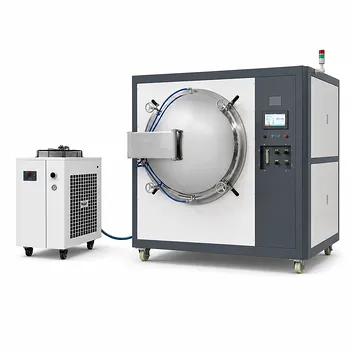
The necessity of a vacuum hot pressing furnace lies in its ability to simultaneously address the two critical failure points of sintering Copper/Reduced Graphene Oxide (Cu/rGO) composites: chemical oxidation and structural porosity. By maintaining a high vacuum (up to 10^-3 Pa) while applying significant axial mechanical pressure (often reaching 80 MPa), this equipment ensures the copper matrix remains pure and achieves near-theoretical density, directly resulting in superior electrical conductivity and wear resistance.
Core Takeaway: Standard sintering is insufficient for Cu/rGO composites because it cannot prevent copper oxidation or achieve full density simultaneously. Vacuum hot pressing is the only method that synergizes chemical protection with mechanical force to produce a highly conductive, wear-resistant, and pore-free material.
The Role of the Vacuum Environment
Preventing Chemical Degradation
The primary chemical challenge in sintering copper composites is the high reactivity of copper at elevated temperatures. Without protection, the copper matrix will readily oxidize, forming impurities that degrade electrical performance.
A vacuum hot pressing furnace eliminates this issue by creating a vacuum environment, often reaching levels of 10^-3 Pa. This effectively isolates the material from oxygen.
Protecting the Interface
Beyond the copper matrix, the vacuum also protects the reduced graphene oxide (rGO). While the primary reference emphasizes the copper matrix, supplementary data indicates that vacuum environments generally prevent the oxidation of carbon materials at high heat. Preserving the purity of both the copper and the rGO is essential for maintaining a strong bonding interface between the two materials.
The Role of Mechanical Pressure
Promoting Plastic Flow
Heat alone is often insufficient to densify copper/graphene composites completely. The furnace applies axial mechanical pressure (e.g., 80 MPa) during the heating process.
This pressure forces the powder particles to rearrange. It promotes the plastic flow of the copper matrix around the graphene sheets, filling voids that thermal sintering alone might leave behind.
Eliminating Internal Pores
The direct application of force significantly increases the relative density of the material. By physically squeezing out internal pores, the process creates a compact structure.
This densification is directly linked to performance. A non-porous structure ensures unimpeded electron flow (higher conductivity) and greater structural integrity (higher wear resistance).
Precision Control and Microstructure
Controlling Heating Kinetics
Successful sintering is not just about reaching a high temperature; it is about how you get there. These furnaces allow for precise control over heating rates (e.g., 10°C/min).
Preserving Graphene Structure
Controlled heating prevents thermal shock and abnormal grain coarsening. Rapid or uncontrolled temperature fluctuations can destroy the delicate structure of graphene or lead to uneven grain growth in the copper. Steady heating ensures the composite microstructure remains uniform, optimizing the final electrical properties.
Understanding the Trade-offs
Equipment Complexity vs. Material Quality
While vacuum hot pressing yields superior results, it introduces variables that must be carefully managed. The process requires a delicate balance between pressure, temperature, and vacuum levels.
The Risk of Embrittlement
If the vacuum level is compromised, even slightly, materials like copper (and titanium in similar contexts) can become brittle due to oxygen uptake.
Thermal Stress Management
While pressure aids densification, applying it too early or too aggressively before the material creates sufficient plasticity can lead to internal stresses. The "synergy" mentioned in the references relies on the simultaneous and calculated application of heat and pressure, not just their presence.
Making the Right Choice for Your Goal
To maximize the utility of a vacuum hot pressing furnace for your Cu/rGO project, consider the following priorities:
- If your primary focus is Electrical Conductivity: Ensure your vacuum levels are strictly maintained at 10^-3 Pa or better to prevent oxide barriers from forming between particles.
- If your primary focus is Mechanical Wear Resistance: Prioritize the optimization of axial pressure (aiming toward 80 MPa) to maximize plastic flow and eliminate microscopic pores.
- If your primary focus is Microstructural Homogeneity: Focus on the ramp-up phase; utilize a steady heating rate (such as 10°C/min) to prevent grain coarsening before peak temperature is reached.
Ultimately, the vacuum hot pressing furnace is required because it is the only processing tool capable of forcing the copper matrix to densify around graphene sheets without chemically destroying the constituents.
Summary Table:
| Feature | Impact on Cu/rGO Composites | Benefit |
|---|---|---|
| High Vacuum (10^-3 Pa) | Prevents copper and graphene oxidation | Superior electrical conductivity & pure matrix |
| Axial Pressure (80 MPa) | Promotes plastic flow and eliminates pores | Near-theoretical density & wear resistance |
| Controlled Heating | Prevents grain coarsening and thermal shock | Uniform microstructure & material integrity |
| Simultaneous Action | Synergizes chemical protection with force | Optimal interface bonding & high performance |
Elevate Your Material Research with KINTEK Precision
Unlock the full potential of your Copper/Reduced Graphene Oxide (Cu/rGO) composites with KINTEK’s advanced thermal processing solutions. Our state-of-the-art vacuum hot pressing furnaces are engineered to provide the precise synergy of high-vacuum environments and controlled mechanical pressure necessary to eliminate porosity and prevent chemical degradation.
Beyond sintering, KINTEK specializes in a comprehensive range of laboratory equipment designed for the most demanding applications, including:
- High-Temperature Furnaces: Muffle, tube, rotary, and specialized CVD/PECVD systems.
- Material Processing: Crushing, milling, and hydraulic presses (pellet, hot, isostatic) for perfect sample preparation.
- Advanced Reactors: High-temperature high-pressure reactors and autoclaves.
- Energy Research: Electrolytic cells, electrodes, and complete battery research tools.
Ready to achieve near-theoretical density and superior conductivity in your materials? Contact our technical experts today to find the perfect equipment configuration for your laboratory.
Related Products
- Vacuum Hot Press Furnace Heated Vacuum Press Machine Tube Furnace
- 600T Vacuum Induction Hot Press Furnace for Heat Treat and Sintering
- Vacuum Hot Press Furnace Machine Heated Vacuum Press
- Vacuum Hot Press Furnace Machine for Lamination and Heating
- Vacuum Heat Treat and Pressure Sintering Furnace for High Temperature Applications
People Also Ask
- What advantages does a vacuum hot press furnace provide for LSLBO ceramic electrolytes? Achieve 94% Relative Density
- What role does a Vacuum Hot Press (VHP) furnace play in the densification of austenitic stainless steel 316 composites?
- What are the advantages of using a vacuum hot pressing furnace? Superior Densification for 2024Al/Gr/SiC Composites
- What are the advantages of a vacuum hot press furnace for LTPO solid electrolytes? Boost Density and Conductivity
- What core processing conditions does a vacuum hot press furnace provide? Achieve High-Density Cu-SiC/Diamond Composites