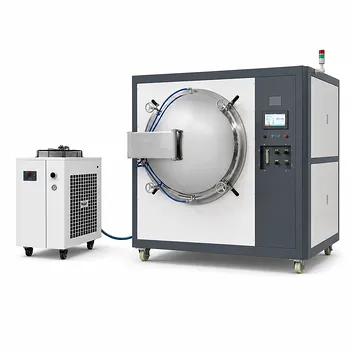
The necessity of a vacuum hot pressing sintering furnace stems from the specific chemical volatility and physical densification requirements of Ni-Cr-Co-Ti-V high-entropy alloys. While conventional furnaces rely solely on thermal energy to bond particles, a vacuum hot press applies 25 MPa of axial mechanical pressure in a protective vacuum environment at 1150°C to overcome the inherent limitations of standard sintering.
Core Takeaway The vacuum hot pressing furnace is essential because it solves two simultaneous challenges: it prevents the oxidation of highly reactive elements like Titanium and Vanadium, and it uses mechanical force to drive plastic flow. This synergy produces a bulk alloy with high density and a uniform microstructure that pressureless sintering simply cannot achieve.
The Critical Role of the Vacuum Environment
Preventing Elemental Oxidation
Ni-Cr-Co-Ti-V alloys contain Titanium (Ti) and Vanadium (V), both of which are chemically active elements.
In a conventional furnace containing air or impure atmospheres, these elements react rapidly at high temperatures to form brittle oxides.
The vacuum environment eliminates oxygen from the chamber, ensuring these active elements remain metallic and integrated into the alloy matrix rather than forming contaminants.
Purification and Degassing
Beyond preventing oxidation, the vacuum actively cleans the material during the heating phase.
It promotes the removal of volatile substances and gases trapped within the powder gaps.
This ensures the interface between particles is clean, which is a prerequisite for strong atomic bonding.
The Mechanics of Pressure-Assisted Sintering
Enhancing Atomic Diffusion
Thermal energy alone (heat) is often insufficient to fully densify complex high-entropy alloys.
The application of axial mechanical pressure (25 MPa) works in tandem with the 1150°C heat to significantly enhance atomic diffusion.
This external force accelerates the movement of atoms across particle boundaries, reducing the time required to form a solid bond.
Driving Plastic Flow for High Density
Conventional sintering relies on slow diffusion mechanisms that often leave residual pores.
Vacuum hot pressing forces plastic flow and particle rearrangement, mechanically compressing the powder to eliminate internal voids.
This results in a bulk alloy with extremely high density and a fine, uniform microstructure that outperforms pressureless methods.
Understanding the Trade-offs
Geometry Limitations
While hot pressing offers superior density, it is generally limited to simple shapes (like disks or cylinders) due to the uniaxial nature of the pressure.
Complex geometries often require secondary machining or alternative processing methods like Hot Isostatic Pressing (HIP), which applies pressure from all directions.
Process Efficiency
Vacuum hot pressing is typically a batch process, which can be slower and more expensive than continuous conventional sintering.
However, for high-entropy alloys where material integrity is paramount, the trade-off in processing speed is justified by the superior mechanical properties obtained.
Making the Right Choice for Your Goal
When determining if this equipment is strictly necessary for your specific application, consider your performance targets:
- If your primary focus is Material Purity: The vacuum capability is non-negotiable to prevent the degradation of Titanium and Vanadium phases.
- If your primary focus is Mechanical Strength: The application of mechanical pressure is required to eliminate porosity and achieve the high density needed for structural integrity.
- If your primary focus is Microstructural Uniformity: The rapid densification provided by hot pressing prevents excessive grain growth, preserving a finer, more uniform grain structure.
By leveraging the dual action of vacuum protection and mechanical force, you ensure the Ni-Cr-Co-Ti-V alloy achieves its theoretical performance potential.
Summary Table:
| Feature | Conventional Sintering | Vacuum Hot Pressing (KINTEK) |
|---|---|---|
| Mechanism | Thermal energy only | Thermal energy + 25 MPa axial pressure |
| Atmosphere | Ambient or inert gas | High vacuum (prevents oxidation of Ti/V) |
| Densification | Passive diffusion (residual pores) | Active plastic flow (high density) |
| Purity | Risk of oxide contaminants | High purity via degassing and vacuum |
| Microstructure | Potential grain growth | Fine, uniform grain structure |
Elevate Your Material Research with KINTEK Precision
Don't let oxidation or porosity compromise your advanced alloys. KINTEK specializes in high-performance laboratory equipment designed for the most demanding sintering applications. From our advanced vacuum hot pressing and sintering furnaces to Hot Isostatic Presses (HIP) and induction melting systems, we provide the tools needed to achieve theoretical density and material purity.
Our value to you:
- Comprehensive Range: Whether you need muffle, tube, or vacuum furnaces, or specialized crushing and milling systems for powder preparation, we have the solution.
- Tailored Solutions: Our equipment is ideal for synthesizing high-entropy alloys, battery research, and advanced ceramics.
- Expert Support: We provide more than just hardware; we provide the reliability required for groundbreaking research.
Ready to optimize your Ni-Cr-Co-Ti-V alloy synthesis? Contact KINTEK today for a consultation and find the perfect high-temperature solution for your lab.
Related Products
- 600T Vacuum Induction Hot Press Furnace for Heat Treat and Sintering
- Vacuum Heat Treat and Sintering Furnace with 9MPa Air Pressure
- Vacuum Heat Treat and Pressure Sintering Furnace for High Temperature Applications
- Vacuum Hot Press Furnace Heated Vacuum Press Machine Tube Furnace
- Vacuum Hot Press Furnace Machine Heated Vacuum Press
People Also Ask
- What role does an induction vacuum hot pressing furnace play in sintering? Achieve 98% Density in Carbide Blocks
- What advantages does a vacuum hot press furnace provide for LSLBO ceramic electrolytes? Achieve 94% Relative Density
- What role does a Vacuum Hot Press (VHP) furnace play in the densification of austenitic stainless steel 316 composites?
- What are the advantages of a vacuum hot press furnace for W-50%Cu? Achieve 99.6% Density at Lower Temperatures
- What role does mechanical pressure play during the vacuum diffusion bonding of tungsten and copper? Keys to Solid Bonding