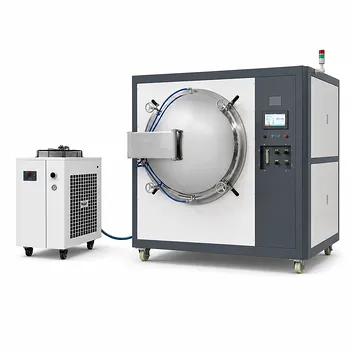
A vacuum oven is essential for drying sodium-ion battery electrodes because it removes organic solvents and moisture at low temperatures, preventing material oxidation and ensuring mechanical stability. By creating a negative pressure environment, the oven lowers the boiling point of solvents like NMP (N-methyl-pyrrolidone), allowing them to evaporate rapidly without exposing the active materials to damaging heat. This process is critical for ensuring the electrode adheres to the current collector and remains chemically stable during battery operation.
Vacuum drying provides a controlled, low-temperature environment that eliminates volatile contaminants and trace moisture, which are the primary enemies of battery longevity and safety. Without this step, residual moisture would trigger chemical reactions that degrade the electrolyte and cause the electrode coating to peel or crack.
The Physics of Vacuum Drying
Lowering the Solvent Boiling Point
Organic solvents used in electrode slurries, such as NMP or DMF, often have high boiling points at atmospheric pressure. A vacuum oven reduces the internal pressure, which effectively lowers the boiling point of these liquids. This allows the solvents to transition into a gaseous state and exit the electrode pores at much lower temperatures than would otherwise be possible.
Accelerating Evaporation and Efficiency
The negative pressure environment creates a steep concentration gradient between the liquid solvent in the electrode and the surrounding atmosphere. This significantly increases drying efficiency, drawing out trapped volatiles from deep within the porous structure of the coating. This thoroughness is difficult to achieve with standard atmospheric heating alone.
Preventing Re-adsorption of Moisture
Standard ovens allow the electrode to remain in contact with ambient air, which often contains humidity. A vacuum environment prevents the re-adsorption of moisture from the atmosphere during the drying cycle. This ensures that once the electrode is dry, it stays dry until it is moved to a controlled environment like a glovebox or dry room.
Preserving Material Integrity
Preventing Active Material Oxidation
Sodium-ion active materials are often sensitive to oxygen and heat; high temperatures in an oxygen-rich environment can lead to unwanted oxidation. By removing the air (and thus the oxygen), a vacuum oven allows for high-heat drying without the risk of degrading the chemical structure of the cathode or anode.
Protecting the Metal Current Collector
The current collectors—typically aluminum or copper foil—are also susceptible to oxidation and corrosion at elevated temperatures. Vacuum drying ensures that the interface between the active material and the metal foil remains clean and conductive. This preserves the electrical contact necessary for high-performance charging and discharging.
Optimizing Mechanical Adhesion
Proper drying strengthens the bond between the polymeric binder (such as PVDF) and the current collector. By removing solvents gradually and thoroughly, the process prevents the electrode material from peeling or delaminating during the subsequent battery assembly and cycling phases.
Maximizing Electrochemical Performance
Preventing Electrolyte Decomposition
In sodium-ion batteries, even trace amounts of moisture can react with the electrolyte salts (like NaPF6). This reaction can produce hydrofluoric acid (HF) or other corrosive byproducts that attack the internal components of the cell. Vacuum drying is the primary defense against this moisture-induced degradation, directly extending the cycle life of the battery.
Improving the Solid Electrolyte Interphase (SEI)
A dry electrode is critical for the formation of a stable Solid Electrolyte Interphase (SEI) film on the anode. If residual solvents or moisture are present, the SEI layer will be unstable and irregular. This leads to poor coulombic efficiency and high internal resistance, hampering the battery's overall energy output.
Ensuring Accurate Mass Measurement
For researchers, vacuum drying is vital for obtaining reliable specific capacitance data. By removing all "hidden" weight from residual solvents, scientists can achieve accurate mass weighing of the active materials. This ensures that the performance metrics reported are based on the actual material rather than trapped fluids.
Understanding the Trade-offs
Drying Speed vs. Coating Quality
While rapid drying is efficient, removing solvents too quickly can lead to "skinning," where the top layer dries and traps solvent underneath. This can cause cracking or pinholes in the electrode surface. Manufacturers must balance the vacuum level and temperature curve to ensure the coating remains uniform and structurally sound.
Heat Transfer Challenges
In a vacuum, heat cannot be transferred via convection (air movement), leaving only conduction and radiation. This can lead to uneven heating if the electrode sheets are not in direct contact with the heated shelves. Users must ensure proper loading techniques to avoid "cold spots" that result in incomplete drying.
Applying This to Your Battery Project
Recommendations for Success
- If your primary focus is Research & Development: Prioritize high vacuum levels and longer drying times to ensure 100% solvent removal for accurate electrochemical benchmarking.
- If your primary focus is Industrial Scale-up: Implement precisely controlled temperature curves to prevent electrode cracking while maximizing throughput.
- If your primary focus is Long-term Cycle Life: Focus on the post-drying moisture content, ensuring electrodes are transferred immediately to a moisture-free environment to prevent re-contamination.
Mastering the vacuum drying process is the bridge between a fragile coating and a high-performance, long-lasting sodium-ion battery.
Summary Table:
| Feature | Benefit | Impact on Battery |
|---|---|---|
| Lowered Boiling Point | Rapid solvent removal (NMP/DMF) at low temps | Prevents thermal degradation of active materials |
| Oxygen-Free Environment | Eliminates oxidation risks | Preserves current collector (Al/Cu) conductivity |
| Moisture Elimination | Prevents HF formation and side reactions | Extends cycle life and stabilizes SEI layer |
| Deep Pore Extraction | Thorough removal of trapped volatiles | Enhances mechanical adhesion and prevents cracking |
Elevate Your Battery Research with KINTEK Precision
Achieving the perfect electrode coating is only half the battle—mastering the drying process is what defines battery longevity. KINTEK specializes in high-performance laboratory equipment designed for the rigorous demands of energy storage research.
Whether you are scaling up sodium-ion production or conducting fundamental R&D, our comprehensive range of vacuum ovens, atmosphere furnaces, and battery research tools provides the controlled environments necessary for superior electrochemical performance. From high-temperature reactors to hydraulic pellet presses and PTFE consumables, we offer everything you need to ensure material integrity.
Ready to optimize your drying protocols? Contact our technical experts today for tailored solutions that drive innovation.
References
- Yun Zhao, Zongping Shao. Synergistic γ‐In<sub>2</sub>Se<sub>3</sub>@rGO Nanocomposites with Beneficial Crystal Transformation Behavior for High‐Performance Sodium‐Ion Batteries. DOI: 10.1002/advs.202303108
This article is also based on technical information from Kintek Solution Knowledge Base .
Related Products
- 56L Vertical Laboratory Vacuum Drying Oven
- 23L Laboratory Vacuum Drying Oven
- Vacuum Heat Treat Sintering Brazing Furnace
- 2200 ℃ Graphite Vacuum Heat Treat Furnace
- Dental Porcelain Zirconia Sintering Ceramic Vacuum Press Furnace
People Also Ask
- Why is a laboratory vacuum drying oven recommended for rice straw residues? Protect Your Biomass Integrity
- What role does a laboratory vacuum drying oven play in the preparation of modified multi-walled carbon nanotubes?
- What is the importance of using a laboratory vacuum drying oven? Preserving Slow-Release Microcapsule Integrity
- Why is a Laboratory Vacuum Drying Oven recommended for PBAT microspheres? Protect Sensitive Polymer Integrity
- What role does a laboratory vacuum drying oven play in processing nanoparticle powder samples? Protect Sample Integrity