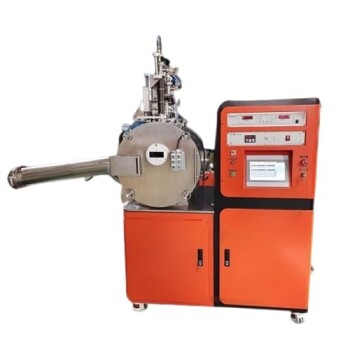
Precision control determines coating success. A vacuum retort furnace with integrated argon flow control is essential for industrial aluminizing because it creates a strictly controlled anaerobic environment. This system eliminates residual oxygen and moisture to prevent the oxidation of sensitive superalloy substrates while stabilizing internal pressure to ensure the efficient transport of volatile aluminum compounds to the workpiece.
Industrial aluminizing relies on an environment totally free of impurities to protect high-value substrates. The combination of a vacuum retort and argon flow control ensures this purity while regulating the pressure dynamics required for consistent, high-quality diffusion.
The Critical Role of Atmosphere Control
Protecting the Superalloy Substrate
The primary danger in high-temperature diffusion processes is the presence of oxygen or moisture. Superalloy substrates are highly reactive at these temperatures.
If residual oxygen or moisture remains in the chamber, it causes unwanted oxidation. This degrades the surface integrity of the workpiece before the coating can even form.
Creating an Anaerobic Environment
To prevent this degradation, the process requires a strictly controlled anaerobic environment. A standard furnace cannot achieve the necessary purity levels on its own.
A vacuum retort furnace creates a sealed, isolated zone. This physical barrier is the first line of defense against the external atmosphere.
The Function of Argon Flow
While the vacuum removes air, the integrated argon flow control system acts as an active purification agent.
It ensures the total exclusion of any remaining oxygen or moisture. By introducing an inert gas like argon, the system flushes contaminants that the vacuum alone might miss, securing a pristine environment for the alloy.
Optimizing Process Mechanics
Efficient Compound Transport
Aluminizing involves the movement of volatile aluminum compounds from the source to the workpiece. This transport mechanism is sensitive to atmospheric conditions.
Without precise control, the movement of these compounds becomes erratic. This leads to uneven coatings or insufficient diffusion into the substrate.
Stabilizing Process Pressure
The argon flow control system does more than just purify; it actively maintains stable process pressure.
Stability is critical for the kinetics of the process. By regulating the pressure, the system ensures that the aluminum vapor reaches the workpiece efficiently and consistently.
Understanding the Operational Trade-offs
The Cost of Complexity
Implementing a vacuum retort with argon flow adds layers of complexity to the manufacturing process. Unlike simpler atmospheric furnaces, this system requires rigorous monitoring of both vacuum integrity and gas flow rates.
Sensitivity to System Integrity
The system's effectiveness relies entirely on the seal of the retort and the precision of the flow controller. Any failure in the exclusion of moisture immediately compromises the superalloy.
Reliability in this context is binary; the environment is either perfectly anaerobic, or the process fails.
Making the Right Choice for Your Goal
To determine if this configuration matches your operational needs, consider your primary objectives:
- If your primary focus is Substrate Integrity: The argon flow control is non-negotiable, as it ensures the total exclusion of oxygen required to prevent superalloy oxidation.
- If your primary focus is Coating Consistency: The system is essential for maintaining the stable process pressure needed for the efficient transport of volatile aluminum compounds.
Mastering the balance between atmosphere purity and pressure stability is the key to achieving a flaw-free industrial aluminizing process.
Summary Table:
| Feature | Function in Aluminizing | Impact on Superalloy |
|---|---|---|
| Vacuum Retort | Creates a sealed, isolated anaerobic zone | Prevents surface degradation and oxidation |
| Argon Flow Control | Flushes residual moisture and oxygen | Secures a pristine environment for pure coating |
| Pressure Regulation | Stabilizes transport of volatile Al compounds | Ensures consistent coating thickness and diffusion |
Elevate Your Coating Precision with KINTEK
Don't let oxidation compromise your high-value superalloys. KINTEK specializes in advanced thermal solutions, offering high-performance vacuum retort furnaces and CVD systems designed for the most demanding industrial aluminizing processes. Our equipment provides the rigorous atmosphere control and pressure stability needed for flawless diffusion coatings.
From high-temperature furnaces and crushing systems to isostatic presses and high-pressure reactors, KINTEK empowers your lab or production facility with reliable, cutting-edge technology.
Ready to optimize your heat treatment results? Contact our technical experts today to find the perfect solution for your specific application.
References
- Jakub Jopek, Marcin Drajewicz. High Temperature Protective Coatings for Aeroengine Applications. DOI: 10.21062/mft.2023.052
This article is also based on technical information from Kintek Solution Knowledge Base .
Related Products
- Vacuum Sealed Continuous Working Rotary Tube Furnace Rotating Tube Furnace
- Laboratory Vacuum Tilt Rotary Tube Furnace Rotating Tube Furnace
- 1400℃ Controlled Atmosphere Furnace with Nitrogen and Inert Atmosphere
- Vacuum Heat Treat Furnace with Ceramic Fiber Liner
- Vacuum Arc Induction Melting Furnace
People Also Ask
- What are the advantages of using a rotary tube furnace for MoVOx catalysts? Elevate Uniformity and Crystallinity
- What are the process advantages of using a rotary tube furnace for WS2 powder? Achieve Superior Material Crystallinity
- Why is a vacuum tube furnace with argon protection required for RGO/Cu? Ensure Conductivity and Material Purity
- Why is a rotary tube furnace preferred over a fixed tube furnace for the carbonization of asphaltenes? Superior Quality
- What is a rotary tube furnace? Achieve Superior Uniformity for Powders and Granules