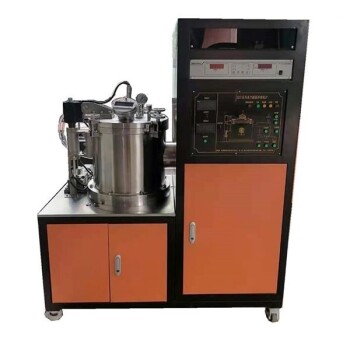
A vacuum tube furnace is used for 1280°C sintering because it provides a high-vacuum reducing atmosphere that prevents the oxidation and deterioration of WC-Co-TiC nanoparticles. This specific environment facilitates liquid-phase sintering of the metallic binder and promotes essential elemental interdiffusion at the interface. By eliminating reactive gases, the furnace ensures the formation of a high-density cemented carbide phase and a robust metallurgical bond with the 304 stainless steel substrate.
The vacuum tube furnace acts as a critical protective and reactive chamber, preventing the chemical degradation of reactive carbides while enabling the atomic migration necessary to join dissimilar materials into a single, dense composite.
Preventing Chemical Degradation at High Temperatures
Avoiding Oxidation of Reactive Elements
At 1280°C, elements like Titanium (Ti) and Chromium (Cr) within the 304 stainless steel are extremely reactive with oxygen and nitrogen. The vacuum environment effectively eliminates these gases, preventing the formation of oxide layers that would otherwise act as barriers to bonding and cause material embrittlement.
Controlling Decarburization of Tungsten Carbide
High-temperature environments can cause Tungsten Carbide (WC) to lose carbon, leading to the formation of brittle phases that weaken the composite. The controlled atmosphere within the tube furnace stabilizes the carbon content, ensuring the nanoparticles retain their intended hardness and wear resistance.
Removing Volatile Impurities
The vacuum pressure management helps remove volatile impurities from the surface of the powders. This cleaning effect at the atomic level is essential for ensuring the purity of the sintered alloy and the stability of its final microstructure.
Mechanisms of Densification and Bonding
Facilitating Liquid-Phase Sintering
At the sintering temperature of 1280°C, the Cobalt (Co) binder reaches a state where it can effectively wet the carbide grains. The vacuum environment allows this liquid phase to flow into and fill internal pores without gas entrapment, enabling the material to achieve near-theoretical density.
Promoting Elemental Interdiffusion
A strong bond between the WC-Co-TiC and the 304 stainless steel requires the migration of atoms such as Iron (Fe), Nickel (Ni), and Tungsten (W) across the interface. The absence of atmospheric interference allows these atoms to move freely, creating a seamless metallurgical transition between the hardmetal and the steel.
Precise Segmented Thermal Control
Vacuum tube furnaces allow for segmented temperature control, which is vital for managing different stages of the process, such as dewaxing and pre-sintering. This precision ensures that the internal stresses are minimized as the composite transitions through different thermal phases.
Understanding the Trade-offs
Equipment Throughput vs. Precision
Vacuum tube furnaces are excellent for precise atmosphere control and high-temperature accuracy, but they often have smaller hot zones compared to industrial batch furnaces. This makes them ideal for specialized composite fabrication but may limit high-volume production speeds.
Cooling Rates and Microstructure
Cooling in a vacuum is primarily radiative and can be slower than in gas-quenched systems. While a slower cool-down can help relieve internal stresses between the different expansion coefficients of steel and carbide, it requires careful management to prevent unwanted grain growth.
Material Volatilization
Under high vacuum and high heat, certain alloying elements with high vapor pressures may begin to evaporate. Operators must balance the vacuum level to ensure it is deep enough to prevent oxidation but stable enough to prevent the loss of critical alloying elements from the 304 stainless steel matrix.
Making the Right Choice for Your Goal
To achieve the best results with WC-Co-TiC/304 stainless steel composites, consider the following technical priorities:
- If your primary focus is Maximum Interface Strength: Ensure the vacuum level is maintained at or below 10⁻³ Pa to maximize elemental interdiffusion and prevent oxide barriers.
- If your primary focus is Hardness and Wear Resistance: Use a partial pressure of a reducing gas (like hydrogen) if necessary to strictly prevent the decarburization of the WC nanoparticles.
- If your primary focus is High Density and Low Porosity: Focus on the "soak time" at 1280°C to allow the liquid cobalt phase sufficient time to infiltrate all interstitial voids.
By mastering the vacuum environment, you transform a simple mixture of powders into a high-performance, integrated metallurgical system.
Summary Table:
| Key Process | Role of Vacuum Tube Furnace | Final Composite Impact |
|---|---|---|
| Atmosphere Control | Eliminates $O_2$/$N_2$ and prevents decarburization | Prevents oxidation & material brittleness |
| Liquid-Phase Sintering | Facilitates wetting of Cobalt (Co) binder | Achieves near-theoretical density & low porosity |
| Elemental Diffusion | Enables migration of Fe, Ni, and W atoms | Creates a seamless, robust metallurgical bond |
| Thermal Precision | Provides segmented control & impurity removal | Ensures pure microstructure & minimized internal stress |
Elevate Your Material Research with KINTEK Precision
Optimize your sintering processes and achieve superior interface strength with KINTEK’s advanced laboratory solutions. Specializing in high-performance thermal processing, KINTEK offers a comprehensive range of vacuum tube furnaces, CVD/PECVD systems, and atmosphere furnaces specifically designed to meet the rigorous demands of composite fabrication.
Whether you are working on WC-Co-TiC composites or advanced alloy development, our equipment provides the precise atmosphere control and thermal stability necessary to prevent chemical degradation. Beyond furnaces, our portfolio includes hydraulic presses for pellet preparation, high-pressure reactors, and essential consumables like high-purity ceramics and crucibles.
Ready to achieve near-theoretical density in your next project? Contact KINTEK today to discover how our high-temperature solutions can transform your lab's efficiency and results!
References
- Rui Zhu, Zhengyi Jiang. Effect of WC Content on Microstructure and Element Diffusion of Nano WC-Co-TiC/304 Stainless Steel Composites for Micro Drill. DOI: 10.3390/met13030475
This article is also based on technical information from Kintek Solution Knowledge Base .
Related Products
- Vacuum Sealed Continuous Working Rotary Tube Furnace Rotating Tube Furnace
- Laboratory High Pressure Vacuum Tube Furnace
- Laboratory Vacuum Tilt Rotary Tube Furnace Rotating Tube Furnace
- Split Chamber CVD Tube Furnace with Vacuum Station Chemical Vapor Deposition System Equipment Machine
- 1200℃ Controlled Atmosphere Furnace Nitrogen Inert Atmosphere Furnace
People Also Ask
- What are the process advantages of using a rotary tube furnace for WS2 powder? Achieve Superior Material Crystallinity
- What are the advantages of using a rotary tube furnace for MoVOx catalysts? Elevate Uniformity and Crystallinity
- Why is a vacuum tube furnace with argon protection required for RGO/Cu? Ensure Conductivity and Material Purity
- Why is a rotary tube furnace preferred over a fixed tube furnace for the carbonization of asphaltenes? Superior Quality
- What is a rotary tube furnace? Achieve Superior Uniformity for Powders and Granules