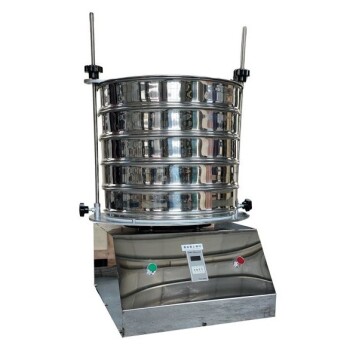
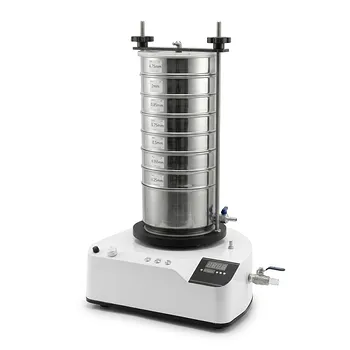
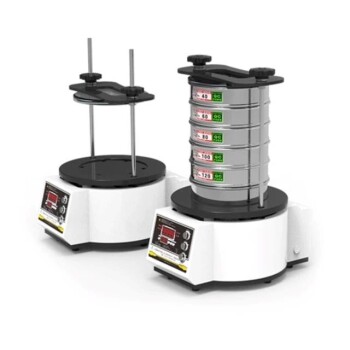
The primary function of an industrial-grade standard sieve in this context is to act as a critical physical filtration step following the thermal regeneration of a catalyst. While the muffle furnace burns off carbonaceous deposits (coke), the sieve is required to mechanically separate the revitalized catalyst from residual inorganic impurities—specifically microalgae ash—and fine structural fragments that result from the high-temperature process.
While the furnace restores the catalyst's chemical potential, the sieve restores its physical integrity. It serves as the final quality assurance step, ensuring that only catalyst particles of the correct size and purity are reintroduced into the reaction cycle, preventing system clogging and contamination.
The Dual Challenge of Regeneration
Addressing Inorganic Residues
The regeneration process in a muffle furnace is effective at removing organic carbon deposits through combustion.
However, this process does not eliminate inorganic materials. When processing feedstocks like microalgae, inorganic ash remains mixed with the catalyst after the coke is burned off.
Without removal, this ash accumulates, effectively diluting the catalyst and potentially poisoning active sites.
Managing Thermal Degradation
High-temperature environments place significant thermal stress on catalyst materials.
This stress often causes the catalyst pellets or particles to fracture, creating dust and "fines" (extremely small fragments).
These fine fragments can increase pressure drop in reactor beds and disrupt fluid dynamics if not removed before reuse.
The Role of the Standard Sieve
Ensuring Chemical Purity
The sieve uses a specific aperture size designed to pass fine particulates while retaining the usable catalyst.
By sifting the material, the microalgae ash is physically separated from the catalyst batch.
This restores the bulk purity of the catalyst, ensuring that the material entering the next cycle is chemically active rather than inert debris.
Standardizing Physical Form
Beyond purity, the sieve classifies the material by size.
It captures and removes the fractured catalyst fines described earlier.
This ensures that the recovered catalyst maintains a uniform physical form, which is essential for consistent flow rates and contact time in subsequent reactions.
Understanding the Trade-offs
Yield vs. Purity
Using a sieve introduces a necessary loss of material.
While removing ash and fines is critical, there is always a risk of discarding usable, slightly undersized catalyst particles along with the waste.
You must balance the strictness of your sieving (mesh size) against the cost of replacing the lost catalyst volume.
The Risk of Mesh Blinding
If the ash content is particularly high or sticky, the sieve apertures can become clogged ("blinded").
This reduces the efficiency of the separation process and can lead to ash being carried over into the "clean" catalyst stream.
Regular maintenance and correct aperture selection are vital to prevent this mechanical failure.
Making the Right Choice for Your Process
Selecting the correct sieve specifications depends on your tolerance for impurities versus your need to conserve catalyst volume.
- If your primary focus is process stability: Prioritize a finer mesh size to remove maximum ash and fines, ensuring the highest protection for your reactor downstream, even if it means slightly higher catalyst attrition.
- If your primary focus is cost minimization: Select a mesh size that strictly targets the ash profile, allowing smaller (but viable) catalyst fragments to remain in the batch to maximize yield.
The sieve is not just a filter; it is the define gatekeeper that determines the long-term viability of your recycled catalyst.
Summary Table:
| Aspect | Role of Sieve in Regeneration | Benefit to Process |
|---|---|---|
| Inorganic Removal | Separates microalgae ash from catalyst | Prevents site poisoning and dilution |
| Structural Integrity | Filters out fractured "fines" and dust | Maintains pressure drop and flow dynamics |
| Size Classification | Ensures uniform particle size distribution | Guarantees consistent reaction contact time |
| Quality Control | Final physical filtration gatekeeper | Protects downstream equipment from clogging |
Maximize Your Catalyst Lifecycle with KINTEK Precision Solutions
Don't let ash accumulation or thermal degradation compromise your laboratory or industrial throughput. KINTEK specializes in high-performance laboratory equipment, providing the essential tools you need for every stage of the catalyst cycle—from thermal treatment in our advanced muffle and vacuum furnaces to precise material classification with our industrial-grade sieving equipment and crushing systems.
Whether you are managing complex microalgae feedstocks or conducting high-pressure battery research, our comprehensive range of high-temperature reactors, hydraulic presses, and specialized consumables ensures your materials meet the strictest purity standards.
Ready to optimize your regeneration process? Contact KINTEK today to discover how our high-precision equipment can enhance your lab's efficiency and yield.
References
- Nur Adilah Abd Rahman, Aimaro Sanna. Stability of Li-LSX Zeolite in the Catalytic Pyrolysis of Non-Treated and Acid Pre-Treated Isochrysis sp. Microalgae. DOI: 10.3390/en13040959
This article is also based on technical information from Kintek Solution Knowledge Base .
Related Products
- Custom PTFE Teflon Parts Manufacturer for PTFE Mesh F4 Sieve
- Laboratory Test Sieves and Sieving Machines
- Three-dimensional electromagnetic sieving instrument
- Laboratory Vibratory Sieve Shaker Machine for Dry and Wet Three-Dimensional Sieving
- Vibratory Sieve Shaker Machine Dry Three-Dimensional Vibrating Sieve
People Also Ask
- What are the primary reasons for selecting PTFE as a matrix? Enhance Composites with Carbon Nanotube Reinforcement
- How is PTFE utilized for insulation in Alloy 22 corrosion setups? Ensure Signal Purity & Accuracy
- Is PTFE corrosion resistant? Discover the Ultimate Chemical Resistance for Your Lab
- What are the specific applications of PTFE in micro-batch slug flow systems? Enhance Your Microfluidic Reaction Purity
- What is the mesh size of a sieve? A Guide to Particle Size and Sieve Selection