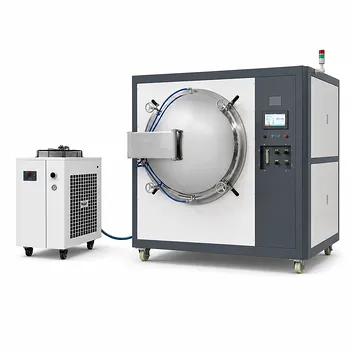
Drying petroleum coke residues in a vacuum oven at 110°C for 24 hours is essential to remove deep-seated moisture while preserving the material's chemical and physical integrity. This specific protocol ensures that the sample reaches a stable, dry weight basis for accurate analysis without suffering from secondary oxidation or structural degradation that occurs in standard atmospheric ovens.
The use of a vacuum environment lowers the boiling point of water, allowing for thorough dehydration of internal pores at a moderate temperature of 110°C. This method protects sensitive surface functional groups and maintains the original pore structure, providing an authentic representation of the residue's physicochemical state.
The Role of Vacuum Environments in Moisture Removal
Deep Pore Dehydration
Petroleum coke residues often possess complex, narrow pore networks that trap moisture via capillary forces. In a vacuum environment, the reduction in pressure lowers the boiling point of water, allowing it to evaporate from these deep pores more efficiently than at atmospheric pressure.
Establishing a Uniform Dry Weight
For precise quantitative analysis, researchers must establish a consistent dry weight basis. This 24-hour drying period ensures all adsorbed water is eliminated, which is a critical prerequisite for the accurate calculation of elemental concentrations and heavy metal distributions.
Protecting the Material’s Chemical Integrity
Preventing Secondary Oxidation
Drying at high temperatures in the presence of air can lead to secondary oxidation, which alters the sample's chemical composition. The vacuum oven removes oxygen from the environment, ensuring that the petroleum coke residue does not react with the atmosphere during the heating process.
Preserving Surface Functional Groups
The "authentic" state of the residue depends on its surface functional groups, which are often sensitive to heat and oxygen. By maintaining a relatively low temperature of 110°C under vacuum, the process prevents the premature decomposition or transformation of these chemical active sites.
Maintaining the Physical Microstructure
Preventing Pore Collapse
Delicate micropores within carbonaceous materials can be susceptible to structural damage during rapid or high-heat drying. The controlled, low-pressure environment of a vacuum oven helps preserve the developed pore structure, ensuring that subsequent porosity measurements are accurate.
Surface State Preservation
If the surface chemistry or physical structure is altered during drying, the data gathered from the sample will not reflect its true state post-gasification. Vacuum drying ensures that the physicochemical state remains unchanged, allowing for a reliable assessment of how the material behaved during industrial processing.
Understanding the Trade-offs
Time and Energy Requirements
The primary drawback of this method is the 24-hour duration, which slows down the laboratory workflow compared to flash-drying techniques. While effective, the process requires significant energy and equipment time to ensure total moisture removal.
Potential Loss of Volatile Organic Compounds
While 110°C is low enough to protect most functional groups, it may still be high enough to cause the volatilization of light organic fractions trapped in the coke. If your research focuses specifically on highly volatile adsorbed species, even lower temperatures or specialized extraction methods might be necessary.
How to Apply This to Your Project
When preparing petroleum coke residues for analysis, your specific research objectives will dictate the importance of the vacuum drying stage.
- If your primary focus is accurate elemental or heavy metal analysis: Focus on the 24-hour duration to ensure a perfectly stable dry weight basis, as even trace moisture can skew concentration calculations.
- If your primary focus is characterizing surface chemistry or reactivity: Prioritize the vacuum setting over the temperature to ensure that oxidation does not introduce artificial functional groups to the sample.
- If your primary focus is pore structure and surface area (BET) analysis: Use the vacuum oven to prevent pore collapse, as atmospheric drying can lead to surface tension effects that shrink or close delicate micropores.
By strictly adhering to vacuum drying protocols, you ensure that your analytical results reflect the true properties of the material rather than artifacts of the drying process.
Summary Table:
| Key Aspect | Vacuum Drying Benefit | Purpose for Analysis |
|---|---|---|
| Moisture Removal | Deep pore dehydration | Establishes a consistent dry weight basis |
| Chemical Stability | Prevents secondary oxidation | Maintains original surface functional groups |
| Physical Structure | Prevents pore collapse | Ensures accurate BET and porosity measurements |
| Data Reliability | Authentic representation | Eliminates artifacts from the drying process |
Elevate Your Material Analysis with KINTEK Precision
Ensure the integrity of your research with laboratory equipment designed for accuracy. KINTEK specializes in high-performance vacuum ovens and high-temperature furnaces tailored for demanding petroleum and carbon research. Beyond drying, we offer a comprehensive range of crushing and milling systems, hydraulic presses, and high-pressure reactors to streamline your sample preparation workflow.
Why choose KINTEK?
- Precision Engineering: Maintain exact temperatures and vacuum levels for delicate residues.
- Comprehensive Solutions: From MPCVD/CVD systems to PTFE consumables, we provide everything your lab needs.
- Expert Support: Our team helps you select the right tools to prevent sample degradation and ensure reproducible results.
Ready to optimize your drying protocols? Contact us today to find the perfect equipment for your lab!
References
- Man Zhang, Qian Zhang. Catalytic Gasification of Petroleum Coke with Different Ratios of K2CO3 and Evolution of the Residual Coke Structure. DOI: 10.3390/molecules28196779
This article is also based on technical information from Kintek Solution Knowledge Base .
Related Products
- 56L Vertical Laboratory Vacuum Drying Oven
- 23L Laboratory Vacuum Drying Oven
- Vacuum Heat Treat Sintering Brazing Furnace
- 2200 ℃ Graphite Vacuum Heat Treat Furnace
- Dental Porcelain Zirconia Sintering Ceramic Vacuum Press Furnace
People Also Ask
- Why is a laboratory vacuum drying oven recommended for rice straw residues? Protect Your Biomass Integrity
- What role does a laboratory vacuum drying oven play in the preparation of modified multi-walled carbon nanotubes?
- What is the importance of using a laboratory vacuum drying oven? Preserving Slow-Release Microcapsule Integrity
- Why is a Laboratory Vacuum Drying Oven recommended for PBAT microspheres? Protect Sensitive Polymer Integrity
- What role does a laboratory vacuum drying oven play in processing nanoparticle powder samples? Protect Sample Integrity