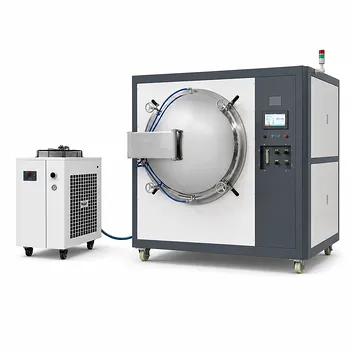
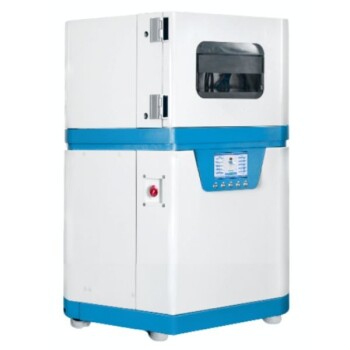
Segmented temperature control and precise holding capabilities are essential for preserving material integrity during the sintering process. By maintaining specific thermal plateaus, such as at 200°C or 800°C, the furnace allows for the gradual elimination of residual gases and the relief of internal stresses within the green body. This synchronization of internal and external temperatures prevents thermal shock cracking and ensures a uniform, stable microstructure in the final alloy.
Without precise, segmented thermal management, the thermal disparity between a sample's surface and its core can lead to structural failure. Controlled holding periods are the only mechanism to ensure uniform densification while strictly preventing brittle interfacial reactions.
Managing Material Stress and Uniformity
Eliminating Volatiles and Internal Stress
A "green body" (the unfired material) often contains binders, residual gases, and inherent mechanical stresses from the forming process.
If the temperature rises continuously without pause, these gases may become trapped, leading to voids or cracks. Segmented control allows the furnace to "hold" at specific temperatures, giving these volatiles time to escape and allowing internal stresses to relax naturally.
Achieving Thermal Equilibrium
Heat penetrates materials from the outside in. Without holding periods, the surface of the sample may reach critical sintering temperatures while the core remains significantly cooler.
Holding the temperature at set intervals ensures that the core temperature catches up to the surface temperature. This creates a uniform thermal environment throughout the entire volume of the material.
Preventing Thermal Shock
Rapid temperature changes can cause catastrophic failure in ceramics and metal alloys.
By implementing a segmented heating profile, you minimize the temperature gradient between the interior and exterior of the sample. This careful management directly prevents cracking caused by thermal shock, preserving the sample's physical integrity.
Controlling Chemical Reactions and Microstructure
Optimization of Densification
Vacuum hot pressing is designed to achieve high density through simultaneous heat and pressure.
To achieve full densification, the material must remain within a specific temperature window long enough for phase transformation and sintering to occur. Precise holding ensures the material spends the exact amount of time required in this optimal zone.
Preventing Unwanted Interfacial Reactions
Beyond physical cracking, lack of precision can alter the chemical makeup of your material.
If temperatures overshoot specific limits (such as 630°C in certain aluminum matrix composites), unwanted chemical reactions occur between reinforcing particles and the matrix. This can generate brittle interfacial products, such as WAl12, which severely degrade mechanical performance.
Ensuring Microstructural Stability
The ultimate goal of the process is a consistent final product.
Uniform thermal history across the sample leads to a uniform microstructure. This consistency ensures that the mechanical properties—such as strength and hardness—are stable and predictable throughout the entire sintered alloy.
Understanding the Trade-offs
Process Time vs. Material Quality
Implementing segmented control significantly increases the duration of the sintering cycle.
While a direct ramp-up is faster, it prioritizes throughput over quality. You must accept a longer processing time as the necessary "cost" for achieving a defect-free internal structure.
Complexity of Profile Design
Precise holding requires a deep understanding of the material's specific thermal properties.
Setting the wrong holding points or durations can be ineffective. You must invest time in characterizing your material to determine exactly where gas release and phase transitions occur to program the segments correctly.
Optimizing Your Sintering Profile
When configuring your vacuum hot-press furnace, your heating profile should be dictated by the specific vulnerabilities of your material.
- If your primary focus is Avoiding Cracks: Prioritize multiple holding segments during the ramp-up phase to ensure core-to-surface thermal equilibrium.
- If your primary focus is Mechanical Performance: Set strict upper-limit temperature controls to prevent the formation of brittle interfacial phases like WAl12.
- If your primary focus is Degassing: extend the holding duration at lower temperatures (e.g., 200°C) to allow ample time for volatiles to escape the green body.
True precision in hot pressing is not just about reaching a target temperature; it is about controlling the journey to get there.
Summary Table:
| Feature | Purpose | Key Material Benefit |
|---|---|---|
| Segmented Heating | Gradual elimination of volatiles & gases | Prevents internal voids and gas-induced cracking |
| Precise Holding | Synchronizes core and surface temperatures | Eliminates thermal shock and structural failure |
| Thermal Equilibrium | Stress relief within the green body | Ensures a uniform, stable microstructure |
| Limit Controls | Prevents temperature overshooting | Stops the formation of brittle interfacial phases |
Elevate Your Material Research with KINTEK Precision
Don't compromise the integrity of your alloys and ceramics with imprecise thermal management. KINTEK specializes in advanced vacuum hot-press furnaces and a comprehensive range of high-temperature solutions, including muffle, tube, and CVD furnaces. Our equipment is engineered for the rigorous demands of sintering, offering the precise segmented control needed to eliminate thermal shock and ensure uniform densification.
From high-pressure reactors and autoclaves to specialized hydraulic presses and crushing systems, KINTEK provides laboratory professionals with the tools to achieve predictable, high-performance results. Discover how our precision engineering can optimize your sintering profiles—contact us today to discuss your project!
Related Products
- Vacuum Hot Press Furnace Heated Vacuum Press Machine Tube Furnace
- 600T Vacuum Induction Hot Press Furnace for Heat Treat and Sintering
- Vacuum Hot Press Furnace Machine Heated Vacuum Press
- Vacuum Hot Press Furnace Machine for Lamination and Heating
- Vacuum Heat Treat and Pressure Sintering Furnace for High Temperature Applications
People Also Ask
- What advantages does a vacuum hot press furnace provide for LSLBO ceramic electrolytes? Achieve 94% Relative Density
- What role does a Vacuum Hot Press (VHP) furnace play in the densification of austenitic stainless steel 316 composites?
- What are the advantages of using a vacuum hot pressing furnace? Superior Densification for 2024Al/Gr/SiC Composites
- What are the advantages of a vacuum hot press furnace for LTPO solid electrolytes? Boost Density and Conductivity
- What core processing conditions does a vacuum hot press furnace provide? Achieve High-Density Cu-SiC/Diamond Composites