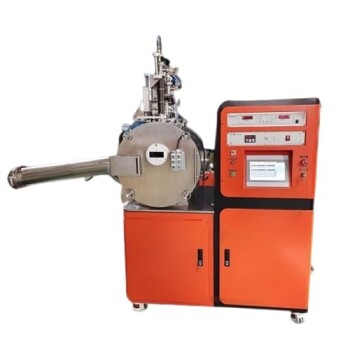
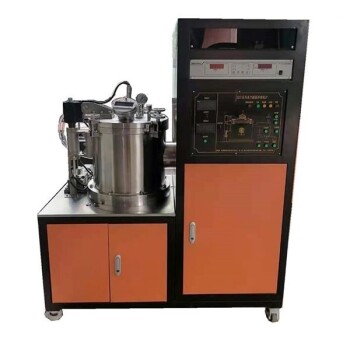
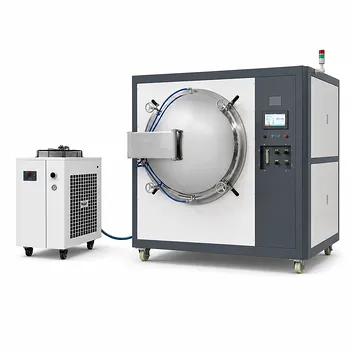
Maintaining a low-pressure environment is strictly necessary to preserve the integrity of reactive elements within the alloy. Vacuum melting equipment creates a controlled atmosphere, often around 10 torr, which prevents Chromium (Cr) and Boron (B) from oxidizing or volatilizing during the high-heat production process.
Vacuum melting is not merely a cleaning step; it is a composition control mechanism. By eliminating gaseous impurities and stabilizing volatile elements, the process ensures the precise chemical stoichiometry required for high-performance magnetic materials.
The Critical Role of Pressure Control
The production of CoCrPtB (Cobalt-Chromium-Platinum-Boron) alloys involves high temperatures that make the material highly susceptible to atmospheric interference. Lowering the pressure is the primary defense against chemical degradation.
Preventing Oxidation of Active Elements
Chromium and Boron are highly "active" elements, meaning they react aggressively with oxygen.
If processed in standard atmospheric conditions, these elements would rapidly oxidize. This reaction creates impurities that fundamentally alter the alloy's structure, rendering it useless for high-precision magnetic applications.
Controlling Volatilization
High heat does not just cause reactions; it can cause evaporation.
Certain elements within the alloy matrix have high vapor pressures and are prone to volatilization—essentially boiling away into a gas. The vacuum environment suppresses this phenomenon, keeping the active elements within the melt rather than losing them to the atmosphere.
Achieving Compositional Purity
For magnetic materials, the specific ratio of elements (stoichiometry) dictates performance. Vacuum melting is the tool used to lock this ratio in place.
Removal of Gaseous Impurities
The vacuum process does more than protect the melt; it actively cleans it.
By lowering the pressure, the equipment extracts dissolved gases and other volatile impurities from the molten metal. This results in a cleaner, denser final product with fewer microscopic defects.
Ensuring Magnetic Performance
The ultimate goal of this process is the reliability of the magnetic material.
Variations in chemical composition, caused by either oxidation or the loss of volatile elements, lead to inconsistent magnetic properties. Vacuum melting ensures that the final alloy matches the exact specifications required for high-performance use.
Understanding the Operational Trade-offs
While vacuum melting is essential for CoCrPtB alloys, it introduces distinct challenges to the manufacturing workflow.
Increased Process Complexity
Vacuum systems add significant layers of mechanical complexity.
Operators must manage pump down times, seal integrity, and pressure monitoring systems. This increases the technical skill required for production compared to standard induction melting.
Sensitivity to Leakage
The system's reliance on a pristine environment makes it fragile.
Even a minor vacuum leak can introduce enough oxygen to ruin a batch of CoCrPtB. The margin for error is non-existent, requiring rigorous maintenance schedules to ensure seal integrity.
Optimizing Your Production Strategy
When fabricating complex magnetic alloys, the melting environment is just as critical as the raw ingredients.
- If your primary focus is Compositional Accuracy: Ensure your vacuum equipment can maintain a steady state of 10 torr or lower to completely halt the volatilization of Boron.
- If your primary focus is Material Purity: Prioritize a slow pump-down cycle to maximize the extraction of gaseous impurities before the melt reaches peak temperature.
Control the pressure, and you control the material's potential.
Summary Table:
| Feature | Impact of Vacuum Melting (approx. 10 Torr) | Benefit to CoCrPtB Alloy |
|---|---|---|
| Oxidation Control | Prevents Cr and B from reacting with oxygen | Maintains structural integrity and purity |
| Volatilization | Suppresses evaporation of active elements | Ensures precise chemical stoichiometry |
| Impurity Removal | Extracts dissolved gases/volatile contaminants | Results in a cleaner, denser final product |
| Magnetic Quality | Stabilizes elemental ratios | Guarantees consistent magnetic performance |
Elevate Your Advanced Material Synthesis with KINTEK
Precise atmospheric control is the difference between high-performance alloys and failed batches. KINTEK specializes in state-of-the-art laboratory equipment designed for rigorous research and production standards. Our range of vacuum induction melting systems, high-temperature furnaces (CVD, PECVD, and atmosphere), and crushing equipment provides the reliability needed for sensitive CoCrPtB alloy fabrication.
Whether you require specialized high-temperature high-pressure reactors, precise pellet presses, or durable ceramic crucibles, KINTEK delivers the technical expertise and comprehensive toolkits your lab demands.
Ready to optimize your material purity? Contact our technical specialists today to discuss how our custom heating and vacuum solutions can enhance your research outcomes.
Related Products
- Lab-Scale Vacuum Induction Melting Furnace
- Vacuum Induction Melting Spinning System Arc Melting Furnace
- Vacuum Arc Induction Melting Furnace
- Vacuum Heat Treat Furnace and Levitation Induction Melting Furnace
- Non Consumable Vacuum Arc Induction Melting Furnace
People Also Ask
- How do vacuum induction or arc melting furnaces facilitate the synthesis of U-Al-C MAX phases? Precision Heat & Purity
- Why use VIM for rare earth steel? Essential Precision for Melting Reactive Lanthanum and Cerium
- What types of metals are typically processed in a vacuum induction melting furnace? High-Purity Alloys for Critical Applications
- What is the primary function of a vacuum induction melting furnace in Ni-Mo-Cr-Fe master alloy prep? Ensure High Purity
- What is the function of a vacuum induction melting furnace? Essential Guide for High-Purity FeCrAl Alloy Production