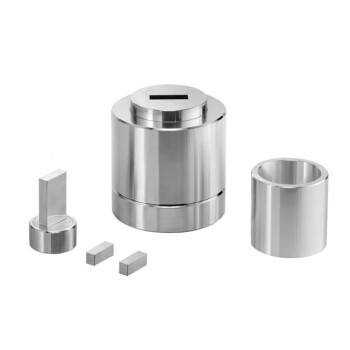
precise pressure control is the fundamental driver that transforms a loose mixture of titanium hydride, yttrium hydride, and aluminum powder into a viable reactive solid.
By applying a specific pressure—such as $4 \times 10^6$ Pa—the hydraulic press compresses the powder into pellets with a targeted bulk density (e.g., $3\text{ g/cm}^3$). This precise compaction is critical because it forces the particles into tight physical contact, a prerequisite for enabling solid-phase diffusion and the necessary alloying reactions during the subsequent high-temperature vacuum dehydrogenation process.
Core Insight
While molding appears to be a simple shaping step, its true purpose is microstructural preparation. Without the exact particle-to-particle contact achieved through precise pressure, the atoms cannot diffuse effectively across boundaries, leading to incomplete alloying and structural failure during heat treatment.
The Mechanics of Particle Interaction
Achieving Critical Density
In the Ti-Al-Y alloy powder molding stage, the goal is not merely to pack powder into a mold. You are aiming for a specific physical state.
A laboratory hydraulic press allows you to dial in exact force parameters to achieve a consistent bulk density, such as $3\text{ g/cm}^3$.
Eliminating Inter-Particle Voids
Loose powders naturally contain significant air gaps and voids.
By applying precise pressure, you mechanically eliminate these voids. This brings the titanium hydride, yttrium hydride, and aluminum particles into immediate, intimate proximity.
Establishing Tight Contact
The primary reference highlights that tight contact between particles is the single most important outcome of this stage.
If the pressure varies, the contact area between particles becomes inconsistent. This inconsistency acts as a barrier to the chemical processes required in the next stage of manufacturing.
Enabling the Alloying Reaction
Facilitating Solid-Phase Diffusion
The molding stage sets the stage for the high-temperature vacuum dehydrogenation process.
During this subsequent heating phase, the material relies on solid-phase diffusion to form the alloy. Diffusion is the movement of atoms from one particle to another.
The Bridge for Atomic Movement
Atoms cannot easily diffuse across open gaps. They require a physical bridge.
The precise pressure applied by the press creates these bridges. It ensures that the distinct elements in the powder mixture are touching sufficiently to allow atoms to migrate and mix at the molecular level.
Driving the Alloying Reaction
Successful alloying is a direct consequence of this diffusion.
If the pressure is insufficient, diffusion is retarded. This results in a weak, inhomogeneous material rather than a unified alloy.
Common Pitfalls to Avoid
The Risk of Under-Pressurization
If the hydraulic press fails to maintain the target pressure (e.g., falling below $4 \times 10^6$ Pa), the resulting pellet will have low green density.
This lack of density leaves gaps between particles, preventing the solid-phase diffusion necessary for the alloying reaction. The final product will likely suffer from poor mechanical performance or incomplete chemical integration.
Handling and Structural Integrity
Beyond chemistry, there is a practical mechanical trade-off.
As noted in broader powder metallurgy contexts, the "green billet" (the pressed powder) must have enough strength to be handled and loaded into a vacuum furnace. Precise pressure ensures the pellet holds its shape and integrity during this transition, preventing crumbling or deformation before the sintering or dehydrogenation process even begins.
Making the Right Choice for Your Goal
To ensure the success of your Ti-Al-Y alloy production, focus on the following objectives when setting your hydraulic press parameters:
- If your primary focus is Chemical Homogeneity: Prioritize hitting the exact target density to maximize particle contact areas, which guarantees efficient solid-phase diffusion.
- If your primary focus is Process Yield: Ensure pressure consistency to maintain sufficient "green strength," allowing pellets to be moved into the vacuum furnace without breakage.
Precise pressure is not just about shaping the powder; it is the catalyst that enables the material to react and evolve into a high-performance alloy.
Summary Table:
| Factor | Parameter/Effect | Importance for Ti-Al-Y Alloy |
|---|---|---|
| Target Pressure | $4 \times 10^6$ Pa | Creates the necessary force for uniform compaction |
| Bulk Density | $3\text{ g/cm}^3$ | Establishes the ideal physical state for chemical reactions |
| Particle Interaction | Tight Physical Contact | Eliminates voids to allow for atomic bridge formation |
| Subsequent Process | Solid-Phase Diffusion | Facilitates alloying during high-temp vacuum dehydrogenation |
| Structural Goal | Green Strength | Prevents crumbling during handling and furnace loading |
Elevate Your Materials Research with KINTEK Precision
Don't let inconsistent pressure compromise your alloy's integrity. KINTEK specializes in advanced laboratory equipment designed for the most demanding powder metallurgy applications. Our precision hydraulic presses (pellet, hot, isostatic) ensure the exact bulk density and particle contact required for superior solid-phase diffusion and chemical homogeneity.
From high-temperature furnaces for vacuum dehydrogenation to specialized crushing and milling systems, KINTEK provides a comprehensive range of solutions for researchers and manufacturers.
Ready to achieve perfect green density and flawless alloying reactions?
Contact KINTEK experts today to find the ideal equipment for your laboratory.
References
- Natalia Karakchieva, И. А. Курзина. Influence of Yttrium on the Phase Composition of the Ti-Al System Obtained by the ‘Hydride Technology’. DOI: 10.3390/met12091481
This article is also based on technical information from Kintek Solution Knowledge Base .
Related Products
- Ball Press Mold for Lab
- Laboratory Hydraulic Press Split Electric Lab Pellet Press
- 24T 30T 60T Heated Hydraulic Press Machine with Heated Plates for Laboratory Hot Press
- kbr pellet press 2t
- Laboratory Manual Hydraulic Pellet Press for Lab Use
People Also Ask
- What are the advantages of using a laboratory hydraulic press for hot pressing? Achieve Peak Nano-Composite Density
- How to use a press mold? Master the Art of Creating Consistent Ceramic Forms
- What is the press mould method? A Guide to Consistent, Detailed Ceramic Forms
- What is the purpose of specialized pressure devices in sulfide solid-state batteries? Ensure Chemo-Mechanical Stability
- Why are pressure molds with non-conductive resin inner walls required for battery testing? Ensure Data Accuracy