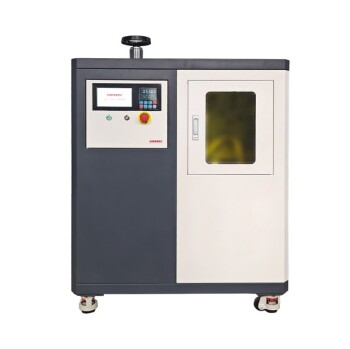
Precise pressure control during the hot pressing of Thallium Bromide (TlBr) is essential for achieving full material densification and inducing specific crystal orientations. By maintaining continuous, stable pressure (typically around 30 kN) within a specific temperature window (455–465°C), the process eliminates internal voids and aligns the crystal structure. This mechanical stability directly dictates the semiconductor's final performance, specifically its current-voltage characteristics and gamma-ray detection efficiency.
The synergy of thermal and mechanical forces acts as a governing mechanism for material quality. Without stable pressure application, the TlBr crystal suffers from internal porosity and poor structural alignment, rendering it unsuitable for high-precision photon counting applications.
The Mechanics of Material Consolidation
Achieving Full Densification
The primary function of applying stable pressure is to transform purified raw materials into a solid, high-density block. By exerting approximately 30 kN of axial force, the press forces loose material to consolidate within the mold. This ensures the resulting crystal block achieves the precise dimensions required for detector assembly.
Eliminating Micro-Porosity
Pressure does not merely compress the material; it actively eliminates internal defects. The continuous application of force eliminates internal micro-porosity that naturally occurs during sintering. This promotes tight inter-granular bonding, which is necessary to create a unified, robust semiconductor material.
Suppressing Defect Formation
The application of pressure creates a controlled stress field during the crystal growth phase. This stress field helps suppress the formation of defects that would otherwise compromise the structural integrity of the crystal. A defect-free structure is a prerequisite for reliable semiconductor performance.
Crystal Orientation and Electrical Performance
Inducing Specific Crystal Orientations
Beyond simple density, the "deep need" of the hot pressing process is the alignment of the crystal lattice. The thermal-mechanical coupling—applying pressure while the material is at 455–465°C—adjusts and enforces specific crystal orientations. This alignment is not a byproduct; it is a critical engineering goal of the pressing process.
Optimizing Current-Voltage Characteristics
The physical orientation of the crystal directly impacts how electricity flows through the semiconductor. Proper alignment ensures optimal current-voltage characteristics. This stability is vital for the consistent operation of the final device under an applied bias voltage.
Maximizing Detection Efficiency
For TlBr to function as a radiation detector, it must efficiently interact with incoming particles. The high density and specific orientation achieved through pressure control result in an excellent gamma-ray attenuation coefficient. This maximizes the device's photon-counting efficiency and energy resolution.
Critical Trade-offs and Process Limitations
The Necessity of Thermal-Mechanical Coupling
Pressure cannot be viewed in isolation; it must be perfectly coupled with temperature. If the temperature deviates from the 455–465°C range, the 30 kN of pressure will not achieve the desired plasticity or bonding. The process relies entirely on the simultaneous application of both forces for a duration of approximately 2 hours.
Purity as a Precursor
It is critical to note that precise pressure control cannot compensate for chemically impure raw materials. High-purity precursors, often achieved through multi-zone melting to remove impurities, are required before the hot press stage. Pressure optimizes the structure, but it cannot fix the electrical degradation caused by chemical contamination.
Making the Right Choice for Your Goal
To ensure your TlBr manufacturing process yields detector-grade crystals, consider the following outcome-based recommendations:
- If your primary focus is Structural Integrity: Ensure your press maintains continuous stability at 30 kN to eliminate micro-porosity and achieve full densification.
- If your primary focus is Electrical Performance: Prioritize the precise coupling of pressure with the 455–465°C temperature window to enforce the specific crystal orientations required for efficient charge transport.
- If your primary focus is Energy Resolution: Verify that the pressure application duration (approx. 2 hours) is sufficient to suppress defect formation throughout the entire crystal volume.
Ultimate success in TlBr molding relies on using pressure not just as a compacting force, but as a tool to engineer the microscopic lattice for maximum detection efficiency.
Summary Table:
| Parameter | Targeted Requirement | Impact on TlBr Quality |
|---|---|---|
| Applied Force | ~30 kN (Stable) | Full densification and elimination of micro-porosity |
| Temp. Window | 455–465°C | Facilitates material plasticity and thermal-mechanical coupling |
| Press Duration | Approx. 2 Hours | Suppresses defect formation and ensures lattice alignment |
| Core Objective | Crystal Orientation | Optimizes current-voltage and photon-counting efficiency |
Elevate Your Crystal Growth with KINTEK Precision Solutions
Achieving the perfect thermal-mechanical coupling for Thallium Bromide (TlBr) requires equipment that delivers uncompromising stability. At KINTEK, we specialize in high-performance laboratory solutions designed for the most demanding semiconductor research. Our advanced hot presses and isostatic hydraulic presses provide the precise pressure control and temperature uniformity essential for eliminating defects and optimizing crystal orientation.
Beyond pressing, KINTEK offers a comprehensive portfolio including:
- High-Temperature Furnaces: Muffle, tube, and vacuum furnaces for precise sintering.
- Crushing & Milling Systems: Achieve the high-purity precursors necessary for crystal growth.
- Thermal Processing: Cooling solutions, cooling traps, and freeze dryers for controlled environments.
Ready to maximize your energy resolution and detection efficiency? Contact our technical experts today to find the ideal equipment for your laboratory.
References
- Ashkan Ajeer, Robert Moss. A step closer to a benchtop x-ray diffraction computed tomography (XRDCT) system. DOI: 10.21175/rad.abstr.book.2023.21.2
This article is also based on technical information from Kintek Solution Knowledge Base .
Related Products
- Manual High Temperature Heated Hydraulic Press Machine with Heated Plates for Lab
- Automatic Heated Hydraulic Press Machine with Heated Plates for Laboratory Hot Press
- Touchscreen Automatic Vacuum Heat Press
- Automatic Heated Hydraulic Press Machine with Heated Plates for Laboratory Hot Press 25T 30T 50T
- Heated Hydraulic Press Machine with Heated Plates for Vacuum Box Laboratory Hot Press
People Also Ask
- What is a hot hydraulic press? Harness Heat and Pressure for Advanced Manufacturing
- What is a heated hydraulic press used for? Essential Tool for Curing, Molding, and Laminating
- Why is a heated hydraulic press used for warm pressing NASICON green tapes? Optimize Your Solid Electrolyte Density
- What does a hydraulic heat press do? Achieve Industrial-Scale, Consistent Pressure for High-Volume Production
- Why is a heated laboratory hydraulic press necessary for composite laminates? Achieve Void-Free Structural Integrity