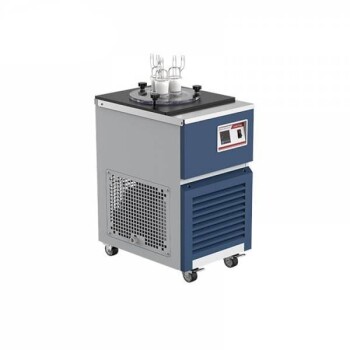
High-temperature vacuum drying is strictly necessary to eliminate surface contaminants that compromise cell chemistry. Before assembly, copper foil inevitably hosts trace moisture and volatile organic compounds (VOCs). Removing these is non-negotiable because the Li6PS5Cl electrolyte is highly reactive to impurities.
The drying process eliminates moisture that would otherwise trigger degradation reactions at the electrolyte interface, preventing a significant increase in the battery’s internal impedance.
The Critical Role of Surface Preparation
To understand why this step is mandatory, one must look beyond the copper foil itself and focus on its interaction with the electrolyte.
The Sensitivity of Sulfide Electrolytes
Sulfide electrolytes, specifically Li6PS5Cl, are chemically unstable in the presence of protic solvents or moisture.
Even microscopic amounts of water adsorbed on the copper surface can initiate immediate chemical breakdown. This sensitivity requires a preparation standard far higher than that of conventional battery systems.
The Mechanism of the Vacuum Oven
The drying process utilizes a dual approach to ensure purity: thermal energy and negative pressure.
By applying high temperatures, typically around 80 degrees Celsius, the process increases the kinetic energy of adsorbed molecules. Simultaneously, the vacuum environment lowers the boiling point of liquids and promotes the desorption of gases.
Targeting Volatile Organic Compounds (VOCs)
Beyond moisture, copper foil often retains volatile organic compounds from manufacturing or storage environments.
These organic residues can act as insulating layers or reactive sites. The vacuum oven effectively strips these compounds away, leaving a pristine metal surface ready for interface with the electrolyte.
Understanding the Risks of Inadequate Drying
Skipping or rushing this purification step leads to immediate and often irreversible performance issues.
Interfacial Degradation
If moisture remains on the copper, it triggers interfacial degradation reactions upon contact with the Li6PS5Cl.
This reaction does not just consume a small amount of electrolyte; it fundamentally alters the chemical composition of the interface. This creates a resistive layer that hinders ion transport.
The Spike in Internal Impedance
The direct measurable result of this degradation is an increase in the cell's internal impedance.
High impedance limits the power capability of the cell and reduces its overall efficiency. Once this resistive interface is formed due to moisture, it cannot be reversed by subsequent cycling.
Ensuring Reliable Cell Performance
Best Practices for Assembly
- If your primary focus is maximizing conductivity: Ensure the oven reaches at least 80°C to fully activate the desorption of stubborn VOCs.
- If your primary focus is long-term stability: Prioritize the duration of the vacuum hold to guarantee the complete removal of deep-seated moisture triggers.
Thorough vacuum drying is not merely a cleaning step; it is a fundamental prerequisite for chemical stability in sulfide-based solid-state batteries.
Summary Table:
| Parameter | Importance in Li6PS5Cl Assembly | Expected Outcome |
|---|---|---|
| Temperature (80°C) | Increases kinetic energy to desorb VOCs and moisture. | Pristine, reactive-free copper surface. |
| Vacuum Environment | Lowers boiling points; facilitates gas desorption. | Elimination of insulating organic layers. |
| Moisture Removal | Prevents breakdown of sulfide electrolytes. | Minimized interfacial resistance. |
| VOC Stripping | Removes manufacturing residues. | Enhanced ion transport and lower impedance. |
Elevate Your Battery Research with KINTEK Precision
Achieving the perfect interface in Li6PS5Cl solid-state batteries requires more than just high-quality materials—it requires the right environment. At KINTEK, we specialize in the high-performance laboratory equipment essential for advanced energy storage research.
From our precision vacuum ovens and high-temperature furnaces designed for rigorous electrode preparation to specialized battery research tools, hydraulic presses, and crushing systems, we provide the end-to-end solutions your lab needs to eliminate contamination and maximize cell conductivity.
Don't let moisture compromise your results. Contact KINTEK today to discover how our comprehensive range of equipment and consumables can streamline your assembly process and ensure reliable, high-performance battery data.
Related Products
- 23L Laboratory Vacuum Drying Oven
- 56L Vertical Laboratory Vacuum Drying Oven
- Vacuum Heat Treat Sintering Brazing Furnace
- Dental Porcelain Zirconia Sintering Ceramic Vacuum Press Furnace
- Ultra-High Temperature Graphite Vacuum Graphitization Furnace
People Also Ask
- Why is a laboratory vacuum drying oven recommended for rice straw residues? Protect Your Biomass Integrity
- What role does a laboratory vacuum drying oven play in the preparation of modified multi-walled carbon nanotubes?
- What is the importance of using a laboratory vacuum drying oven? Preserving Slow-Release Microcapsule Integrity
- Why is a Laboratory Vacuum Drying Oven recommended for PBAT microspheres? Protect Sensitive Polymer Integrity
- What role does a laboratory vacuum drying oven play in processing nanoparticle powder samples? Protect Sample Integrity