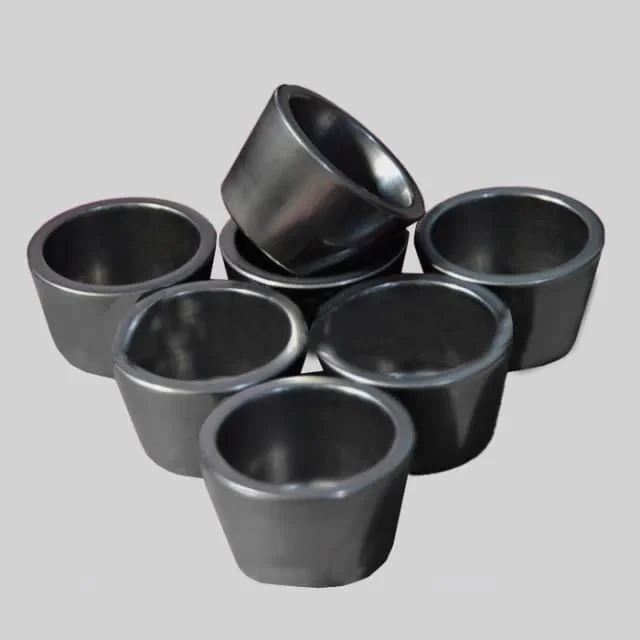
Thin Film Deposition Parts
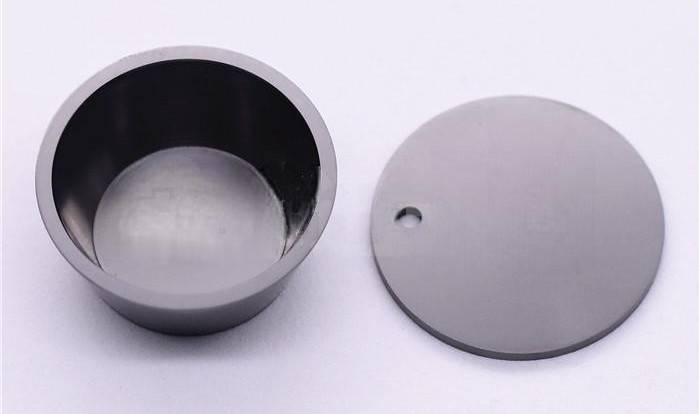
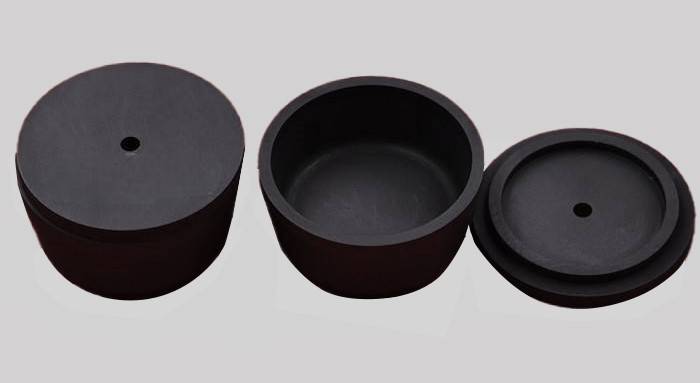
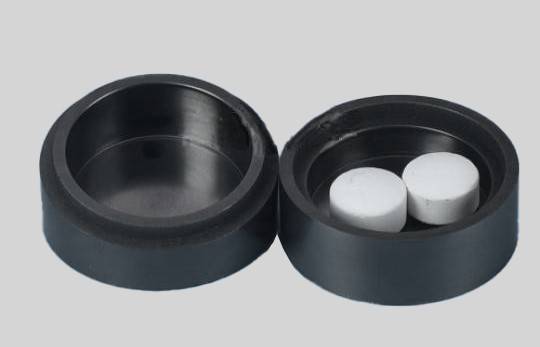
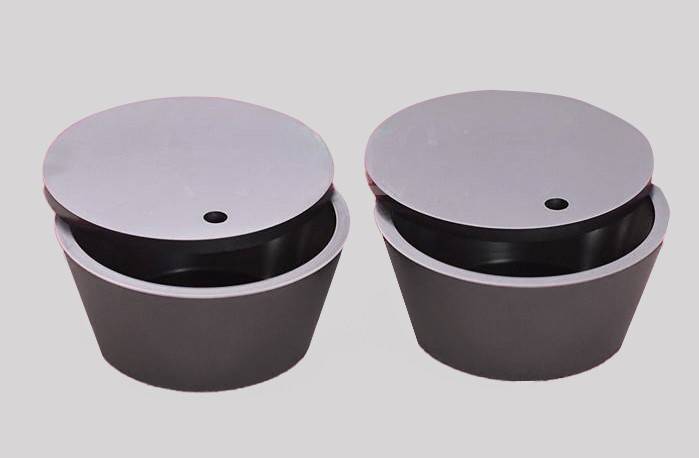
High Purity Pure Graphite Crucible for Electron Beam Evaporation
Item Number : KMS02
Price varies based on specs and customizations
- Material
- Graphite
- Specification
- Ф35-65*17-30mm
- cover
- optional

Shipping:
Contact us to get shipping details Enjoy On-time Dispatch Guarantee.
Why Choose Us
Easy ordering process, quality products, and dedicated support for your business success.
Applications
Electron beam evaporation graphite crucible is a technology that uses electron beams to create flexible and rough graphite films. Its key parameters include carbon source supply, electron beam irradiation energy, applied voltage, evaporation temperature, and evaporation time. The applied voltage modulates the adhesion between the graphite layer and the bottom layer of the crucible. To ensure a flat graphite layer, the flow rate and particle size of the carbon source feed should be controlled to achieve uniform deposition and evaporation.
In the field of power electronics, electron beam evaporation graphite crucible technology is widely used. It involves depositing a carbon source material using an electron beam to form a thin film of graphite. The graphite crucible manufactured by this process has low resistance, low corona and high yield strength. It is widely used in heat dissipation, withstand voltage manufacturing and testing of electronic equipment.
Detail & Parts
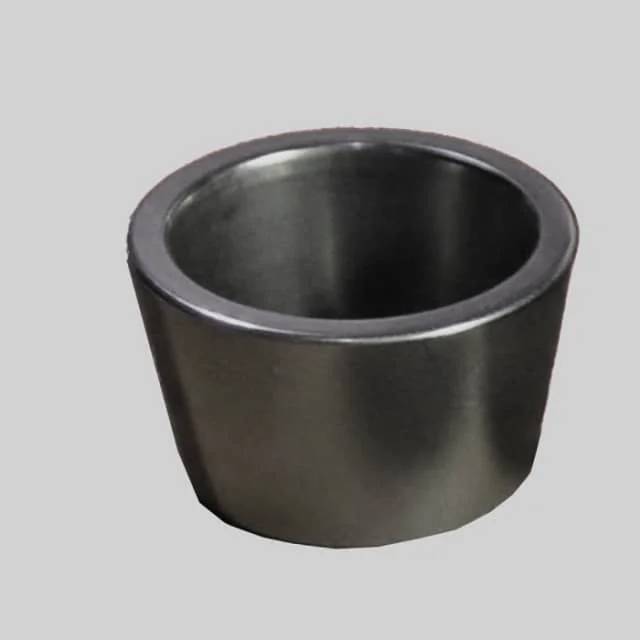
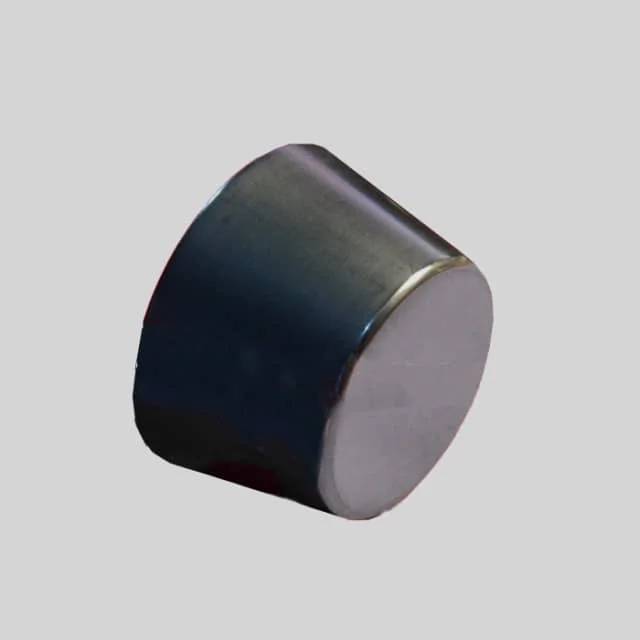
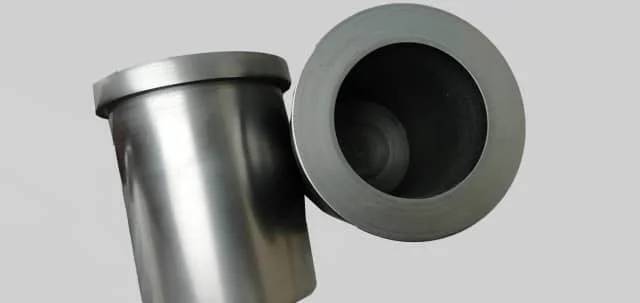
Technical specifications
| Graphite Crucible Dimensions | 35*17mm | 35*22mm | 40*20mm | 42.5*19.5mm | 45*22.5mm | 50*25mm | 65*30mm |
The crucibles we show are available in different sizes and custom sizes are available on request.
Advantage
- Preparation accuracy: Electron beam evaporation technology can precisely control the deposition process, resulting in high-precision and consistent graphite crucibles.
- Thermal shock resistance: Graphite films formed by electron beam evaporation have excellent thermal shock resistance and are suitable for applications with rapid temperature changes.
- Wear resistance: Electron beam evaporated graphite crucible has good wear resistance, making it durable and able to withstand harsh conditions.
- Chemical Resistance: These crucibles are resistant to acids, alkalis and chemical contamination, ensuring their reliability and longevity in chemically aggressive environments.
- Flexibility and roughness: The graphite film formed by this technique has a certain degree of flexibility and roughness, making it effective for various applications.
In conclusion, e-beam evaporated graphite crucibles have precise preparation, thermal shock resistance, abrasion resistance, chemical resistance, flexibility and roughness. They are widely used in power electronics, molecular binding testing, laser technology, batteries, high voltage capacitors and medical device applications.
Trusted by Industry Leaders
FAQ
What Are Thermal Evaporation Sources?
Comparison Of Electron Beam Evaporation Graphite Crucible Technology And Traditional Technology.
How Are High-purity Graphite Crucibles Made?
What Are The Main Types Of Thermal Evaporation Sources?
What Are The Common Applications Of High-purity Graphite Crucibles?
How Do Thermal Evaporation Sources Work?
What Are The Common Materials Used For Evaporating Crucibles?
What Factors Should Be Considered When Selecting High-purity Graphite Crucibles?
What Are The Advantages Of Using Thermal Evaporation Sources?
What Are The Advantages Of Using Evaporating Crucibles?
What Applications Are Thermal Evaporation Sources Used For?
How Should Evaporating Crucibles Be Handled And Maintained?
REQUEST A QUOTE
Our professional team will reply to you within one business day. Please feel free to contact us!
Related Products

High Purity Pure Graphite Crucible for Evaporation
Vessels for high temperature applications, where materials are kept at extremely high temperatures to evaporate, allowing thin films to be deposited on substrates.
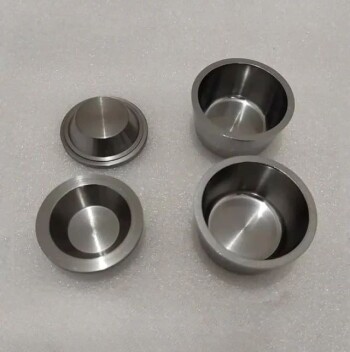
Electron Beam Evaporation Coating Tungsten Crucible and Molybdenum Crucible for High Temperature Applications
Tungsten and molybdenum crucibles are commonly used in electron beam evaporation processes due to their excellent thermal and mechanical properties.
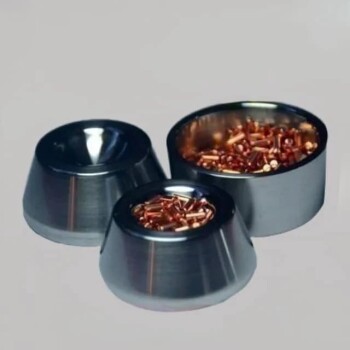
Electron Beam Evaporation Coating Gold Plating Tungsten Molybdenum Crucible for Evaporation
These crucibles act as containers for the gold material evaporated by the electron evaporation beam while precisely directing the electron beam for precise deposition.
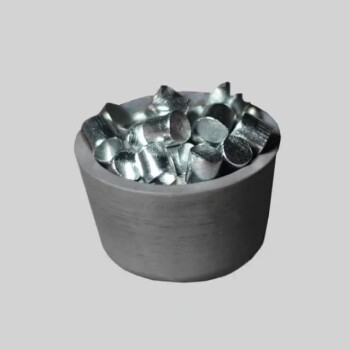
Electron Beam Evaporation Coating Conductive Boron Nitride Crucible BN Crucible
High-purity and smooth conductive boron nitride crucible for electron beam evaporation coating, with high temperature and thermal cycling performance.
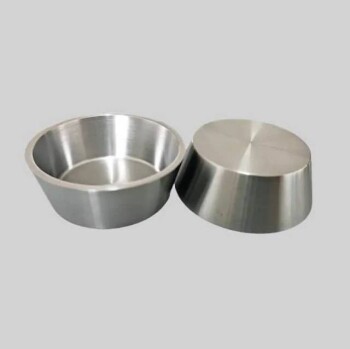
E Beam Crucibles Electron Gun Beam Crucible for Evaporation
In the context of electron gun beam evaporation, a crucible is a container or source holder used to contain and evaporate the material to be deposited onto a substrate.

Electron Beam Evaporation Coating Oxygen-Free Copper Crucible and Evaporation Boat
Electron Beam Evaporation Coating Oxygen-Free Copper Crucible enables precise co-deposition of various materials. Its controlled temperature and water-cooled design ensure pure and efficient thin film deposition.
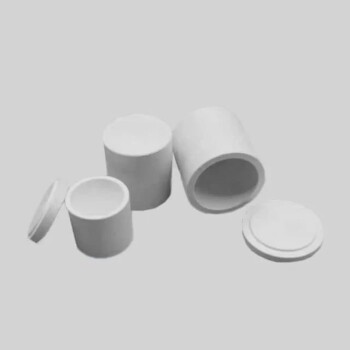
Evaporation Crucible for Organic Matter
An evaporation crucible for organic matter, referred to as an evaporation crucible, is a container for evaporating organic solvents in a laboratory environment.

Ceramic Evaporation Boat Set Alumina Crucible for Laboratory Use
It can be used for vapor deposition of various metals and alloys. Most metals can be evaporated completely without loss. Evaporation baskets are reusable.1

Molybdenum Tungsten Tantalum Evaporation Boat for High Temperature Applications
Evaporation boat sources are used in thermal evaporation systems and are suitable for depositing various metals, alloys and materials. Evaporation boat sources are available in different thicknesses of tungsten, tantalum and molybdenum to ensure compatibility with a variety of power sources. As a container, it is used for vacuum evaporation of materials. They can be used for thin film deposition of various materials, or designed to be compatible with techniques such as electron beam fabrication.

Carbon Graphite Boat -Laboratory Tube Furnace with Cover
Covered Carbon Graphite Boat Laboratory Tube Furnaces are specialized vessels or vessels made of graphite material designed to withstand extreme high temperatures and chemically aggressive environments.

Horizontal High Temperature Graphite Vacuum Graphitization Furnace
Horizontal Graphitization Furnace: This type of furnace is designed with the heating elements placed horizontally, allowing for uniform heating of the sample. It's well-suited for graphitizing large or bulky samples that require precise temperature control and uniformity.

Vertical High Temperature Graphite Vacuum Graphitization Furnace
Vertical high temperature graphitization furnace for carbonization and graphitization of carbon materials up to 3100℃.Suitable for shaped graphitization of carbon fiber filaments and other materials sintered in a carbon environment.Applications in metallurgy, electronics, and aerospace for producing high-quality graphite products like electrodes and crucibles.

Engineering Advanced Fine Ceramics Alumina Al2O3 Crucible With Lid Cylindrical Laboratory Crucible
Cylindrical Crucibles Cylindrical crucibles are one of the most common crucible shapes, suitable for melting and processing a wide variety of materials, and are easy to handle and clean.
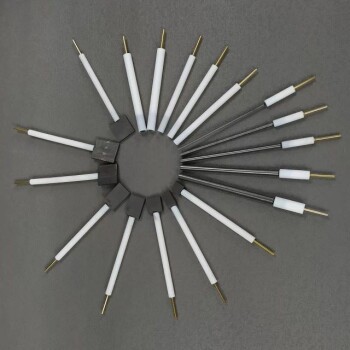
Graphite Disc Rod and Sheet Electrode Electrochemical Graphite Electrode
High-quality graphite electrodes for electrochemical experiments. Complete models with acid and alkali resistance, safety, durability, and customization options.

Ultra-High Temperature Graphite Vacuum Graphitization Furnace
The ultra-high temperature graphitization furnace utilizes medium frequency induction heating in a vacuum or inert gas environment. The induction coil generates an alternating magnetic field, inducing eddy currents in the graphite crucible, which heats up and radiates heat to the workpiece, bringing it to the desired temperature. This furnace is primarily used for graphitization and sintering of carbon materials, carbon fiber materials, and other composite materials.
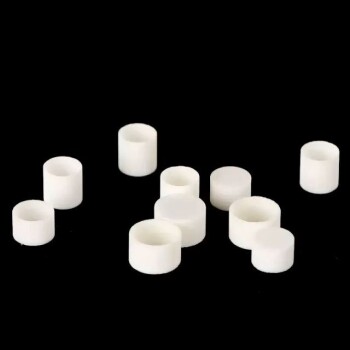
Engineering Advanced Fine Ceramics Alumina Crucibles (Al2O3) for Thermal Analysis TGA DTA
TGA/DTA thermal analysis vessels are made of aluminum oxide (corundum or aluminum oxide). It can withstand high temperature and is suitable for analyzing materials that require high temperature testing.
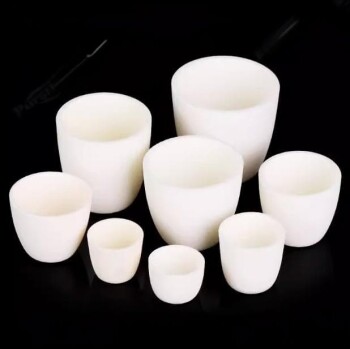
Arc-Shaped Alumina Ceramic Crucible High Temperature Resistant for Engineering Advanced Fine Ceramics
In the journey of scientific exploration and industrial production, every detail is crucial. Our arc-shaped alumina ceramic crucibles, with their excellent high temperature resistance and stable chemical properties, have become a powerful assistant in laboratories and industrial fields. They are made of high-purity alumina materials and manufactured through precision processes to ensure excellent performance in extreme environments.
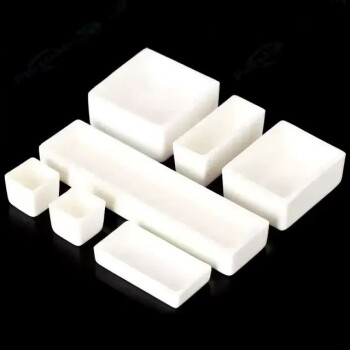
Engineering Advanced Fine Alumina Al2O3 Ceramic Crucible for Laboratory Muffle Furnace
Alumina ceramic crucibles are used in some materials and metal melting tools, and flat-bottomed crucibles are suitable for melting and processing larger batches of materials with better stability and uniformity.

Large Vertical Graphite Vacuum Graphitization Furnace
A large vertical high-temperature graphitization furnace is a type of industrial furnace used for the graphitization of carbon materials, such as carbon fiber and carbon black. It is a high-temperature furnace that can reach temperatures of up to 3100°C.

Evaporation Boat for Organic Matter
The evaporation boat for organic matter is an important tool for precise and uniform heating during the deposition of organic materials.
Related Articles
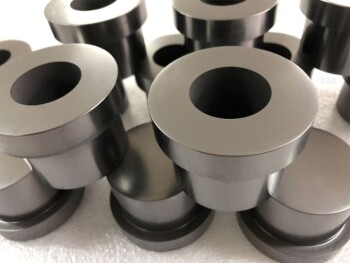
High Purity Graphite Crucible: Features, Production, and Usage
An in-depth look at high purity graphite crucibles, their production processes, and their industrial applications.
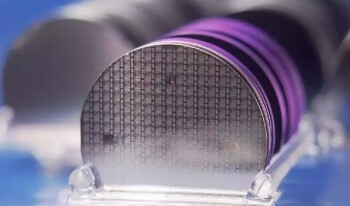
Graphite Crucible in the Future Production of Third Generation Semiconductor Compounds
Explores the role and future trends of graphite crucibles in the production of third-generation semiconductor materials.
Electron Beam Evaporation: Advanced Thin Film Creation
Explores the technology and applications of electron beam evaporation in thin film production.
The Role and Types of Crucibles in Scientific Experiments
Explores the significance and various types of crucibles in scientific experiments, focusing on their materials and applications.
Electron Beam Evaporation Coating Technology and Material Selection
An in-depth look at the principles and applications of electron beam evaporation coating technology, including material selection and various fields of application.
Electron Beam Evaporation Technology in Vacuum Coating
An in-depth look at electron beam evaporation, its types, advantages, and disadvantages in vacuum coating processes.
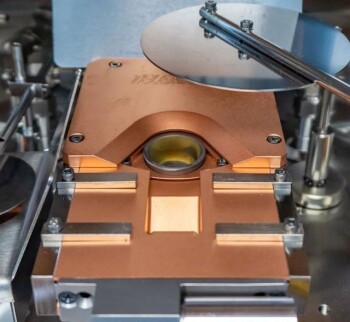
Electron Beam Evaporation Coating: Advantages, Disadvantages, and Applications
An in-depth look at the pros and cons of electron beam evaporation coating and its various applications in industries.
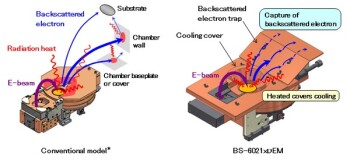
Electron Beam Evaporation Coating: Principles, Characteristics, and Applications
An in-depth analysis of electron beam evaporation coating technology, its advantages, disadvantages, and applications in thin film manufacturing.
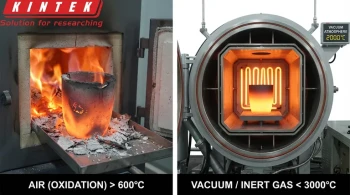
Why Your Graphite Components Keep Failing—And How to Stop It for Good
Graphite parts failing below their temp limit? We reveal the hidden cause (oxidation) and show you how to protect your experiments and budget.
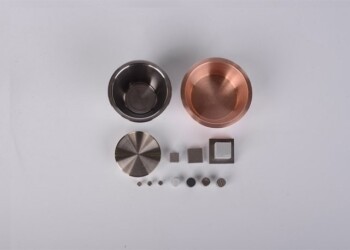
Types of Evaporation Sources for Evaporative Coating
Explore different evaporation sources used in thin film deposition, including filaments, crucibles, and evaporation boats.
Introduction to Various Ceramic Crucibles
An overview of different types of ceramic crucibles, their properties, and applications.
Alumina Crucibles in Precision Casting
Explores the use of alumina crucibles in precision casting, focusing on their properties and advantages in high-temperature alloy melting.