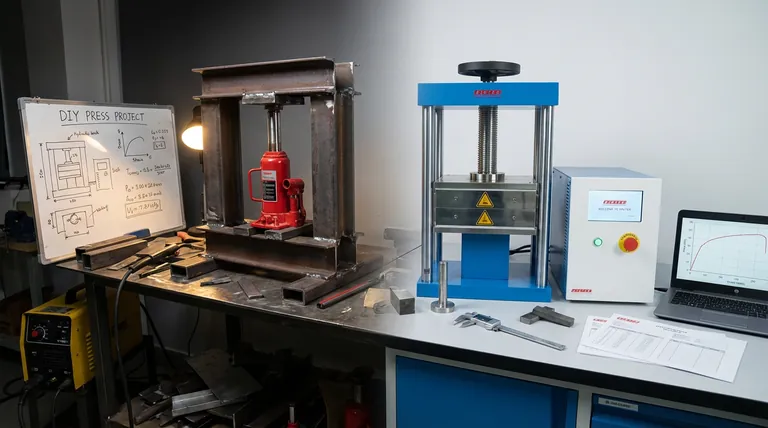
It’s a familiar scene in workshops and labs across the country: a manager, looking to save budget, sketches a plan on a whiteboard. "A few lengths of H-beam, a 20-ton bottle jack... we could build this ourselves and save thousands." The idea of a DIY hydraulic press seems like a straightforward, cost-effective solution. After all, how hard can it be to weld together some steel?
This is where the story often begins. Unfortunately, it's rarely where it ends well.
From Weekend Project to Workshop Nightmare: The Common Struggle
The initial enthusiasm for a DIY press project quickly collides with a series of frustrating and costly realities. The first trip to the steel supplier is a shock—the price of thick, structural steel is far higher than anticipated. Then comes the realization that the shop's standard welder isn't powerful enough for the deep, structural welds required for a high-tonnage frame. The project stalls.
What starts as a "quick weekend build" devolves into a months-long drain on time and resources. Even if the team pushes through and assembles a press, the problems are often just beginning. The frame visibly flexes under load. Bearings won't press in straight. And a quiet, nagging fear accompanies every operation: is this thing actually safe?
This isn't just an inconvenience; it has direct business consequences.
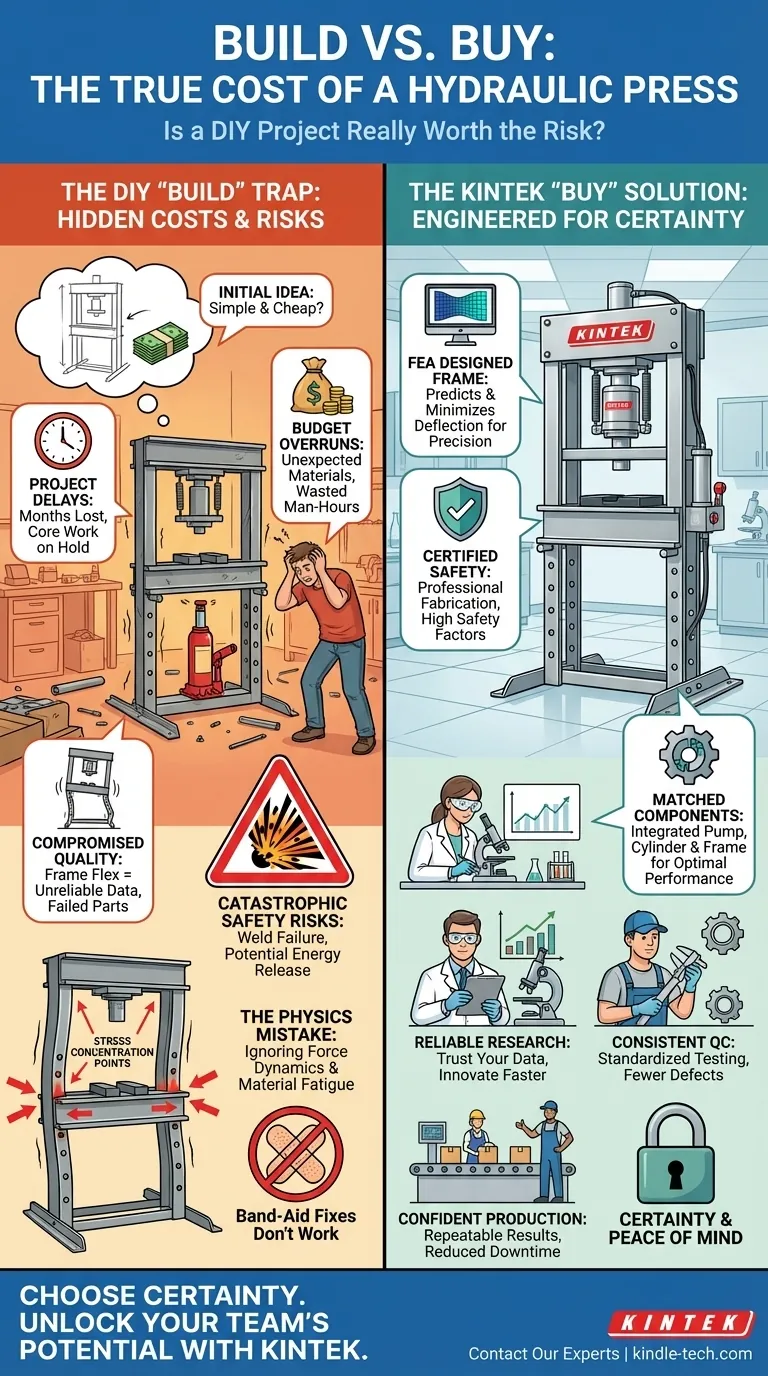
- Project Delays: The primary project that needed the press is now on hold, waiting for a tool that doesn't work as expected.
- Budget Overruns: The "savings" from a DIY build are eaten up by unexpected material costs, tool rentals, and, most significantly, the man-hours wasted on fabrication instead of core work.
- Compromised Quality: For a lab or production facility, a flexing, imprecise press means unreliable test data, failed parts, and inconsistent quality control.
- Catastrophic Safety Risks: This is the most critical consequence. An improperly designed or welded press frame isn't just weak; it's a vessel containing immense potential energy. A weld failure under load is not a crack, it's an explosion of metal.
So why does such a seemingly straightforward project go wrong so often? The answer lies not in a lack of effort, but in a fundamental misunderstanding of the problem.
Why 'Stronger' Isn't 'Smarter': The Physics Everyone Ignores
The core mistake is treating a hydraulic press as a simple assembly project rather than what it truly is: an engineered system for managing immense force.
The problem isn't just about making the frame "strong." The fundamental principle at play is material science and force dynamics. When you apply 20 tons of force, that energy doesn't just push down; it tries to tear the frame apart. The stress concentrates at specific points—welds, corners, and pinholes. Doubling the tonnage doesn't just require double the steel; the required strength against flexion and failure increases exponentially.
This is why the common "solutions" for a failing DIY press are ineffective:
- Adding more steel plates? This might add weight, but without proper engineering, it often fails to reinforce the critical stress points. It's like putting a band-aid on a structural flaw.
- Using a bigger bottle jack? This is incredibly dangerous. It puts forces on the frame that it was never designed to handle, dramatically increasing the risk of a catastrophic failure.
The DIY approach fails because it focuses on the visible components (steel beams, a jack) while ignoring the invisible but critical factor: engineered design that accounts for stress, strain, and material fatigue.
Engineered for Certainty: The Solution Embodied
To truly solve this problem, you don't need a better welder or a bigger pile of steel. You need a tool designed from the ground up by experts who understand the physics of force. You need a tool where safety and precision are not afterthoughts, but the core of its design.
This is the principle behind KINTEK's line of laboratory and industrial hydraulic presses. They are not merely assembled; they are engineered. Our presses are the physical embodiment of the solution to the root cause:
- The Problem of Frame Flex: Our frames are designed using Finite Element Analysis (FEA) software to predict and minimize deflection under load. This ensures that the force you apply goes exactly where you intend, delivering precise and repeatable results for material testing, sample preparation, or component assembly.
- The Problem of Safety: Our presses are built with certified materials and by professional fabricators who adhere to strict welding and assembly standards. They are designed with a safety factor that far exceeds their rated tonnage, providing certainty and peace of mind.
- The Problem of Mismatched Components: We provide a complete, integrated system. The hydraulic pump, cylinder, and frame are perfectly matched to work together for optimal performance, control, and longevity, eliminating the guesswork and risk of a piecemeal approach.
Choosing a KINTEK press isn't about "buying" instead of "building." It's about choosing certainty over chance, and precision engineering over hopeful guesswork.
Beyond the Fix: What Certainty Unlocks for Your Team
When you remove the uncertainty and risk of an unreliable tool, you unlock your team's true potential. Instead of spending time worrying about their equipment, they can focus on their actual goals.
- Research labs can trust their material compression data, leading to faster innovation and more reliable discoveries. No more second-guessing if a failed sample was due to the material itself or a wobbly press.
- Quality control departments can implement standardized, repeatable testing protocols, guaranteeing product consistency and reducing defects.
- Production workshops can press-fit bearings and assemble components with confidence, knowing each unit is made to the same exact specification, improving product reliability and reducing warranty claims.
Ultimately, a professionally engineered press frees you to do what you do best: innovate, test, and produce. You can take on more ambitious projects, explore more sensitive materials, and operate with a level of confidence that a DIY project could never provide.
Stop letting a "simple" tool become your biggest bottleneck. If your work demands reliability, precision, and absolute safety, it's time to equip your team with the professional-grade tools they deserve. Let's discuss the specific challenges of your project and find the right engineered solution to move your work forward with confidence. Contact Our Experts.
Visual Guide
Related Products
- Heated Hydraulic Press Machine with Heated Plates for Vacuum Box Laboratory Hot Press
- Automatic High Temperature Heated Hydraulic Press Machine with Heated Plates for Lab
- Manual High Temperature Heated Hydraulic Press Machine with Heated Plates for Lab
- Heated Hydraulic Press Machine with Integrated Manual Heated Plates for Lab Use
- 24T 30T 60T Heated Hydraulic Press Machine with Heated Plates for Laboratory Hot Press
Related Articles
- Why Your Composite and Polymer Parts Keep Failing: The Secret Is Simultaneous Heat and Pressure
- The Physics of Flawless Materials: Deconstructing the Hydraulic Hot Press
- Hydraulic Hot Press: Principles, Components, Features, Advantages, and Applications
- More Than a Squeeze: The Physics and Psychology of the Hydraulic Hot Press
- Comprehensive Guide to Hydraulic Hot Press: Function, Features and Applications



















