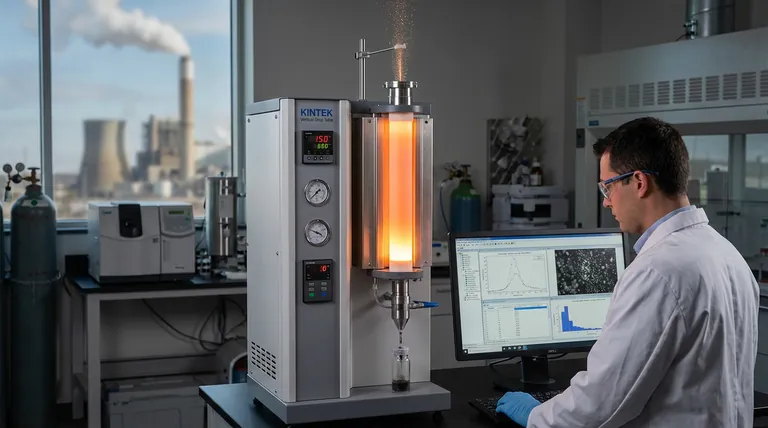
The Illusion of Control in a Black Box
Imagine a power plant's combustion chamber. It's a colossal, chaotic inferno, processing tons of pulverized coal or biomass every hour.
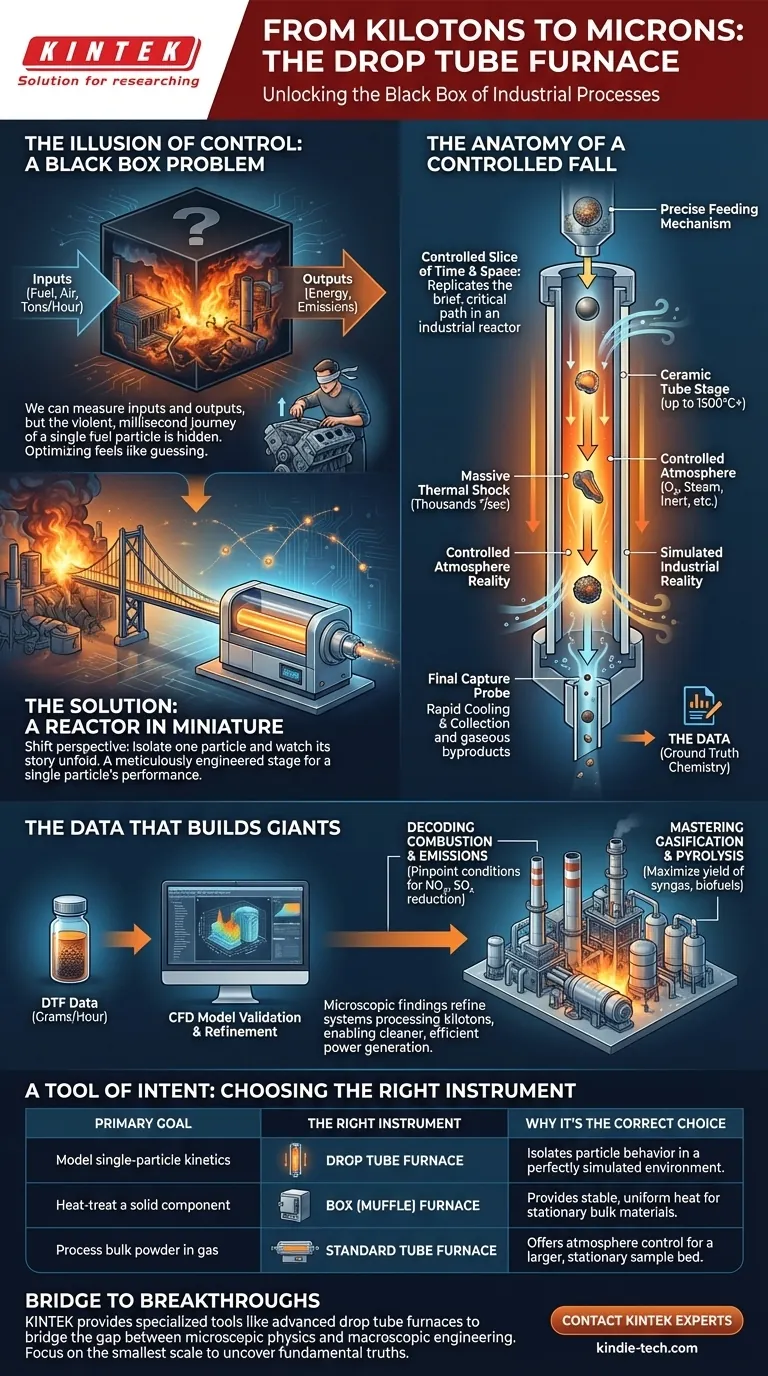
Engineers can measure the inputs (fuel, air) and the outputs (energy, emissions). But the process inside—the violent, millisecond-long journey of a single fuel particle—is a black box. Optimizing this system feels like trying to tune a car engine while blindfolded. You can make adjustments, but you're guessing at the fundamental mechanics.
This is a classic problem of scale. Our minds struggle to connect the behavior of a massive, complex system to the simple physical laws governing its smallest components. We fall for the illusion of control, tweaking macro-level variables while the real secrets to efficiency and cleanliness lie hidden at the micron level.
To truly master the system, you have to change your perspective. You have to isolate one particle and watch its story unfold.
Creating a Reactor in Miniature
You cannot place a sensor on a single speck of coal inside an 1800°C boiler. The environment is too hostile, the events too fast.
So, you do the next best thing: you perfectly replicate that environment on a tiny, observable scale. This is the entire philosophy behind the drop tube furnace (DTF). It isn't just a heater; it's a meticulously engineered stage for a single particle's performance.
It's a deliberate shift from observing the chaotic crowd to interviewing a single actor.
The Anatomy of a Controlled Fall
The genius of a drop tube furnace lies in its elegant simplicity, designed to answer one question: what happens to a particle when subjected to extreme, instantaneous heat in a specific atmosphere?
The Vertical Stage
At its heart is a long, vertical ceramic tube, heated to temperatures that can exceed 1500°C. This tube isn't a container in the traditional sense. It's a controlled slice of time and space, representing the brief, critical path a particle travels within an industrial reactor.
A Crucible of a Few Seconds
A precise feeding mechanism at the top introduces a fine, steady stream of particles. As they fall, they experience a massive thermal shock, heating up at thousands of degrees per second. This mimics the instant they are blasted into a boiler.
Crucially, the gas environment inside the tube is not air; it is whatever the researcher wants it to be. Pure oxygen to study intense combustion, steam for gasification, or an inert gas for pyrolysis. For a few short seconds, the particle lives through a simulated industrial reality.
The Final Capture
At the bottom, a probe rapidly cools and collects the particle remnants and gaseous byproducts. This captured material is the "data." It tells the story of the particle's transformation, providing the irrefutable physical evidence needed to understand the chemistry.
The Data That Builds Giants
This microscopic data has a massive impact. A drop tube furnace is an analytical instrument, processing only grams per hour, but its findings are used to design and refine systems that process kilotons.
The data it generates is the ground truth used to build and validate the powerful computational fluid dynamics (CFD) models that are the bedrock of modern industrial design.
Decoding Combustion and Emissions
By studying how individual fuel particles ignite and burn, researchers can pinpoint the exact conditions that lead to the formation of pollutants like NOx and SOx. This knowledge allows engineers to redesign burners and optimize air-fuel mixtures, leading to cleaner and more efficient power generation.
Mastering Gasification and Pyrolysis
For next-generation energy systems, like turning waste biomass into valuable synthesis gas (syngas) or biofuels, the DTF is indispensable. It helps determine the ideal temperatures, pressures, and atmospheric compositions to maximize the yield of desired products, moving these technologies from the lab to industrial viability.
A Tool of Intent, Not Convenience
The power of a drop tube furnace comes from its specificity. It is not a general-purpose tool, and confusing its function is a common pitfall. It is an instrument of deep inquiry, not bulk production.
Its operational complexity is high because its purpose is precision. Choosing this furnace is a statement of intent: you are committed to understanding the fundamental kinetics of your process.
If your goal is different, your tool must be as well.
| Your Primary Goal | The Right Instrument | Why It's the Correct Choice |
|---|---|---|
| Model single-particle kinetics | Drop Tube Furnace | Isolates particle behavior in a perfectly simulated environment. |
| Heat-treat a solid component | Box (Muffle) Furnace | Provides stable, uniform heat for stationary bulk materials. |
| Process bulk powder in a controlled gas environment | Standard Tube Furnace | Offers atmosphere control for a larger, stationary sample bed. |
To make breakthroughs in large-scale energy and material processes, we must first have the courage to focus on the smallest scale. The drop tube furnace is more than just lab equipment; it is a bridge between the microscopic world of physics and the macroscopic world of industrial engineering.
At KINTEK, we provide the specialized tools, like advanced drop tube furnaces, that enable researchers to build that bridge. If you're ready to move beyond the black box and uncover the fundamental truths of your process, we can help you specify the right system for your research. Contact Our Experts
Visual Guide
Related Products
- Rotary Tube Furnace Split Multi Heating Zone Rotating Tube Furnace
- Vacuum Sealed Continuous Working Rotary Tube Furnace Rotating Tube Furnace
- Laboratory Vacuum Tilt Rotary Tube Furnace Rotating Tube Furnace
- 1200℃ Split Tube Furnace with Quartz Tube Laboratory Tubular Furnace
- 1700℃ Laboratory High Temperature Tube Furnace with Alumina Tube
Related Articles
- The Geometry of Heat: Why Motion Matters in Material Synthesis
- The Geometry of Heat: Engineering the Perfect Thermal Environment
- Exploring the Functions and Advantages of Rotary Tube Furnaces
- Exploring Rotary Tube Furnaces: A Comprehensive Guide
- Exploring the Advantages of Rotary Tube Furnaces in Industrial and Laboratory Applications



















