The Anatomy of a Failed Experiment
Imagine this: weeks of careful sample preparation, a flawless loading procedure, and a multi-hour heating cycle running overnight. You return to the lab expecting pristine results, only to find a spiderweb of cracks running down the furnace tube. The sample is contaminated, the vacuum is lost, and the work is ruined.
This isn't a failure of chemistry or physics. It's a failure of architecture.
The furnace tube is not merely a container. It is the controlled universe where your experiment lives or dies. Its walls dictate the maximum temperature, the purity of the atmosphere, and the stability of the entire system.
The most common mistake in selecting one is a psychological one: we search for the "best" material. But in thermal processing, there is no "best." There is only the right fit for a specific task, born from a series of deliberate, critical trade-offs.
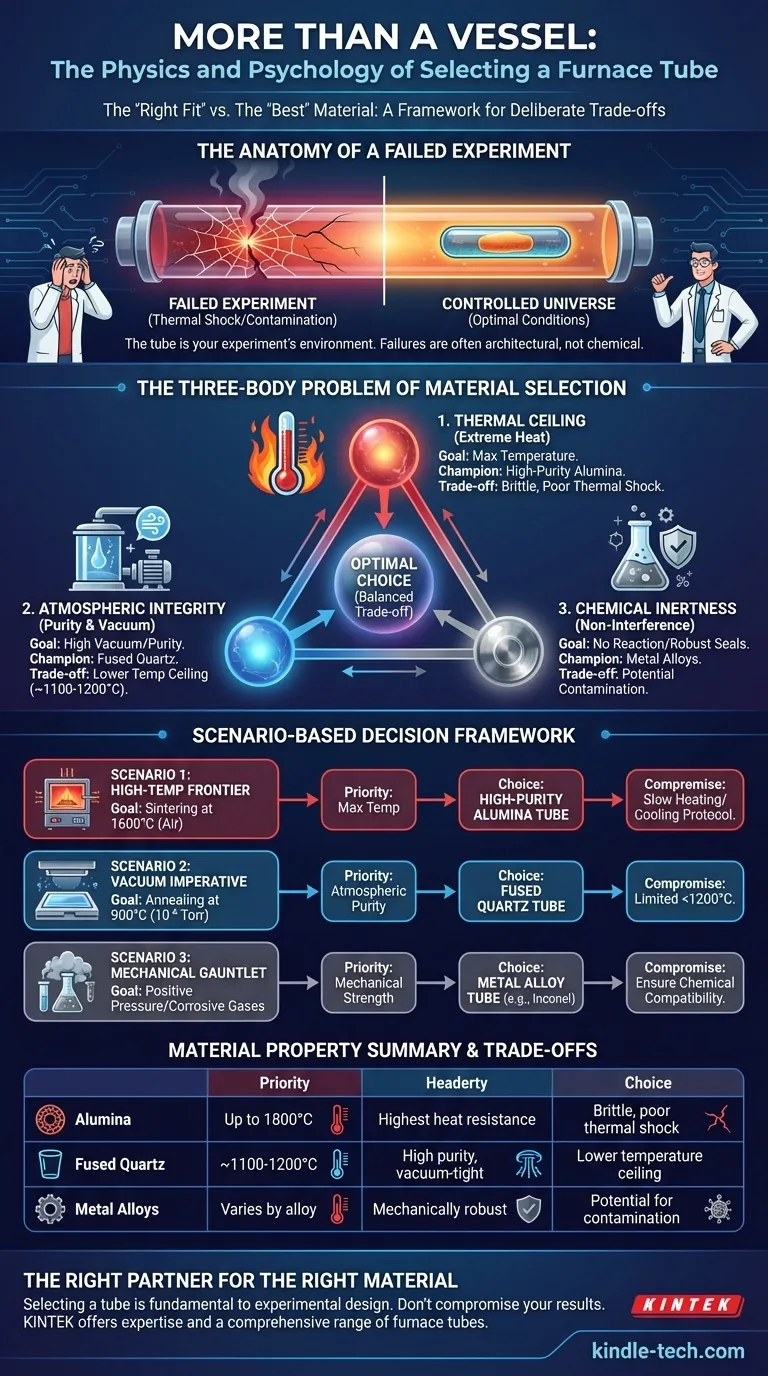
The Three-Body Problem of Material Selection
Choosing a tube material is a balancing act between three competing priorities. Like the classic physics problem, each factor exerts a gravitational pull on the others. Optimize for one, and you inherently compromise on another.
1. The Thermal Ceiling: A Quest for Extreme Heat
For many applications, like sintering advanced ceramics or growing crystals, the goal is simple: get as hot as possible.
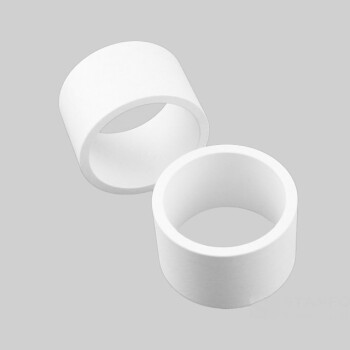
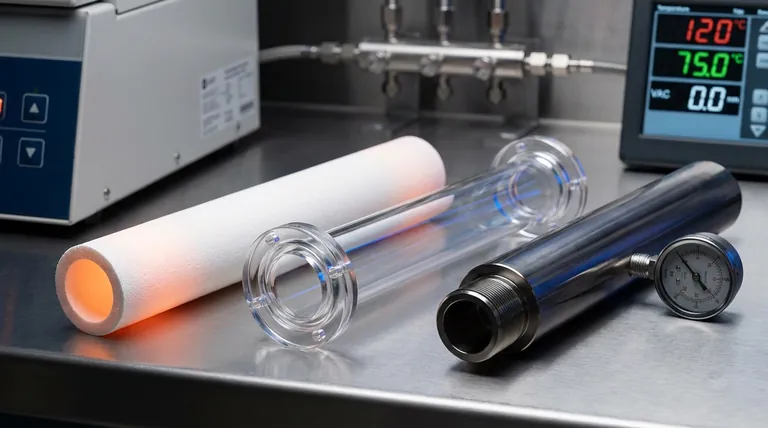
High-purity alumina is the undisputed champion here. This robust ceramic can operate reliably at temperatures up to 1700°C or even 1800°C. It is the workhorse for processing in air or inert atmospheres.
But its strength is also its weakness. Alumina is brittle. It despises rapid temperature changes—a phenomenon known as thermal shock. Heat it too fast or cool it too quickly, and its internal stresses will tear it apart. To reach its thermal ceiling, you must sacrifice speed and flexibility.
2. Atmospheric Integrity: The Mandate for Purity
For other processes, like annealing semiconductors or creating nanomaterials, the atmosphere is paramount. The enemy is contamination, and the ideal state is a perfect, high-grade vacuum.
Here, fused quartz and metal alloys excel. Their non-porous structures are essential for creating a hermetic seal, allowing you to pull a deep vacuum and hold it for hours. Quartz, a high-purity glass, offers the added benefit of transparency, letting you watch your process unfold—a crucial advantage in research and development.
The trade-off? A lower temperature limit. Quartz typically maxes out around 1100-1200°C. Above that, it begins to soften and devitrify.
3. Chemical Inertness: A Vow of Non-Interference
The tube's final duty is to be a silent, impartial observer. It cannot react with the sample, the process gases, or any byproducts.
- Quartz offers exceptional purity, but it's not universally inert. It can be attacked by alkali metals and other specific reagents at high temperatures.
- Alumina is highly stable but can be less pure than quartz and its slight porosity makes it unsuitable for high-vacuum work without specialized designs.
- Metal alloys like Inconel or stainless steel provide incredible mechanical strength and resistance to specific corrosive agents. However, they can introduce subtle metallic contamination unless properly shielded with an inner liner.
A Framework for Deliberate Trade-offs
Your process defines your priority. Once you know what matters most, the choice becomes a logical conclusion rather than a guess.
Scenario 1: The High-Temperature Frontier
- Goal: Sintering zirconia ceramics at 1600°C in an air atmosphere.
- Priority: Maximum Temperature.
- Choice: High-Purity Alumina Tube.
- The Compromise: You accept the risk of thermal shock and design a slow, controlled heating and cooling protocol.
Scenario 2: The Vacuum Imperative
- Goal: Annealing a sensitive thin film at 900°C under a 10⁻⁶ Torr vacuum.
- Priority: Atmospheric Purity & Vacuum Integrity.
- Choice: Fused Quartz Tube.
- The Compromise: You are limited to temperatures well below 1200°C.
Scenario 3: The Mechanical Gauntlet
- Goal: A process involving positive pressure or corrosive gases that demands robust seals and physical durability.
- Priority: Mechanical Strength & Chemical Resistance.
- Choice: Inconel or Stainless Steel Alloy Tube.
- The Compromise: You must account for potential metallic interactions and ensure the alloy is compatible with your specific chemical environment.
| Material | Max Temperature | Key Strength | Inherent Trade-Off |
|---|---|---|---|
| Alumina | Up to 1800°C | Highest heat resistance | Brittle, poor thermal shock |
| Fused Quartz | ~1100-1200°C | High purity, vacuum-tight | Lower temperature ceiling |
| Metal Alloys | Varies by alloy | Mechanically robust | Potential for contamination |
The Right Partner for the Right Material
This intricate dance of properties shows that selecting a furnace tube is not a simple line item on a purchase order. It is a fundamental part of your experimental design. A mistake made here can invalidate countless hours of work.
That is why having the right components is only half the battle. You need a partner who understands the nuances of these trade-offs. At KINTEK, we supply a comprehensive range of high-quality furnace tubes—from alumina and quartz to specialized metal alloys—but our real value lies in the expertise that comes with them. We help you navigate these critical decisions to ensure the architecture of your experiment is sound from the very beginning.
To ensure your results are built on a foundation of material integrity, Contact Our Experts
Visual Guide
Related Products
- High Temperature Alumina (Al2O3) Furnace Tube for Engineering Advanced Fine Ceramics
- Rotary Tube Furnace Split Multi Heating Zone Rotating Tube Furnace
- 1400℃ Laboratory High Temperature Tube Furnace with Alumina Tube
- Laboratory Vacuum Tilt Rotary Tube Furnace Rotating Tube Furnace
- 1700℃ Laboratory High Temperature Tube Furnace with Alumina Tube
Related Articles
- Beyond the Acid Wash: A Systems Approach to Alumina Tube Longevity
- The Unseen Discipline: Mastering the Alumina Furnace Tube
- Entropy and the Alumina Tube: The Art of Precision Maintenance
- The Ceramic Paradox: Why the Best Way to Clean an Alumina Tube is Not to Clean It
- The Geometry of Heat: Why Your Furnace Tube Material Dictates Your Science