Blog The Architecture of Heat: Aligning Engineering Precision with Laboratory Reality
The Architecture of Heat: Aligning Engineering Precision with Laboratory Reality

The Architecture of Heat: Aligning Engineering Precision with Laboratory Reality

11 hours ago

Buying laboratory equipment is rarely just a financial transaction. It is an operational bet on the quality of your future data.

When selecting a tube furnace, there is a temptation to shop for the "best" model—the one with the highest maximum temperature or the most complex control system. This is a mistake.

In the laboratory, "best" is a meaningless metric. "Aligned" is what matters.

A furnace is not a standalone artifact; it is a component in a larger system of synthesis, heat treatment, or testing. To choose the right one, you must ignore the marketing brochures for a moment and look strictly at the non-negotiable physics of your specific application.

Here is how to deconstruct the decision.

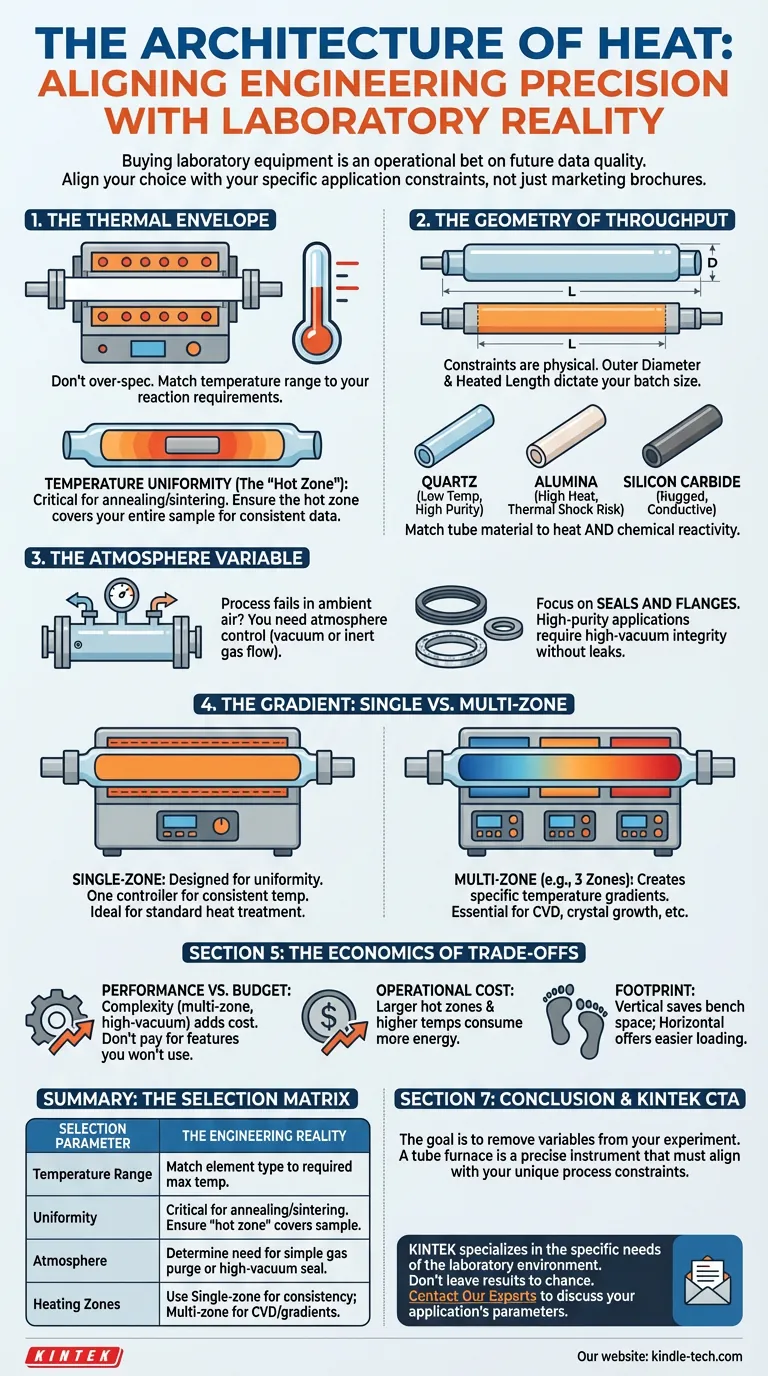
1. The Thermal Envelope

The most obvious specification is often the most misunderstood. You know the temperature your reaction requires. But a furnace rated for 1700°C is vastly different—and significantly more expensive—than one rated for 1200°C.

The engineering challenge here isn't just hitting a number; it is repeatability.

Temperature Uniformity is the silent partner of successful experimentation. In annealing or sintering, a variation of even a few degrees across the tube can alter the crystalline structure of your sample. You aren't paying for heat; you are paying for consistency.

Ensure the heating elements are capable of maintaining a uniform "hot zone" that covers the entire length of your sample.

2. The Geometry of Throughput

In systems engineering, constraints are usually physical. In a tube furnace, the constraint is the tube itself.

The Outer Diameter and Heated Length dictate your throughput. A larger diameter allows for larger batches, but it changes the thermal dynamics.

Furthermore, the material of the tube is a critical interface.

  • Quartz: Excellent for lower temperatures and high purity.
  • Alumina: Essential for high heat but susceptible to thermal shock.
  • Silicon Carbide: Rugged and conductive.

You must match the tube material not just to the heat, but to the chemical reactivity of your samples.

3. The Atmosphere Variable

Many modern materials science processes fail in ambient air. Oxygen is often the enemy.

If your process requires oxidation-sensitive handling, the furnace becomes a vessel for atmosphere control. You are no longer just managing heat; you are managing a vacuum or a flow of inert gas.

This requires a shift in focus to the seals and flanges. A furnace intended for high-purity applications must be capable of sustaining a high vacuum without leak rates that compromise the sample integrity.

4. The Gradient: Single vs. Multi-Zone

This is where the application strictly dictates the hardware.

Single-Zone Furnaces are designed for uniformity. They have one controller and one goal: keep the entire tube at $X$ degrees. This is the workhorse for standard heat treatment.

Multi-Zone Furnaces (typically three zones) are instruments of nuance. With independent controllers, you can create a specific temperature gradient across the tube.

If you are doing Chemical Vapor Deposition (CVD) or crystal growth, a single-zone furnace is useless. You need the ability to manipulate thermal profiles to drive deposition at specific rates.

The Economics of Trade-offs

Every engineering decision involves a trade-off. In furnace selection, the trade-off is usually between flexibility and efficiency.

  • Performance vs. Budget: High-vacuum compatibility and multi-zone control add complexity and cost. Do not pay for a temperature gradient you will never use.
  • Operational Cost: Larger hot zones and higher temperatures consume exponentially more energy.
  • Footprint: Vertical furnaces save bench space; horizontal furnaces offer easier loading.

Summary: The Selection Matrix

To simplify the decision, map your needs against this framework:

Selection Parameter The Engineering Reality
Temperature Range Don't over-spec. Match the element type to your required max temp.
Uniformity Critical for annealing/sintering. Ensuring the "hot zone" covers the sample.
Atmosphere Determine if you need a simple gas purge or a high-vacuum seal.
Heating Zones Use Single-zone for consistency; Multi-zone for CVD/gradients.

Conclusion

The goal is not to buy a machine. The goal is to remove variables from your experiment.

If your furnace is too small, you create a bottleneck. If the temperature fluctuates, you create noise in your data. If the seals leak, you create contamination.

At KINTEK, we specialize in the specific needs of the laboratory environment. We understand that a tube furnace is a precise instrument that must align with your unique process constraints.

Don't leave your results to chance. Contact Our Experts to discuss your application's parameters, and let us help you engineer the perfect thermal solution.

Visual Guide
The Architecture of Heat: Aligning Engineering Precision with Laboratory Reality Visual Guide

Related Products

Related Articles

Related Products

1700℃ Laboratory Quartz Tube Furnace with Alumina Tube Tubular Furnace

1700℃ Laboratory Quartz Tube Furnace with Alumina Tube Tubular Furnace

Looking for a high-temperature tube furnace? Check out our 1700℃ Tube Furnace with Alumina Tube. Perfect for research and industrial applications up to 1700C.

1200℃ Split Tube Furnace with Quartz Tube Laboratory Tubular Furnace

1200℃ Split Tube Furnace with Quartz Tube Laboratory Tubular Furnace

KT-TF12 split tube furnace: high-purity insulation, embedded heating wire coils, and max. 1200C. Widely used for new materials and chemical vapour deposition.

Laboratory Quartz Tube Furnace Tubular RTP Heating Furnace

Laboratory Quartz Tube Furnace Tubular RTP Heating Furnace

Get lightning-fast heating with our RTP Rapid Heating Tube Furnace. Designed for precise, high-speed heating and cooling with convenient sliding rail and TFT touch screen controller. Order now for ideal thermal processing!

Laboratory Vacuum Tilt Rotary Tube Furnace Rotating Tube Furnace

Laboratory Vacuum Tilt Rotary Tube Furnace Rotating Tube Furnace

Discover the versatility of Laboratory Rotary Furnace: Ideal for calcination, drying, sintering, and high-temperature reactions. Adjustable rotating and tilting functions for optimal heating. Suitable for vacuum and controlled atmosphere environments. Learn more now!

Vacuum Heat Treat and Molybdenum Wire Sintering Furnace for Vacuum Sintering

Vacuum Heat Treat and Molybdenum Wire Sintering Furnace for Vacuum Sintering

A vacuum molybdenum wire sintering furnace is a vertical or bedroom structure, which is suitable for withdrawal, brazing, sintering and degassing of metal materials under high vacuum and high temperature conditions. It is also suitable for dehydroxylation treatment of quartz materials.

Vacuum Heat Treat and Sintering Furnace with 9MPa Air Pressure

Vacuum Heat Treat and Sintering Furnace with 9MPa Air Pressure

The air pressure sintering furnace is a high-tech equipment commonly used for the sintering of advanced ceramic materials. It combines vacuum sintering and pressure sintering techniques to achieve high-density and high-strength ceramics.

600T Vacuum Induction Hot Press Furnace for Heat Treat and Sintering

600T Vacuum Induction Hot Press Furnace for Heat Treat and Sintering

Discover the 600T Vacuum Induction Hot Press Furnace, designed for high-temperature sintering experiments in vacuum or protected atmospheres. Its precise temperature and pressure control, adjustable working pressure, and advanced safety features make it ideal for nonmetal materials, carbon composites, ceramics, and metal powders.

1700℃ Muffle Oven Furnace for Laboratory

1700℃ Muffle Oven Furnace for Laboratory

Get superior heat control with our 1700℃ Muffle Furnace. Equipped with intelligent temperature microprocessor, TFT touch screen controller & advanced insulation materials for precise heating up to 1700C. Order now!

Graphite Vacuum Furnace Bottom Discharge Graphitization Furnace for Carbon Materials

Graphite Vacuum Furnace Bottom Discharge Graphitization Furnace for Carbon Materials

Bottom-out graphitization furnace for carbon materials, ultra-high temperature furnace up to 3100°C, suitable for graphitization and sintering of carbon rods and carbon blocks. Vertical design, bottom discharging, convenient feeding and discharging, high temperature uniformity, low energy consumption, good stability, hydraulic lifting system, convenient loading and unloading.

Vacuum Heat Treat Sintering Brazing Furnace

Vacuum Heat Treat Sintering Brazing Furnace

A vacuum brazing furnace is a type of industrial furnace used for brazing, a metalworking process that joins two pieces of metal using a filler metal that melts at a lower temperature than the base metals. Vacuum brazing furnaces are typically used for high-quality applications where a strong, clean joint is required.

1800℃ Muffle Oven Furnace for Laboratory

1800℃ Muffle Oven Furnace for Laboratory

KT-18 muffle furnace with Japan Al2O3 polycrystalline fibe and Silicon Molybdenum heating element, up to 1900℃, PID temperature control and 7" smart touch screen. Compact design, low heat loss, and high energy efficiency. Safety interlock system and versatile functions.

1700℃ Controlled Atmosphere Furnace Nitrogen Inert Atmosphere Furnace

1700℃ Controlled Atmosphere Furnace Nitrogen Inert Atmosphere Furnace

KT-17A Controlled atmosphere furnace: 1700℃ heating, vacuum sealing technology, PID temperature control, and versatile TFT smart touch screen controller for laboratory and industrial use.

Vacuum Dental Porcelain Sintering Furnace

Vacuum Dental Porcelain Sintering Furnace

Get precise and reliable results with KinTek's Vacuum Porcelain Furnace. Suitable for all porcelain powders, it features hyperbolic ceramic furnace function, voice prompt, and automatic temperature calibration.

Vacuum Heat Treat Furnace with Ceramic Fiber Liner

Vacuum Heat Treat Furnace with Ceramic Fiber Liner

Vacuum furnace with polycrystalline ceramic fiber insulation liner for excellent heat insulation and uniform temperature field. Choose from 1200℃ or 1700℃ max. working temperature with high vacuum performance and precise temperature control.

Vacuum Hot Press Furnace Heated Vacuum Press Machine Tube Furnace

Vacuum Hot Press Furnace Heated Vacuum Press Machine Tube Furnace

Reduce forming pressure & shorten sintering time with Vacuum Tube Hot Press Furnace for high-density, fine-grain materials. Ideal for refractory metals.

1400℃ Muffle Oven Furnace for Laboratory

1400℃ Muffle Oven Furnace for Laboratory

Get precise high-temperature control up to 1500℃ with KT-14M Muffle furnace. Equipped with a smart touch screen controller and advanced insulation materials.

Molybdenum Vacuum Heat Treat Furnace

Molybdenum Vacuum Heat Treat Furnace

Discover the benefits of a high-configuration molybdenum vacuum furnace with heat shield insulation. Ideal for high-purity, vacuum environments like sapphire crystal growth and heat treatment.

Graphite Vacuum Furnace High Thermal Conductivity Film Graphitization Furnace

Graphite Vacuum Furnace High Thermal Conductivity Film Graphitization Furnace

The high thermal conductivity film graphitization furnace has uniform temperature, low energy consumption and can operate continuously.

Horizontal High Temperature Graphite Vacuum Graphitization Furnace

Horizontal High Temperature Graphite Vacuum Graphitization Furnace

Horizontal Graphitization Furnace: This type of furnace is designed with the heating elements placed horizontally, allowing for uniform heating of the sample. It's well-suited for graphitizing large or bulky samples that require precise temperature control and uniformity.

Vertical High Temperature Graphite Vacuum Graphitization Furnace

Vertical High Temperature Graphite Vacuum Graphitization Furnace

Vertical high temperature graphitization furnace for carbonization and graphitization of carbon materials up to 3100℃.Suitable for shaped graphitization of carbon fiber filaments and other materials sintered in a carbon environment.Applications in metallurgy, electronics, and aerospace for producing high-quality graphite products like electrodes and crucibles.


Leave Your Message



















