Blog The Art of Absence: Why the Best Metallurgy Happens in a Void
The Art of Absence: Why the Best Metallurgy Happens in a Void

The Art of Absence: Why the Best Metallurgy Happens in a Void

4 hours ago

We tend to view fire as a chaotic force. It consumes. It chars. It alters.

In the world of advanced materials science, however, chaos is a liability. When you are hardening a turbine blade or brazing a critical aerospace component, you cannot afford the unpredictability of the open air.

This is where the vacuum furnace enters the equation.

It is not merely a specialized oven. It is a philosophy of control. By removing the atmosphere, we remove the variables. By creating a void, we create perfection.

Here is how the absence of air creates the strongest materials on earth.

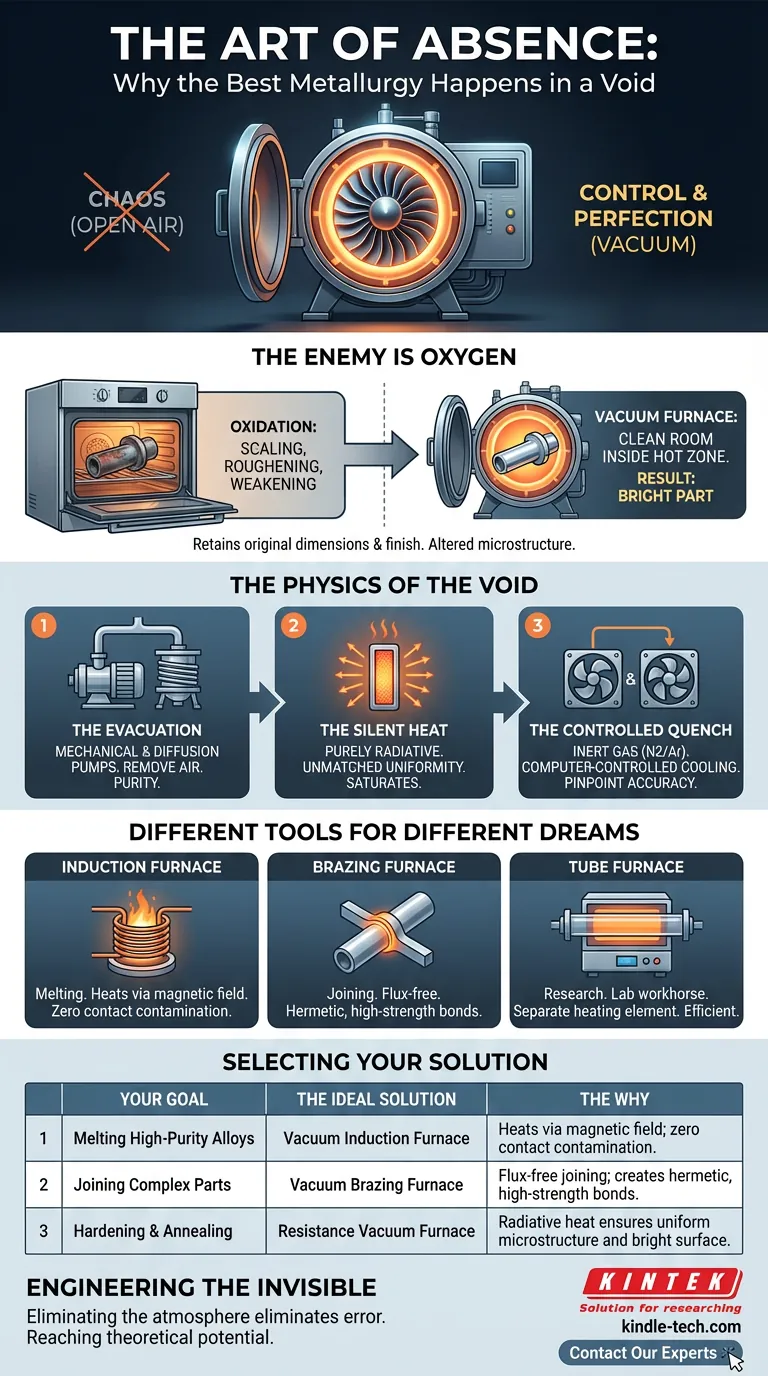
The Enemy is Oxygen

To understand the furnace, you have to understand the psychology of the metal.

At high temperatures, metals are desperate to react. They want to bond with oxygen, nitrogen, and water vapor. In a standard oven, this results in oxidation—a scaling, roughening, and weakening of the surface.

For high-precision parts, this is unacceptable.

The vacuum furnace solves this by effectively creating a "clean room" inside a hot zone. By pumping out the air, we strip away the ability for the metal to react.

The result is not just a hot part; it is a bright part.

When a component leaves a vacuum furnace, it retains its original dimensions and surface finish. It emerges as clean as it went in, but with a fundamentally altered microstructure.

The Physics of the Void

The process of vacuum heat treatment is a study in precise, almost surgical stages. It is less about "baking" and more about managing an environment.

1. The Evacuation

The door seals. The noise begins.

First, mechanical pumps perform the heavy lifting, removing the bulk of the atmosphere. Then, diffusion or turbomolecular pumps take over, hunting down the remaining molecules to achieve a high vacuum.

This isn't just about emptiness; it's about purity.

2. The Silent Heat

In a vacuum, there is no air to carry heat. Convection is impossible.

Heating becomes purely radiative. Energy travels directly from graphite or molybdenum heating elements to the workpiece. This allows for unmatched uniformity. The heat doesn't swirl; it saturates.

3. The Controlled Quench

Once the metal has soaked at temperature, the structure is set. Now, it must be locked in.

The chamber is backfilled with inert gas—usually nitrogen or argon. High-speed fans circulate this gas through heat exchangers.

Because the gas injection is computer-controlled, engineers can dictate the cooling rate with pinpoint accuracy, determining exactly how hard or ductile the final material will be.

Different Tools for Different Dreams

Not all voids are created equal. The design of the furnace changes based on what you are trying to achieve.

The Induction Furnace (Melting)

Here, the heat feels like magic. An electromagnetic field induces current inside the metal itself.

The metal melts without ever touching a heating element. This is the gold standard for high-purity superalloys where even a distinct particle of contamination could cause catastrophic failure later on.

The Brazing Furnace (Joining)

Brazing in open air requires flux—a chemical cleaning agent that leaves a mess.

In a vacuum, the environment is so clean that the brazing filler metal flows into the joints purely through capillary action. No flux. No voids. Just a bond that is often stronger than the parent material.

The Tube Furnace (The Lab Workhorse)

For research and smaller scales, the tube furnace separates the heating element from the vacuum environment using a ceramic or quartz barrier. It is the efficient choice for small-sample experimentation.

The Cost of Complexity

There is a romantic notion that high-tech equipment runs itself. It does not.

A vacuum furnace is a complex ecosystem of seals, pumps, sensors, and heating elements. It requires a culture of discipline.

  • Leak Integrity: A single compromised O-ring destroys the process.
  • Thermal History: Heating elements degrade. They must be monitored.
  • Safety: You are dealing with invisible heat and pressure differentials.

The machine gives you precision, but only if you give it respect.

Selecting Your Solution

The choice of equipment is never just about maximum temperature. It is about the specific metallurgical outcome you require.

Your Goal The Ideal Solution The "Why"
Melting High-Purity Alloys Vacuum Induction Furnace Heats via magnetic field; zero contact contamination.
Joining Complex Parts Vacuum Brazing Furnace Flux-free joining; creates hermetic, high-strength bonds.
Hardening & Annealing Resistance Vacuum Furnace Radiative heat ensures uniform microstructure and bright surface.

Engineering the Invisible

The most important part of a vacuum furnace is what isn't there.

By eliminating the atmosphere, we eliminate the error. We allow the chemistry of the metal to reach its theoretical potential without the interference of the natural world.

At KINTEK, we understand this nuance. We don't just sell equipment; we provide the controlled environments that research and industry rely on. Whether you are melting reactive titanium or brazing intricate aerospace sensors, our systems are built to ensure that the "nothingness" inside your furnace delivers everything you need.

If you are ready to upgrade your lab's capabilities and require a partner who understands the depth of these processes, Contact Our Experts.

Visual Guide
The Art of Absence: Why the Best Metallurgy Happens in a Void Visual Guide

Related Products

Related Articles

Related Products

Vacuum Heat Treat Furnace with Ceramic Fiber Liner

Vacuum Heat Treat Furnace with Ceramic Fiber Liner

Vacuum furnace with polycrystalline ceramic fiber insulation liner for excellent heat insulation and uniform temperature field. Choose from 1200℃ or 1700℃ max. working temperature with high vacuum performance and precise temperature control.

Vacuum Heat Treat Sintering Brazing Furnace

Vacuum Heat Treat Sintering Brazing Furnace

A vacuum brazing furnace is a type of industrial furnace used for brazing, a metalworking process that joins two pieces of metal using a filler metal that melts at a lower temperature than the base metals. Vacuum brazing furnaces are typically used for high-quality applications where a strong, clean joint is required.

Molybdenum Vacuum Heat Treat Furnace

Molybdenum Vacuum Heat Treat Furnace

Discover the benefits of a high-configuration molybdenum vacuum furnace with heat shield insulation. Ideal for high-purity, vacuum environments like sapphire crystal growth and heat treatment.

Vacuum Heat Treat and Molybdenum Wire Sintering Furnace for Vacuum Sintering

Vacuum Heat Treat and Molybdenum Wire Sintering Furnace for Vacuum Sintering

A vacuum molybdenum wire sintering furnace is a vertical or bedroom structure, which is suitable for withdrawal, brazing, sintering and degassing of metal materials under high vacuum and high temperature conditions. It is also suitable for dehydroxylation treatment of quartz materials.

2200 ℃ Tungsten Vacuum Heat Treat and Sintering Furnace

2200 ℃ Tungsten Vacuum Heat Treat and Sintering Furnace

Experience the ultimate refractory metal furnace with our Tungsten vacuum furnace. Capable of reaching 2200℃, perfect for sintering advanced ceramics and refractory metals. Order now for high-quality results.

1400℃ Controlled Atmosphere Furnace with Nitrogen and Inert Atmosphere

1400℃ Controlled Atmosphere Furnace with Nitrogen and Inert Atmosphere

Achieve precise heat treatment with KT-14A controlled atmosphere furnace. Vacuum sealed with a smart controller, it's ideal for lab and industrial use up to 1400℃.

2200 ℃ Graphite Vacuum Heat Treat Furnace

2200 ℃ Graphite Vacuum Heat Treat Furnace

Discover the power of the KT-VG Graphite Vacuum Furnace - with a maximum working temperature of 2200℃, it's perfect for vacuum sintering of various materials. Learn more now.

Vacuum Hot Press Furnace Heated Vacuum Press Machine Tube Furnace

Vacuum Hot Press Furnace Heated Vacuum Press Machine Tube Furnace

Reduce forming pressure & shorten sintering time with Vacuum Tube Hot Press Furnace for high-density, fine-grain materials. Ideal for refractory metals.

Vacuum Hot Press Furnace Machine Heated Vacuum Press

Vacuum Hot Press Furnace Machine Heated Vacuum Press

Discover the advantages of Vacuum Hot Press Furnace! Manufacture dense refractory metals & compounds, ceramics, and composites under high temp and pressure.

600T Vacuum Induction Hot Press Furnace for Heat Treat and Sintering

600T Vacuum Induction Hot Press Furnace for Heat Treat and Sintering

Discover the 600T Vacuum Induction Hot Press Furnace, designed for high-temperature sintering experiments in vacuum or protected atmospheres. Its precise temperature and pressure control, adjustable working pressure, and advanced safety features make it ideal for nonmetal materials, carbon composites, ceramics, and metal powders.

Vacuum Heat Treat and Sintering Furnace with 9MPa Air Pressure

Vacuum Heat Treat and Sintering Furnace with 9MPa Air Pressure

The air pressure sintering furnace is a high-tech equipment commonly used for the sintering of advanced ceramic materials. It combines vacuum sintering and pressure sintering techniques to achieve high-density and high-strength ceramics.

1700℃ Laboratory High Temperature Tube Furnace with Alumina Tube

1700℃ Laboratory High Temperature Tube Furnace with Alumina Tube

Looking for a high-temperature tube furnace? Check out our 1700℃ Tube Furnace with Alumina Tube. Perfect for research and industrial applications up to 1700C.

Laboratory Vacuum Tilt Rotary Tube Furnace Rotating Tube Furnace

Laboratory Vacuum Tilt Rotary Tube Furnace Rotating Tube Furnace

Discover the versatility of Laboratory Rotary Furnace: Ideal for calcination, drying, sintering, and high-temperature reactions. Adjustable rotating and tilting functions for optimal heating. Suitable for vacuum and controlled atmosphere environments. Learn more now!

1700℃ Controlled Atmosphere Furnace Nitrogen Inert Atmosphere Furnace

1700℃ Controlled Atmosphere Furnace Nitrogen Inert Atmosphere Furnace

KT-17A Controlled atmosphere furnace: 1700℃ heating, vacuum sealing technology, PID temperature control, and versatile TFT smart touch screen controller for laboratory and industrial use.

1800℃ Muffle Oven Furnace for Laboratory

1800℃ Muffle Oven Furnace for Laboratory

KT-18 muffle furnace with Japan Al2O3 polycrystalline fibe and Silicon Molybdenum heating element, up to 1900℃, PID temperature control and 7" smart touch screen. Compact design, low heat loss, and high energy efficiency. Safety interlock system and versatile functions.

Ultra-High Temperature Graphite Vacuum Graphitization Furnace

Ultra-High Temperature Graphite Vacuum Graphitization Furnace

The ultra-high temperature graphitization furnace utilizes medium frequency induction heating in a vacuum or inert gas environment. The induction coil generates an alternating magnetic field, inducing eddy currents in the graphite crucible, which heats up and radiates heat to the workpiece, bringing it to the desired temperature. This furnace is primarily used for graphitization and sintering of carbon materials, carbon fiber materials, and other composite materials.

Vertical High Temperature Graphite Vacuum Graphitization Furnace

Vertical High Temperature Graphite Vacuum Graphitization Furnace

Vertical high temperature graphitization furnace for carbonization and graphitization of carbon materials up to 3100℃.Suitable for shaped graphitization of carbon fiber filaments and other materials sintered in a carbon environment.Applications in metallurgy, electronics, and aerospace for producing high-quality graphite products like electrodes and crucibles.

Graphite Vacuum Furnace High Thermal Conductivity Film Graphitization Furnace

Graphite Vacuum Furnace High Thermal Conductivity Film Graphitization Furnace

The high thermal conductivity film graphitization furnace has uniform temperature, low energy consumption and can operate continuously.

Horizontal High Temperature Graphite Vacuum Graphitization Furnace

Horizontal High Temperature Graphite Vacuum Graphitization Furnace

Horizontal Graphitization Furnace: This type of furnace is designed with the heating elements placed horizontally, allowing for uniform heating of the sample. It's well-suited for graphitizing large or bulky samples that require precise temperature control and uniformity.

1700℃ Muffle Oven Furnace for Laboratory

1700℃ Muffle Oven Furnace for Laboratory

Get superior heat control with our 1700℃ Muffle Furnace. Equipped with intelligent temperature microprocessor, TFT touch screen controller & advanced insulation materials for precise heating up to 1700C. Order now!


Leave Your Message