The Invisible Aggressor
In the world of materials science, the atmosphere is not your friend.
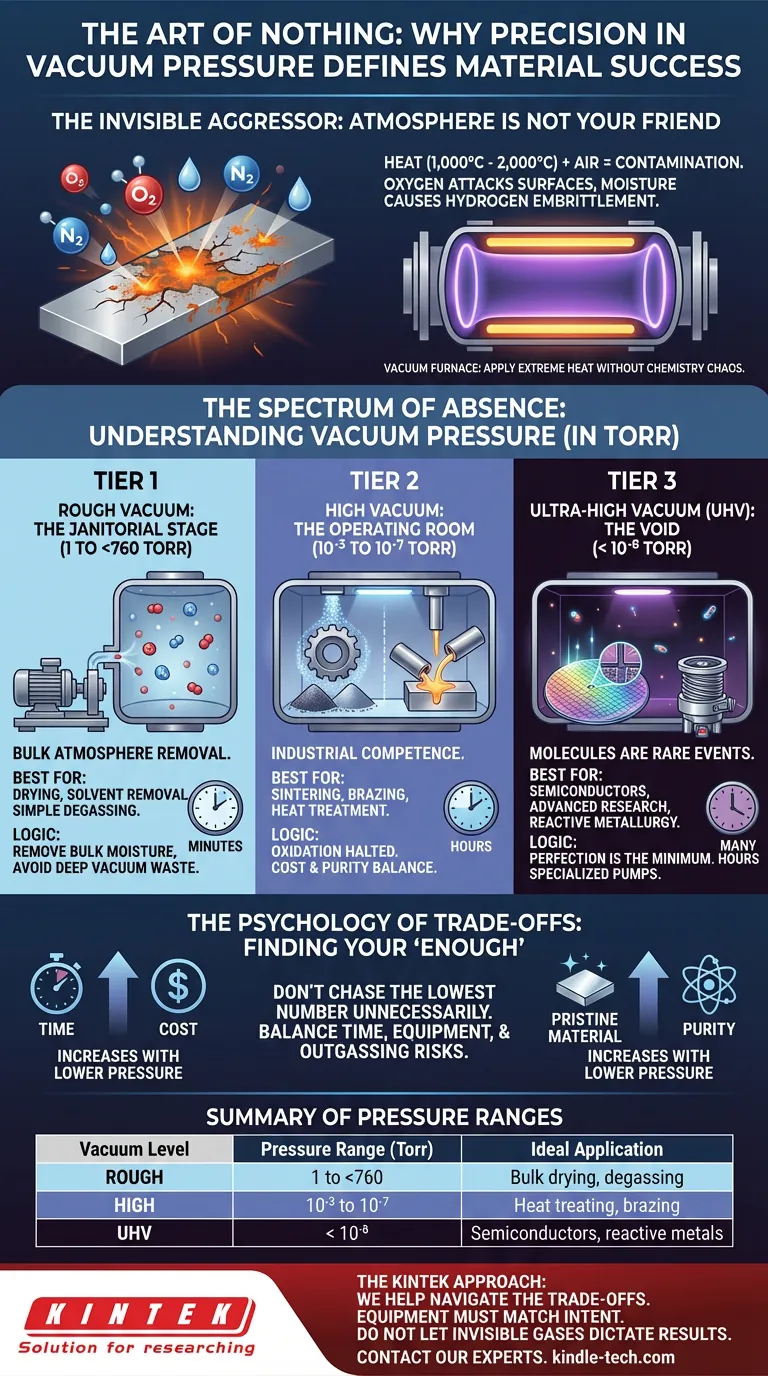
At room temperature, the air we breathe—a soup of nitrogen, oxygen, and water vapor—is benign. But heat changes the rules. Raise the temperature to 1,000°C or 2,000°C, and that same air becomes an aggressive contaminant. Oxygen stops being a life-giver and starts attacking surfaces, forming oxides that weaken bonds. Moisture becomes a source of hydrogen embrittlement.
The vacuum furnace was invented to solve a specific problem: How do we apply extreme heat without the chaos of chemistry?
The answer lies in pressure. But as any engineer knows, "vacuum" is not a single number. It is a spectrum of absence.
Understanding where your process fits on this spectrum is the difference between a pristine aerospace component and a pile of scrap metal.
The Physics of Absence
A vacuum furnace does not simply "remove air." It manages an environment.
The fundamental goal is purity. By lowering the pressure, we physically remove the reactive gas molecules that threaten the integrity of the material.
Consider what happens inside the chamber:
- Removal: Active gases (oxygen) are evacuated.
- Isolation: The material interacts only with itself or intended process gases.
- Efficiency: Without air to conduct heat via convection, we rely on pure radiant heat—uniform, controllable, and capable of reaching 2,400°C.
But here is the catch: You do not always need the void of deep space to dry a solvent. Over-engineering is just as dangerous to your budget as under-engineering is to your product.
The Spectrum of Silence
Pressure in vacuum furnaces is measured in Torr. The lower the number, the fewer the molecules, and the "quieter" the environment.
We can break this down into three distinct tiers of operation.
1. Rough Vacuum (1 to 760 Torr)
Think of this as the "Janitorial Stage."
You are removing the bulk of the atmosphere. The pressure is just below standard atmospheric levels. It is not sterile, but the crowd is gone.
- Best for: Drying, solvent removal, and simple degassing.
- The Logic: If you only need to remove bulk moisture, a deep vacuum is a waste of energy and time.
2. High Vacuum ($10^{-3}$ to $10^{-7}$ Torr)
This is the "Operating Room."
This is the standard for industrial competence. In this range, the environment is pure enough that oxidation is effectively halted. Brazing alloys flow without interference; sintered parts densify without trapped gas pockets.
- Best for: Sintering, brazing, industrial heat treatment.
- The Logic: This is where the balance of cost and purity usually meets for commercial manufacturing.
3. Ultra-High Vacuum (Below $10^{-8}$ Torr)
This is "The Void."
Here, molecules are rare events. This level is reserved for processes where even a single rogue atom can cause failure. It requires specialized pumps (turbomolecular or cryogenic) and significantly more patience.
- Best for: Semiconductor manufacturing, advanced physics research, reactive metallurgy.
- The Logic: Necessary only when perfection is the minimum standard.
The Psychology of Trade-offs
There is a temptation in engineering to chase the lowest possible number. If High Vacuum is good, Ultra-High must be better.
This is a fallacy.
Deep vacuums come with costs—both financial and temporal.
- Time: Pumping down to a rough vacuum takes minutes. Reaching Ultra-High Vacuum can take hours. In a production line, time is the most expensive commodity.
- Equipment: A mechanical pump is a workhorse. A cryogenic pump is a precision instrument requiring maintenance and care.
- Outgassing: Materials breathe. As you heat them, they release trapped internal gases. If your pump isn't sized correctly, the material itself will ruin the vacuum you worked so hard to create.
Finding Your "Enough"
The "best" pressure is not the lowest one. It is the one that reliably solves your specific failure mode without stalling your production.
Summary of Pressure Ranges
| Vacuum Level | Pressure Range (Torr) | Ideal Application |
|---|---|---|
| Rough Vacuum | 1 to <760 | Bulk drying, simple degassing |
| High Vacuum | $10^{-3}$ to $10^{-7}$ | Heat treating, brazing, sintering |
| Ultra-High (UHV) | < $10^{-8}$ | Semiconductors, reactive metals |
The KINTEK Approach
At KINTEK, we appreciate the romance of the engineer's challenge: creating something permanent in a world that wants to degrade it.
We understand that a vacuum furnace is more than a heated box. It is a tool for risk management. Whether you need a rough vacuum for bulk processing or a pristine UHV environment for experimental research, the equipment must match the intent.
We help labs and manufacturers navigate the trade-offs between purity, speed, and cost.
Do not let invisible gases dictate your results.
Contact Our Experts to determine the exact pressure control your process demands.
Visual Guide
Related Products
- Vacuum Hot Press Furnace Heated Vacuum Press Machine Tube Furnace
- 600T Vacuum Induction Hot Press Furnace for Heat Treat and Sintering
- Vacuum Heat Treat Furnace with Ceramic Fiber Liner
- Vacuum Heat Treat and Pressure Sintering Furnace for High Temperature Applications
- Vacuum Heat Treat Furnace and Levitation Induction Melting Furnace
Related Articles
- The Purity Paradox: Choosing the Heart of Your Vacuum Hot Press Furnace
- Comprehensive Guide to Vacuum Hot Press Furnace Application
- Vacuum Hot Press Furnace: A Comprehensive Guide
- Forging Perfection in a Void: The Physics of Ultra-Dense Materials
- Defeating the Void: The Quiet Power of Vacuum Hot Pressing