Blog The Art of Nothingness: Precision and Purity in Vacuum Heat Treatment
The Art of Nothingness: Precision and Purity in Vacuum Heat Treatment

The Art of Nothingness: Precision and Purity in Vacuum Heat Treatment

2 weeks ago

Oxygen is a thief.

In the natural world, air is the medium of life. In the world of high-performance metallurgy, however, air is an aggressive contaminant. It steals electrons. It creates oxide layers. It compromises the structural integrity of the very materials we rely on to hold up bridges or keep airplanes in the sky.

The engineering solution to this problem is radical in its simplicity but complex in its execution: remove the atmosphere entirely.

The vacuum furnace is not merely a tool for getting things hot. It is a controlled environment designed to pause the laws of entropy. By processing materials in a void, we stop nature from doing what it does best—corroding and contaminating—allowing us to achieve a level of purity that is physically impossible in the open air.

Here is the logic behind the silence of the vacuum process.

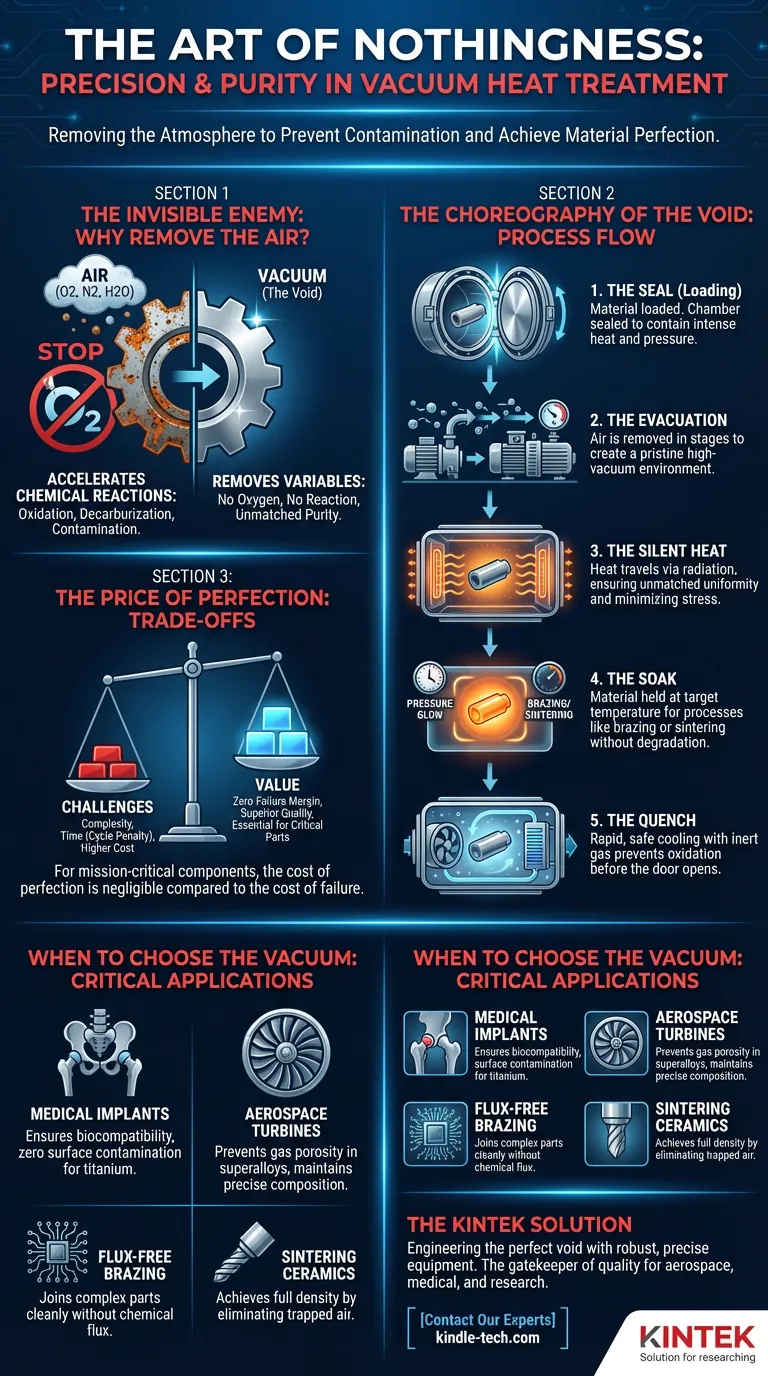
The Invisible Enemy: Why We Remove the Air

To understand the machine, you must understand the failure it prevents.

When you heat steel, titanium, or superalloys in the presence of air, chemical reactions accelerate. Oxygen attacks the surface. Nitrogen reacts with the metal lattice. Water vapor introduces hydrogen embrittlement.

The results are catastrophic for high-precision parts:

  • Oxidation: Tarnish and scale that ruin surface finishes.
  • Decarburization: The loss of carbon in steel, resulting in a soft, weak surface.
  • Contamination: Impurities that weaken the material’s fatigue life.

A vacuum furnace is a fortress. By removing the atmosphere, we remove the variables. There is no oxygen to react. There is no carbon to drift away. There is only the material and the heat.

The Choreography of the Void

The process of a vacuum furnace is slow, deliberate, and unforgiving. It follows a specific rhythm designed to protect the workpiece at every stage.

1. The Seal (Loading)

The process begins with a vessel. The chamber is typically double-walled and water-cooled to contain intense internal heat while keeping the exterior safe. The material is loaded, and the door is sealed.

This seal is the single most critical component. It creates the boundary between the chaos of the atmosphere and the order of the process.

2. The Evacuation

Before heat is applied, the air must go. This is rarely done in a single step.

  • Roughing: A mechanical pump removes the bulk of the air, creating a "rough" vacuum.
  • High Vacuum: A diffusion or turbomolecular pump takes over, hunting down the remaining molecules to achieve a pristine environment.

3. The Silent Heat

In a conventional oven, heat travels via convection—air moving over the part. In a vacuum, there is no air to move.

Heat must travel via radiation. Whether through graphite resistance elements or induction coils, energy is transferred directly to the workpiece as light energy. This results in unmatched uniformity. The heat soaks through the part evenly, minimizing the internal stresses that cause warping.

4. The Soak

The material sits at the target temperature. This is where the magic happens—brazing alloys flow into capillaries, or crystal structures realign during sintering. Because the environment is inert, this can continue for hours without the risk of surface degradation.

5. The Quench

Cooling is just as dangerous as heating. Opening the door at high temperatures would cause immediate, explosive oxidation.

Instead, the furnace is backfilled with an inert gas—usually Argon or Nitrogen. A powerful fan circulates this gas through a heat exchanger, stripping the heat away from the part rapidly but safely. Only when the temperature is stable does the door open.

The Price of Perfection

If vacuum processing is superior, why isn't it used for everything?

It comes down to the psychology of trade-offs. Perfection is expensive.

  • Complexity: Vacuum systems require complex pumps, gauges, and water-cooling systems that demand rigorous maintenance. A single leaking seal ruins the batch.
  • Time: Pumping a chamber down to a high vacuum takes time. It adds a "penalty" to the cycle time that atmospheric furnaces don't suffer.
  • Cost: The capital investment is significantly higher.

However, for mission-critical components, this cost is negligible compared to the cost of failure.

When to Choose the Vacuum

You do not use a vacuum furnace to bake a brick. You use it when the margin for error is zero.

Application Goal Why Vacuum is Essential
Medical Implants Titanium reacts violently with oxygen. Vacuum ensures biocompatibility and zero surface contamination.
Aerospace Turbines Superalloys require precise chemical composition. Vacuum induction melting prevents gas porosity.
Flux-Free Brazing Complex electronics or honeycombs cannot be cleaned of flux. Vacuum brazing joins them cleanly without chemical agents.
Sintering Ceramics To achieve full density in tungsten carbide or ceramics, trapped air must be eliminated completely.

The KINTEK Solution

There is a romance to engineering a perfect void. It requires a machine that is robust enough to withstand intense pressure differentials yet precise enough to control temperature within a single degree.

At KINTEK, we specialize in the equipment that makes this possible. We understand that for our clients—whether in aerospace, medical manufacturing, or advanced research—the vacuum furnace is not just a heater. It is the gatekeeper of quality.

From high-vacuum pumps to advanced heating elements, we provide the tools necessary to win the battle against oxidation.

Contact Our Experts

Visual Guide

The Art of Nothingness: Precision and Purity in Vacuum Heat Treatment Visual Guide

Related Products

Related Articles

Related Products

Vacuum Heat Treat Furnace with Ceramic Fiber Liner

Vacuum Heat Treat Furnace with Ceramic Fiber Liner

Vacuum furnace with polycrystalline ceramic fiber insulation liner for excellent heat insulation and uniform temperature field. Choose from 1200℃ or 1700℃ max. working temperature with high vacuum performance and precise temperature control.

Molybdenum Vacuum Heat Treat Furnace

Molybdenum Vacuum Heat Treat Furnace

Discover the benefits of a high-configuration molybdenum vacuum furnace with heat shield insulation. Ideal for high-purity, vacuum environments like sapphire crystal growth and heat treatment.

Vacuum Heat Treat Sintering Brazing Furnace

Vacuum Heat Treat Sintering Brazing Furnace

A vacuum brazing furnace is a type of industrial furnace used for brazing, a metalworking process that joins two pieces of metal using a filler metal that melts at a lower temperature than the base metals. Vacuum brazing furnaces are typically used for high-quality applications where a strong, clean joint is required.

2200 ℃ Graphite Vacuum Heat Treat Furnace

2200 ℃ Graphite Vacuum Heat Treat Furnace

Discover the power of the KT-VG Graphite Vacuum Furnace - with a maximum working temperature of 2200℃, it's perfect for vacuum sintering of various materials. Learn more now.

Graphite Vacuum Furnace High Thermal Conductivity Film Graphitization Furnace

Graphite Vacuum Furnace High Thermal Conductivity Film Graphitization Furnace

The high thermal conductivity film graphitization furnace has uniform temperature, low energy consumption and can operate continuously.

Vacuum Heat Treat and Pressure Sintering Furnace for High Temperature Applications

Vacuum Heat Treat and Pressure Sintering Furnace for High Temperature Applications

Vacuum pressure sintering furnaces are designed for high temperature hot pressing applications in metal and ceramic sintering. Its advanced features ensure precise temperature control, reliable pressure maintenance, and a robust design for seamless operation.

Horizontal High Temperature Graphite Vacuum Graphitization Furnace

Horizontal High Temperature Graphite Vacuum Graphitization Furnace

Horizontal Graphitization Furnace: This type of furnace is designed with the heating elements placed horizontally, allowing for uniform heating of the sample. It's well-suited for graphitizing large or bulky samples that require precise temperature control and uniformity.

Graphite Vacuum Furnace Bottom Discharge Graphitization Furnace for Carbon Materials

Graphite Vacuum Furnace Bottom Discharge Graphitization Furnace for Carbon Materials

Bottom-out graphitization furnace for carbon materials, ultra-high temperature furnace up to 3100°C, suitable for graphitization and sintering of carbon rods and carbon blocks. Vertical design, bottom discharging, convenient feeding and discharging, high temperature uniformity, low energy consumption, good stability, hydraulic lifting system, convenient loading and unloading.

Vertical High Temperature Graphite Vacuum Graphitization Furnace

Vertical High Temperature Graphite Vacuum Graphitization Furnace

Vertical high temperature graphitization furnace for carbonization and graphitization of carbon materials up to 3100℃.Suitable for shaped graphitization of carbon fiber filaments and other materials sintered in a carbon environment.Applications in metallurgy, electronics, and aerospace for producing high-quality graphite products like electrodes and crucibles.

Vertical Laboratory Tube Furnace

Vertical Laboratory Tube Furnace

Elevate your experiments with our Vertical Tube Furnace. Versatile design allows for operation under various environments and heat treatment applications. Order now for precise results!

Lab-Scale Vacuum Induction Melting Furnace

Lab-Scale Vacuum Induction Melting Furnace

Get precise alloy composition with our Vacuum Induction Melting Furnace. Ideal for aerospace, nuclear energy, and electronic industries. Order now for effective smelting and casting of metals and alloys.

High Temperature Muffle Oven Furnace for Laboratory Debinding and Pre Sintering

High Temperature Muffle Oven Furnace for Laboratory Debinding and Pre Sintering

KT-MD High temperature debinding and pre-sintering furnace for ceramic materials with various molding processes. Ideal for electronic components such as MLCC and NFC.

Small Vacuum Heat Treat and Tungsten Wire Sintering Furnace

Small Vacuum Heat Treat and Tungsten Wire Sintering Furnace

The small vacuum tungsten wire sintering furnace is a compact experimental vacuum furnace specially designed for universities and scientific research institutes. The furnace features a CNC welded shell and vacuum piping to ensure leak-free operation. Quick-connect electrical connections facilitate relocation and debugging, and the standard electrical control cabinet is safe and convenient to operate.

Ultra-High Temperature Graphite Vacuum Graphitization Furnace

Ultra-High Temperature Graphite Vacuum Graphitization Furnace

The ultra-high temperature graphitization furnace utilizes medium frequency induction heating in a vacuum or inert gas environment. The induction coil generates an alternating magnetic field, inducing eddy currents in the graphite crucible, which heats up and radiates heat to the workpiece, bringing it to the desired temperature. This furnace is primarily used for graphitization and sintering of carbon materials, carbon fiber materials, and other composite materials.

Laboratory Scientific Electric Heating Blast Drying Oven

Laboratory Scientific Electric Heating Blast Drying Oven

The desktop fast autoclave sterilizer is a compact and reliable device used for rapid sterilization of medical, pharmaceutical, and research items.

1200℃ Muffle Furnace Oven for Laboratory

1200℃ Muffle Furnace Oven for Laboratory

Upgrade your lab with our 1200℃ Muffle Furnace. Achieve fast, precise heating with Japan alumina fibers and Molybdenum coils. Features TFT touch screen controller for easy programming and data analysis. Order now!

Dental Porcelain Zirconia Sintering Ceramic Furnace Chairside with Transformer

Dental Porcelain Zirconia Sintering Ceramic Furnace Chairside with Transformer

Experience top-notch sintering with Chairside Sintering Furnace with Transformer. Easy to operate, noise-free pallet, and automatic temperature calibration. Order now!

Graphite Vacuum Continuous Graphitization Furnace

Graphite Vacuum Continuous Graphitization Furnace

High-temperature graphitization furnace is a professional equipment for graphitization treatment of carbon materials. It is a key equipment for the production of high-quality graphite products. It has high temperature, high efficiency and uniform heating. It is suitable for various high-temperature treatments and graphitization treatments. It is widely used in metallurgy, electronics, aerospace, etc. industry.

Dental Porcelain Zirconia Sintering Ceramic Vacuum Press Furnace

Dental Porcelain Zirconia Sintering Ceramic Vacuum Press Furnace

Get precise dental results with Dental Vacuum Press Furnace. Automatic temperature calibration, low noise tray, and touch screen operation. Order now!

Vacuum Sealed Continuous Working Rotary Tube Furnace Rotating Tube Furnace

Vacuum Sealed Continuous Working Rotary Tube Furnace Rotating Tube Furnace

Experience efficient material processing with our vacuum-sealed rotary tube furnace. Perfect for experiments or industrial production, equipped with optional features for controlled feeding and optimized results. Order now.


Leave Your Message