The Psychological Weight of a Simple Choice
Imagine this: a multi-day synthesis process is underway. Your novel material, the culmination of weeks of research, is heating inside a tube furnace. Everything depends on the stability of that controlled environment.
But the success of this entire endeavor hinges on a component often treated as an afterthought: the furnace tube itself.
We tend to see the tube as passive hardware. It's just a container. This is a cognitive shortcut, and it's a dangerous one. The tube is an active participant in your process. Its material isn't just a specification; it's a strategic decision that dictates the boundaries of what you can achieve.
The First Filter: Temperature as a Non-Negotiable Boundary
Before considering any other variable, physics imposes a hard limit. The maximum operating temperature of your process is the first and most crucial filter. It doesn't offer room for negotiation.
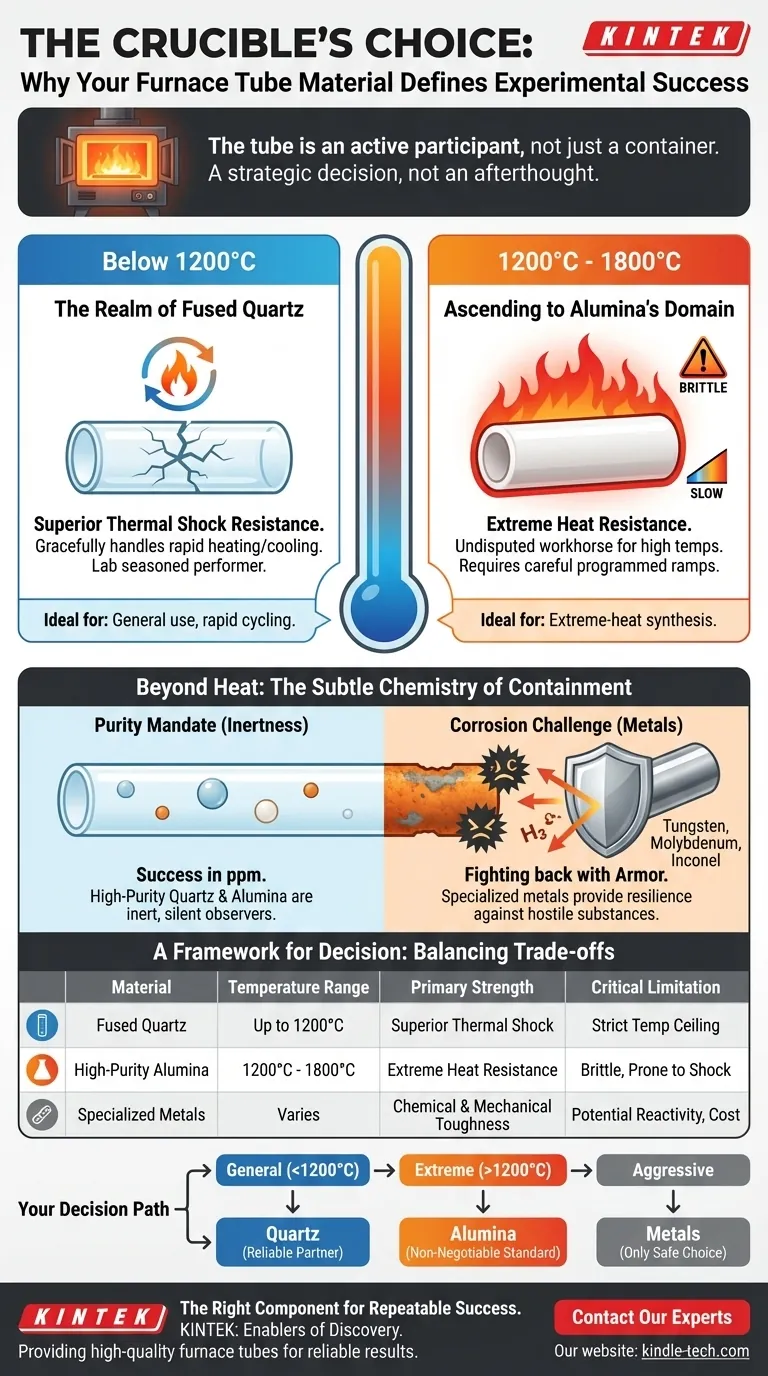
The Realm of Fused Quartz (Below 1200°C)
For processes running at or below 1200°C, fused quartz is the elegant, default solution.
Its defining characteristic is not its temperature ceiling, but its extraordinary resistance to thermal shock. It gracefully handles the stress of rapid heating and cooling cycles that would shatter lesser materials. Think of it as the lab equivalent of a seasoned performer, unflappable under pressure.
Ascending to Alumina's Domain (1200°C - 1800°C)
When your work demands you push beyond 1200°C, you enter the territory of high-purity alumina. This robust ceramic is the undisputed workhorse for high-temperature synthesis, stable in environments that would melt or compromise other materials.
But this thermal strength comes with a trade-off: brittleness. Alumina demands respect. It lacks the thermal shock tolerance of quartz, making careful, programmed heating and cooling ramps essential. It is powerful but unforgiving.
Beyond Heat: The Subtle Chemistry of Containment
Once you've satisfied the demands of temperature, a more subtle but equally important factor emerges: chemistry. The furnace tube isn't just holding your sample; it's the wall of your reactor. Any interaction—or lack thereof—is critical.
The Purity Mandate: When Inertness is Everything
In fields like semiconductor development or advanced materials research, success is measured in parts-per-million. The slightest contamination from the tube wall can compromise an entire batch, rendering results useless.
This is why high-purity quartz and alumina are so prized. They are chemically inert, silent observers that do not introduce unwanted variables into your pristine, controlled atmosphere.
The Corrosion Challenge: Fighting Back with Metals
What if your process involves substances that are actively hostile? Corrosive materials can etch and degrade standard ceramic or quartz tubes, compromising both the tube's integrity and the sample's purity.
In these chemical battlegrounds, you need armor. Specialized metal tubes made of tungsten, molybdenum, or high-temperature alloys like Inconel provide the necessary resilience. They stand firm where others would fail, ensuring the process remains contained and pure.
A Framework for Decision: Balancing the Trade-offs
Choosing the right material is an exercise in risk management. You are balancing a set of competing strengths and weaknesses to find the optimal solution for a specific goal. There is no single "best" material, only the most appropriate one.
This balance can be summarized clearly:
| Material | Temperature Range | Primary Strength | Critical Limitation |
|---|---|---|---|
| Fused Quartz | Up to 1200°C | Superior Thermal Shock | Strict Temperature Ceiling |
| High-Purity Alumina | 1200°C - 1800°C | Extreme Heat Resistance | Brittle, Prone to Shock |
| Specialized Metals | Varies | Chemical & Mechanical Toughness | Potential Reactivity, Cost |
Your decision path becomes logical:
- For general use with rapid heating below 1200°C: Quartz is your reliable partner.
- For extreme-heat synthesis above 1200°C: Alumina is the non-negotiable standard.
- For aggressive, corrosive environments: A specialized metal tube is your only safe choice.
The Right Component for Repeatable Success
An experiment's value lies in its repeatability. The furnace tube is one of the most significant variables in any thermal process. Getting the selection wrong introduces randomness, contamination, and failure. Getting it right is a foundational step toward reliable and meaningful results.
At KINTEK, we specialize in providing the high-quality lab equipment and consumables that form the backbone of critical research. We understand that the right furnace tube is more than just a piece of hardware; it's an enabler of discovery. Whether you require the thermal shock resilience of quartz, the high-temperature stability of alumina, or the chemical fortitude of a metal alloy, we provide the components and expertise to ensure your process is sound.
Don't let this critical choice be an afterthought. Contact Our Experts
Visual Guide
Related Products
- High Temperature Alumina (Al2O3) Furnace Tube for Engineering Advanced Fine Ceramics
- 1400℃ Laboratory High Temperature Tube Furnace with Alumina Tube
- Rotary Tube Furnace Split Multi Heating Zone Rotating Tube Furnace
- 1700℃ Laboratory High Temperature Tube Furnace with Alumina Tube
- Laboratory Vacuum Tilt Rotary Tube Furnace Rotating Tube Furnace
Related Articles
- Beyond the Acid Wash: A Systems Approach to Alumina Tube Longevity
- The Unseen Discipline: Mastering the Alumina Furnace Tube
- Entropy and the Alumina Tube: The Art of Precision Maintenance
- The Ceramic Paradox: Why the Best Way to Clean an Alumina Tube is Not to Clean It
- The Geometry of Heat: Why Your Furnace Tube Material Dictates Your Science