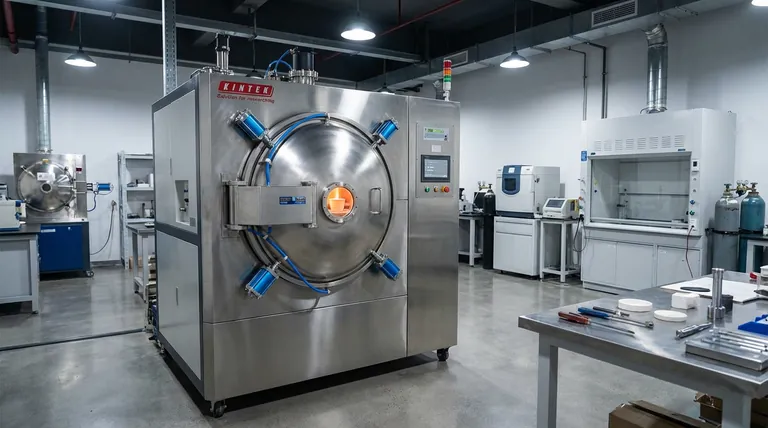
The Cold Wall Paradox
Stand next to a vacuum furnace operating at 2,000°F (1,100°C), and you will notice something unsettling.
The steel vessel is cool to the touch.
Inside, the environment is aggressive enough to melt gold or harden tool steel. Outside, it is room temperature. This is not magic; it is the result of a specific engineering architecture known as the "Cold Wall" design.
But the steel vessel is just the container. The real work—the alchemy of changing a material’s molecular structure—happens inside a suspended, isolated chamber.
This chamber is the Hot Zone.
It is literally a furnace within a furnace. Understanding how it functions is not just a matter of mechanics; it is a study in how we control chaos to achieve perfection.
The Architecture of Isolation
Thermal energy wants to move. It seeks equilibrium. In a standard oven, heat bleeds through the walls into the room.
In a vacuum furnace, we cannot afford that loss.
The hot zone is an engineered thermal system suspended inside the water-cooled shell. It performs three critical functions that define the success of your laboratory processes:
- Concentration: It traps photons. By using layers of reflective materials, it forces radiation back onto the workpiece.
- Uniformity: It eliminates cold spots. In brazing or sintering, a temperature deviation of even a few degrees can be the difference between a certified part and a microscopic fracture.
- Protection: It acts as a shield. It prevents the intense heat from destroying the vacuum seals and the outer vessel.
The hot zone does not just generate heat; it curates it.
The Psychology of Material Selection
When specifying a hot zone, you are essentially managing risk. You are trading cost against purity, and durability against precision.
The industry generally splits into two philosophical camps: Graphite and All-Metal.
1. The Graphite Workhorse
Graphite is robust. It handles thermal shock with grace. It is the economical choice for general heat treating.
- The Logic: If your process involves sintering or hardening standard steels, graphite provides excellent insulation and durability at a reasonable cost.
- The Risk: Carbon. Graphite can release fine dust or react with sensitive materials. If you are processing reactive metals like titanium, graphite is a contamination risk you cannot afford.
2. The All-Metal Surgeon
All-metal hot zones (typically Molybdenum or Tungsten) are built for sterility. They use reflective metal shields rather than fiber insulation.
- The Logic: If you are in aerospace or medical manufacturing, "clean" is the only metric that matters. These zones produce zero particulate and allow for deeper vacuums.
- The Risk: Fragility and cost. Metal shields reflect heat beautifully, but they warp if mishandled and cost significantly more than graphite.
The Decision Matrix
Choosing the right heart for your furnace is about understanding the "personality" of your materials.
If you value flexibility and cost, graphite is the rational choice. It is forgiving and versatile.
If you value absolute purity, metal is the only choice. It is expensive and demanding, but it ensures the integrity of high-stakes components like medical implants.
Summary of Trade-offs
| Feature | Graphite-Based Hot Zone | All-Metal Hot Zone |
|---|---|---|
| Primary Role | The Durability Specialist | The Purity Specialist |
| Best For | General heat treating, sintering | Medical, aerospace, electronics |
| Environment | Carbon environment | Ultra-clean vacuum |
| Economics | Cost-effective | High capital investment |
Precision is a System
In the laboratory, we often obsess over the result—the hardness of the steel, the brightness of the braze.
But the result is merely a lagging indicator of the system that produced it. The hot zone is that system. It is the barrier between the chaos of extreme heat and the precision required by modern science.
At KINTEK, we understand that a furnace is only as good as its hot zone. Whether you require the rugged durability of graphite or the pristine environment of an all-metal shield, our role is to ensure your equipment matches your scientific intent.
We help you navigate the trade-offs so that when you close that furnace door, you are confident in what happens inside.
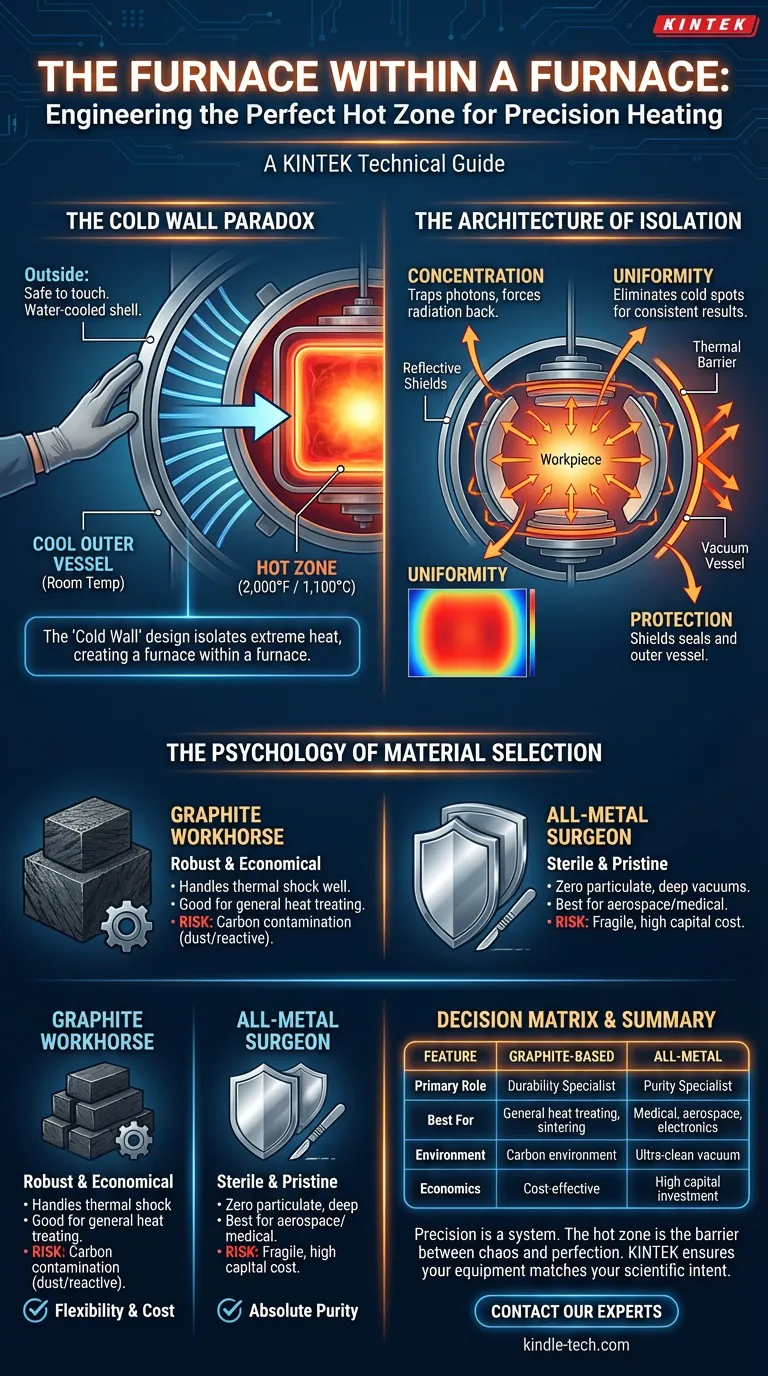
Visual Guide
Related Products
- 2200 ℃ Tungsten Vacuum Heat Treat and Sintering Furnace
- Vacuum Hot Press Furnace Heated Vacuum Press Machine Tube Furnace
- Vacuum Hot Press Furnace Machine Heated Vacuum Press
- 600T Vacuum Induction Hot Press Furnace for Heat Treat and Sintering
- Vacuum Heat Treat and Pressure Sintering Furnace for High Temperature Applications
Related Articles
- The Architecture of Extremes: Mastering the Thermal Ceiling
- Exploring Tungsten Vacuum Furnaces: Operation, Applications, and Advantages
- Your Tungsten Furnace Is Failing. The Culprit Isn't What You Think.
- Classification, Applications, and Components of High-Temperature Vacuum Furnaces
- High-Temperature Vacuum Furnace: Classification, Applications, and Components



















