The Ghost in the Machine
An experiment fails. The sample, once a pristine powder, is now discolored, its crystalline structure ruined. The researcher stares at the result, perplexed. The temperature was perfect, the atmosphere meticulously controlled. What went wrong?
The culprit is often the component we think about the least: the furnace tube.
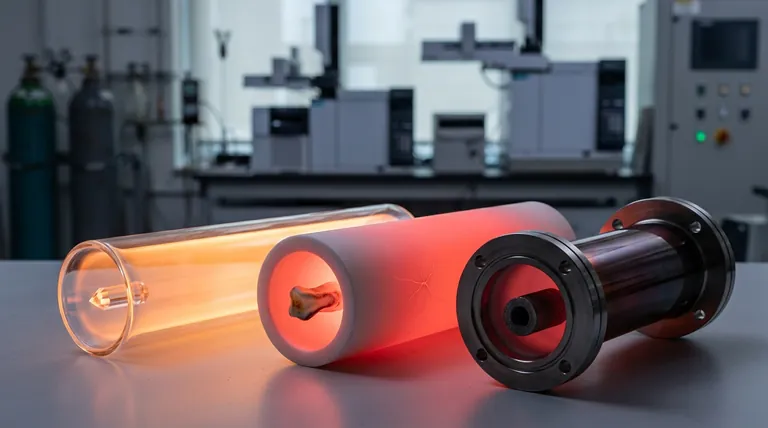
We see it as a simple container—a ceramic or glass pipe. But this is a dangerous mental shortcut. The tube is not passive. It is an active, silent partner in your experiment. It is the crucible, the controlled environment, and the first line of defense against contamination. Choosing the wrong material is like inviting a ghost into your machine—an unseen variable that can invalidate weeks of work.
The Psychological Trap: Focusing Only on Temperature
Our brains are wired to simplify. When we think of a furnace, we think of heat. This leads us to the most common, and most costly, mistake: selecting a tube based solely on its maximum operating temperature.
This is understandable. Temperature is the big, obvious number. But it's only one dimension of a complex, three-dimensional problem. The chemistry of your sample and the atmosphere of your process are equally critical. Overlooking them is like navigating a ship by looking only at the speedometer, ignoring the compass and the weather radar.
The reality is that the tube material dictates the very environment it contains. It is not an inert vessel; it is a reactive boundary.
The Material is the Environment
Think of the tube, the sample, and the process gas as having a constant, silent dialogue. The tube's material determines the language of that conversation. To get predictable results, you must choose a material that speaks the right language for your experiment.
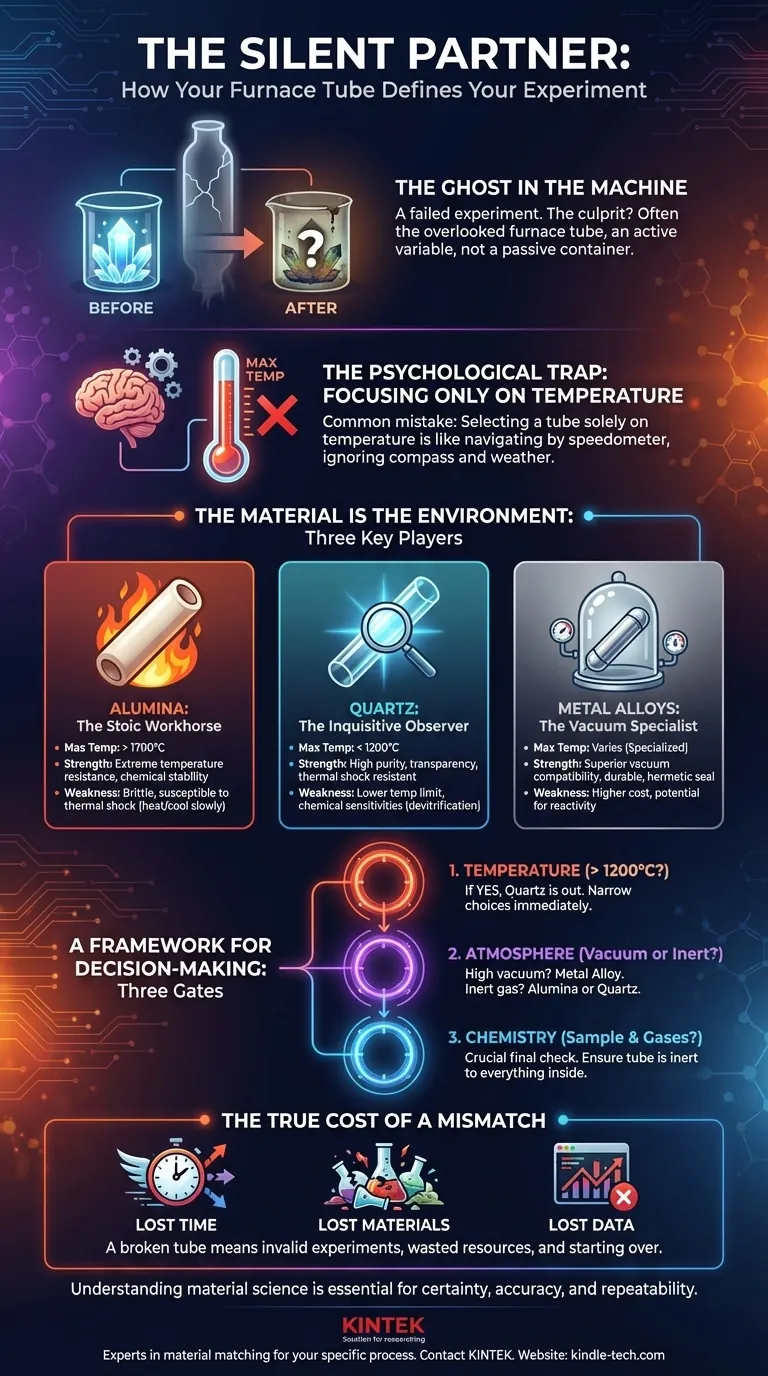
Alumina: The Stoic Workhorse
For synthesizing a novel ceramic at 1600°C, there is no substitute for a high-purity alumina (Al2O3) tube. It is a stoic workhorse, built to withstand immense thermal energy while remaining chemically stable.
But its strength is also its weakness. Alumina is brittle. It demands respect. Heat it too quickly or cool it too fast, and thermal shock will introduce a catastrophic crack, instantly destroying the controlled atmosphere. It performs its duty flawlessly, but only if you adhere to its rigid, unforgiving rules.
Quartz: The Inquisitive Observer
Imagine needing to witness the exact moment a material undergoes a phase transition. A quartz tube is your window into the heart of the reaction. Its transparency is an invaluable asset for processes below 1200°C.
Quartz offers exceptional chemical purity, making it ideal for creating high-purity materials. Yet, it is sensitive. Held at its peak temperature for too long, it can devitrify, becoming cloudy and brittle. Certain alkaline compounds can "poison" it, causing it to fail. It is the perfect observer, but it is not invincible.
Metal Alloys: The Vacuum Specialist
Consider the challenge of sintering a powdered metal part without oxidation. This requires a high vacuum. Under these conditions, some ceramics can outgas, releasing volatile molecules that contaminate the sample.
This is the world of specialized, heat-resistant metal alloys. These tubes are engineered for structural integrity in a near-vacuum, providing a hermetically sealed environment that other materials cannot guarantee. They are the specialists, called upon when the atmospheric demands are absolute.
A Framework for Decision-Making
Choosing the right tube isn't a guess; it's a process of elimination based on the fundamental physics and chemistry of your experiment.
1. Temperature is the First Gate
This is your initial filter. If your process exceeds 1200°C, quartz is off the table. This simple, non-negotiable limit immediately narrows your choices.
2. Atmosphere is the Second Gate
Will you be working in a high vacuum? A specialized metal alloy tube is likely your best bet. Working with an inert gas like argon? Alumina or quartz are excellent candidates. The atmosphere dictates the required structural and chemical stability.
3. Chemistry is the Final Arbiter
What is your sample? What gases are you flowing? The tube must be chemically inert to everything inside it. A seemingly perfect alumina tube can still react with a specific precursor gas, introducing impurities and skewing your results. This final check ensures the integrity of your data.
At a Glance: Material Trade-offs
| Material | Max Temp. | Key Strengths | Critical Weakness |
|---|---|---|---|
| Alumina Ceramic | > 1700°C | Extreme temperature resistance, stability | Brittle, susceptible to thermal shock |
| Quartz | < 1200°C | High purity, transparent, thermal shock resistant | Lower temp limit, chemical sensitivities |
| Metal Alloy | Varies | Superior vacuum compatibility, durable | Higher cost, potential for reactivity |
The True Cost of a Mismatch
A broken furnace tube is more than a minor inconvenience. It represents a cascade of failures.
- Lost Time: Hours of heating, processing, and cooling, all wasted.
- Lost Materials: The valuable, carefully prepared sample is now contaminated or destroyed.
- Lost Data: The entire experiment is invalid, forcing you to start over from scratch.
The cost of the right tube is a fraction of the cost of a failed experiment. It is an investment in certainty, accuracy, and repeatability. Understanding the nuanced interplay between material science and your experimental goals is the key to success. This is why a deep knowledge of laboratory equipment and consumables is not just helpful; it is essential.
Navigating these material trade-offs requires expertise. The team at KINTEK specializes in matching the right materials to the specific thermal, chemical, and atmospheric demands of your process. Let us help you select the silent partner that will ensure your results are not just successful, but also true. Contact Our Experts
Visual Guide
Related Products
- High Temperature Alumina (Al2O3) Furnace Tube for Engineering Advanced Fine Ceramics
- Rotary Tube Furnace Split Multi Heating Zone Rotating Tube Furnace
- 1400℃ Laboratory High Temperature Tube Furnace with Alumina Tube
- Laboratory Vacuum Tilt Rotary Tube Furnace Rotating Tube Furnace
- 1700℃ Laboratory High Temperature Tube Furnace with Alumina Tube
Related Articles
- Beyond the Acid Wash: A Systems Approach to Alumina Tube Longevity
- The Unseen Discipline: Mastering the Alumina Furnace Tube
- Entropy and the Alumina Tube: The Art of Precision Maintenance
- The Ceramic Paradox: Why the Best Way to Clean an Alumina Tube is Not to Clean It
- The Geometry of Heat: Why Your Furnace Tube Material Dictates Your Science