Blog The Symphony of Silence: Engineering Heat in a Vacuum
The Symphony of Silence: Engineering Heat in a Vacuum

The Symphony of Silence: Engineering Heat in a Vacuum

3 hours ago

Heat is usually associated with chaos. A fire burns; an engine explodes; a star collapses.

But in the laboratory, heat is an instrument of precision. It is the tool we use to rearrange the atomic structure of materials, turning the weak into the strong and the brittle into the resilient.

To do this without destroying the material, we have to remove the one thing that fire needs to breathe: Air.

A vacuum furnace is a contradiction. It is a vessel of extreme violence (heat) contained within a vessel of absolute nothingness (vacuum), all wrapped in a jacket of ice-cold protection (water cooling).

Here is the engineering logic behind how we create fire in a void.

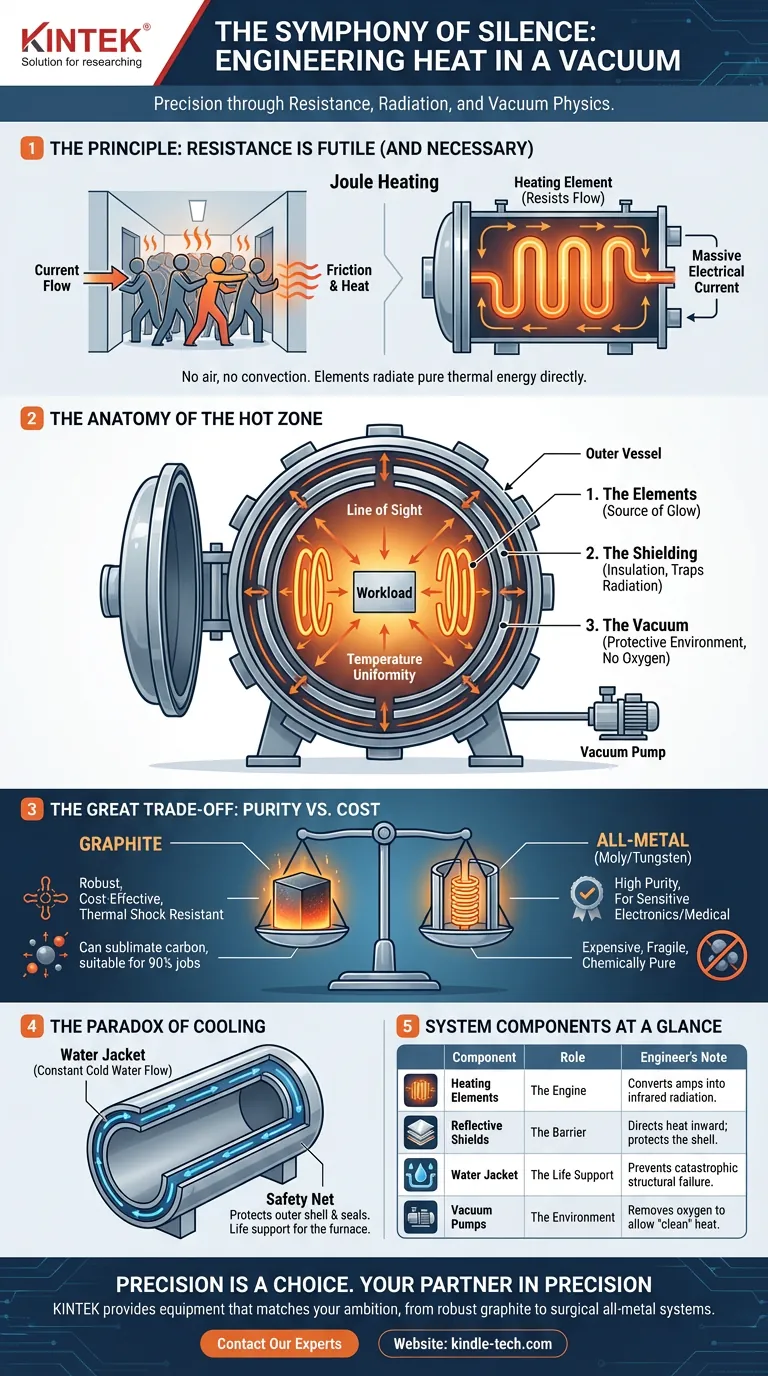
The Principle: Resistance is Futile (and Necessary)

A vacuum furnace does not burn fuel. Burning requires oxygen, and oxygen is the enemy of high-performance metallurgy.

Instead, the system relies on Joule heating.

Think of a narrow hallway crowded with people. If you try to run through it, you create friction. That friction creates heat.

In a vacuum furnace, we force a massive electrical current through a material that resists it. This component—the heating element—fights the flow of electricity. The byproduct of this struggle is thermal energy.

Because there is no air to carry the heat away (convection), the element glows. It radiates pure thermal energy directly onto your workload. It is silent, clean, and incredibly efficient.

The Anatomy of the Hot Zone

The "hot zone" is where the magic happens. It is a carefully engineered stage designed to manage the physics of radiation.

It consists of three critical players:

  1. The Elements: The source of the glow.
  2. The Shielding: The insulation that traps the radiation.
  3. The Vacuum: The protective environment.

In the absence of air, heat travels only by "line of sight." If the heating element cannot "see" the part, the part will not get hot. This requires a layout that surrounds the workload completely, ensuring temperature uniformity.

The Materials of Construction

You cannot use just any metal to build a heater that operates at 2,000°C. The heating elements themselves must be engineered to survive the environment they create.

  • Graphite: The workhorse. It is robust, cost-effective, and handles extreme thermal shock.
  • Molybdenum (Moly): The specialist. It is used when carbon contamination is a non-starter (common in aerospace and medical applications).
  • Ceramics (SiC): The hybrid. Often used in specific oxidation-prone scenarios.

The Great Trade-Off

Engineering is rarely about choosing the "best" option. It is about choosing the right compromise.

When selecting a heating system for a vacuum furnace, you are balancing purity against cost.

The Graphite Path

Graphite is the standard. It is strong and gets stronger as it heats up. However, in the microscopic world, graphite can sublimate. It releases carbon atoms into the vacuum. For 90% of brazing and heat-treating jobs, this is irrelevant.

The All-Metal Path

For sensitive electronics or medical implants, a rogue carbon atom is a defect. Here, we must use an All-Metal Hot Zone. We use Molybdenum or Tungsten elements and shields. They are expensive. They are fragile. But they are chemically pure.

The Paradox of Cooling

The most critical part of a heating system is actually the cooling system.

The entire hot zone sits inside a double-walled steel vessel. Between those walls flows a constant stream of cold water.

This is the safety net. It keeps the outer shell cool to the touch and prevents the vacuum seals from melting. If the water stops, the furnace destroys itself. It is a system that relies on the balance between extreme heat inside and constant cooling outside.

System Components at a Glance

Component Role The Engineer's Note
Heating Elements The Engine Converts amps into infrared radiation.
Reflective Shields The Barrier Directs heat inward; protects the shell.
Water Jacket The Life Support Prevents catastrophic structural failure.
Vacuum Pumps The Environment Removes oxygen to allow "clean" heat.

Precision is a Choice

The difference between a failed experiment and a breakthrough material often comes down to the quality of the thermal cycle.

Did the temperature fluctuate? Did oxygen leak in? Did carbon migrate where it shouldn't have?

These are not just operational details; they are the variables that define your success. Understanding the heating mechanism allows you to stop fighting the furnace and start controlling the outcome.

Your Partner in Precision

At KINTEK, we understand that a vacuum furnace is not just a box that gets hot. It is a complex ecosystem of resistance, radiation, and vacuum physics.

Whether you need the robust reliability of a graphite hot zone or the surgical purity of an all-metal system, we provide the equipment that matches your ambition. We specialize in the lab equipment and consumables that ensure your "line of sight" is always clear.

Do not leave your materials to chance.

Contact Our Experts

Visual Guide

The Symphony of Silence: Engineering Heat in a Vacuum Visual Guide

Related Products

Related Articles

Related Products

Vacuum Hot Press Furnace Machine Heated Vacuum Press

Vacuum Hot Press Furnace Machine Heated Vacuum Press

Discover the advantages of Vacuum Hot Press Furnace! Manufacture dense refractory metals & compounds, ceramics, and composites under high temp and pressure.

Vacuum Hot Press Furnace Heated Vacuum Press Machine Tube Furnace

Vacuum Hot Press Furnace Heated Vacuum Press Machine Tube Furnace

Reduce forming pressure & shorten sintering time with Vacuum Tube Hot Press Furnace for high-density, fine-grain materials. Ideal for refractory metals.

Molybdenum Vacuum Heat Treat Furnace

Molybdenum Vacuum Heat Treat Furnace

Discover the benefits of a high-configuration molybdenum vacuum furnace with heat shield insulation. Ideal for high-purity, vacuum environments like sapphire crystal growth and heat treatment.

600T Vacuum Induction Hot Press Furnace for Heat Treat and Sintering

600T Vacuum Induction Hot Press Furnace for Heat Treat and Sintering

Discover the 600T Vacuum Induction Hot Press Furnace, designed for high-temperature sintering experiments in vacuum or protected atmospheres. Its precise temperature and pressure control, adjustable working pressure, and advanced safety features make it ideal for nonmetal materials, carbon composites, ceramics, and metal powders.

Vacuum Heat Treat Furnace with Ceramic Fiber Liner

Vacuum Heat Treat Furnace with Ceramic Fiber Liner

Vacuum furnace with polycrystalline ceramic fiber insulation liner for excellent heat insulation and uniform temperature field. Choose from 1200℃ or 1700℃ max. working temperature with high vacuum performance and precise temperature control.

2200 ℃ Tungsten Vacuum Heat Treat and Sintering Furnace

2200 ℃ Tungsten Vacuum Heat Treat and Sintering Furnace

Experience the ultimate refractory metal furnace with our Tungsten vacuum furnace. Capable of reaching 2200℃, perfect for sintering advanced ceramics and refractory metals. Order now for high-quality results.

2200 ℃ Graphite Vacuum Heat Treat Furnace

2200 ℃ Graphite Vacuum Heat Treat Furnace

Discover the power of the KT-VG Graphite Vacuum Furnace - with a maximum working temperature of 2200℃, it's perfect for vacuum sintering of various materials. Learn more now.

Laboratory Rapid Thermal Processing (RTP) Quartz Tube Furnace

Laboratory Rapid Thermal Processing (RTP) Quartz Tube Furnace

Get lightning-fast heating with our RTP Rapid Heating Tube Furnace. Designed for precise, high-speed heating and cooling with convenient sliding rail and TFT touch screen controller. Order now for ideal thermal processing!

1700℃ Laboratory High Temperature Tube Furnace with Alumina Tube

1700℃ Laboratory High Temperature Tube Furnace with Alumina Tube

Looking for a high-temperature tube furnace? Check out our 1700℃ Tube Furnace with Alumina Tube. Perfect for research and industrial applications up to 1700C.

Vacuum Heat Treat and Molybdenum Wire Sintering Furnace for Vacuum Sintering

Vacuum Heat Treat and Molybdenum Wire Sintering Furnace for Vacuum Sintering

A vacuum molybdenum wire sintering furnace is a vertical or bedroom structure, which is suitable for withdrawal, brazing, sintering and degassing of metal materials under high vacuum and high temperature conditions. It is also suitable for dehydroxylation treatment of quartz materials.

Vacuum Heat Treat Sintering Brazing Furnace

Vacuum Heat Treat Sintering Brazing Furnace

A vacuum brazing furnace is a type of industrial furnace used for brazing, a metalworking process that joins two pieces of metal using a filler metal that melts at a lower temperature than the base metals. Vacuum brazing furnaces are typically used for high-quality applications where a strong, clean joint is required.

Vacuum Heat Treat and Sintering Furnace with 9MPa Air Pressure

Vacuum Heat Treat and Sintering Furnace with 9MPa Air Pressure

The air pressure sintering furnace is a high-tech equipment commonly used for the sintering of advanced ceramic materials. It combines vacuum sintering and pressure sintering techniques to achieve high-density and high-strength ceramics.

Graphite Vacuum Furnace IGBT Experimental Graphitization Furnace

Graphite Vacuum Furnace IGBT Experimental Graphitization Furnace

IGBT experimental graphitization furnace, a tailored solution for universities and research institutions, with high heating efficiency, user-friendliness, and precise temperature control.

Horizontal High Temperature Graphite Vacuum Graphitization Furnace

Horizontal High Temperature Graphite Vacuum Graphitization Furnace

Horizontal Graphitization Furnace: This type of furnace is designed with the heating elements placed horizontally, allowing for uniform heating of the sample. It's well-suited for graphitizing large or bulky samples that require precise temperature control and uniformity.

Ultra-High Temperature Graphite Vacuum Graphitization Furnace

Ultra-High Temperature Graphite Vacuum Graphitization Furnace

The ultra-high temperature graphitization furnace utilizes medium frequency induction heating in a vacuum or inert gas environment. The induction coil generates an alternating magnetic field, inducing eddy currents in the graphite crucible, which heats up and radiates heat to the workpiece, bringing it to the desired temperature. This furnace is primarily used for graphitization and sintering of carbon materials, carbon fiber materials, and other composite materials.

Vertical High Temperature Graphite Vacuum Graphitization Furnace

Vertical High Temperature Graphite Vacuum Graphitization Furnace

Vertical high temperature graphitization furnace for carbonization and graphitization of carbon materials up to 3100℃.Suitable for shaped graphitization of carbon fiber filaments and other materials sintered in a carbon environment.Applications in metallurgy, electronics, and aerospace for producing high-quality graphite products like electrodes and crucibles.

1700℃ Muffle Oven Furnace for Laboratory

1700℃ Muffle Oven Furnace for Laboratory

Get superior heat control with our 1700℃ Muffle Furnace. Equipped with intelligent temperature microprocessor, TFT touch screen controller & advanced insulation materials for precise heating up to 1700C. Order now!

1200℃ Split Tube Furnace with Quartz Tube Laboratory Tubular Furnace

1200℃ Split Tube Furnace with Quartz Tube Laboratory Tubular Furnace

KT-TF12 split tube furnace: high-purity insulation, embedded heating wire coils, and max. 1200C. Widely used for new materials and chemical vapour deposition.

1700℃ Controlled Atmosphere Furnace Nitrogen Inert Atmosphere Furnace

1700℃ Controlled Atmosphere Furnace Nitrogen Inert Atmosphere Furnace

KT-17A Controlled atmosphere furnace: 1700℃ heating, vacuum sealing technology, PID temperature control, and versatile TFT smart touch screen controller for laboratory and industrial use.

Laboratory Muffle Oven Furnace Bottom Lifting Muffle Furnace

Laboratory Muffle Oven Furnace Bottom Lifting Muffle Furnace

Efficiently produce batches with excellent temperature uniformity using our Bottom Lifting Furnace. Features two electric lifting stages and advanced temperature control up to 1600℃.


Leave Your Message