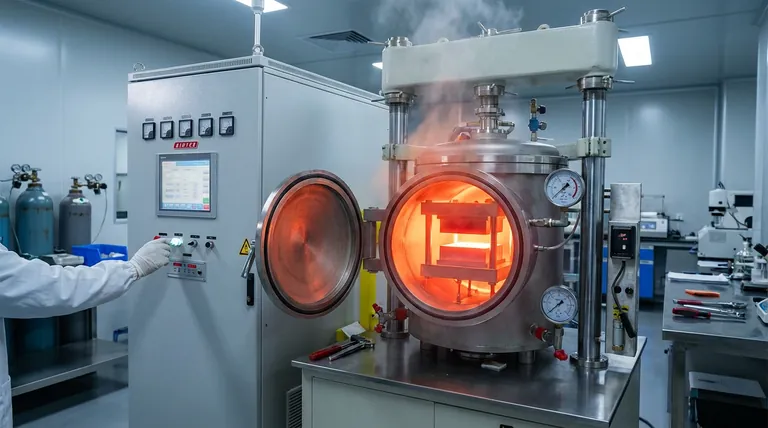
The Anxiety of the Hidden Flaw
In high-performance engineering, the most dangerous enemy is the one you cannot see.
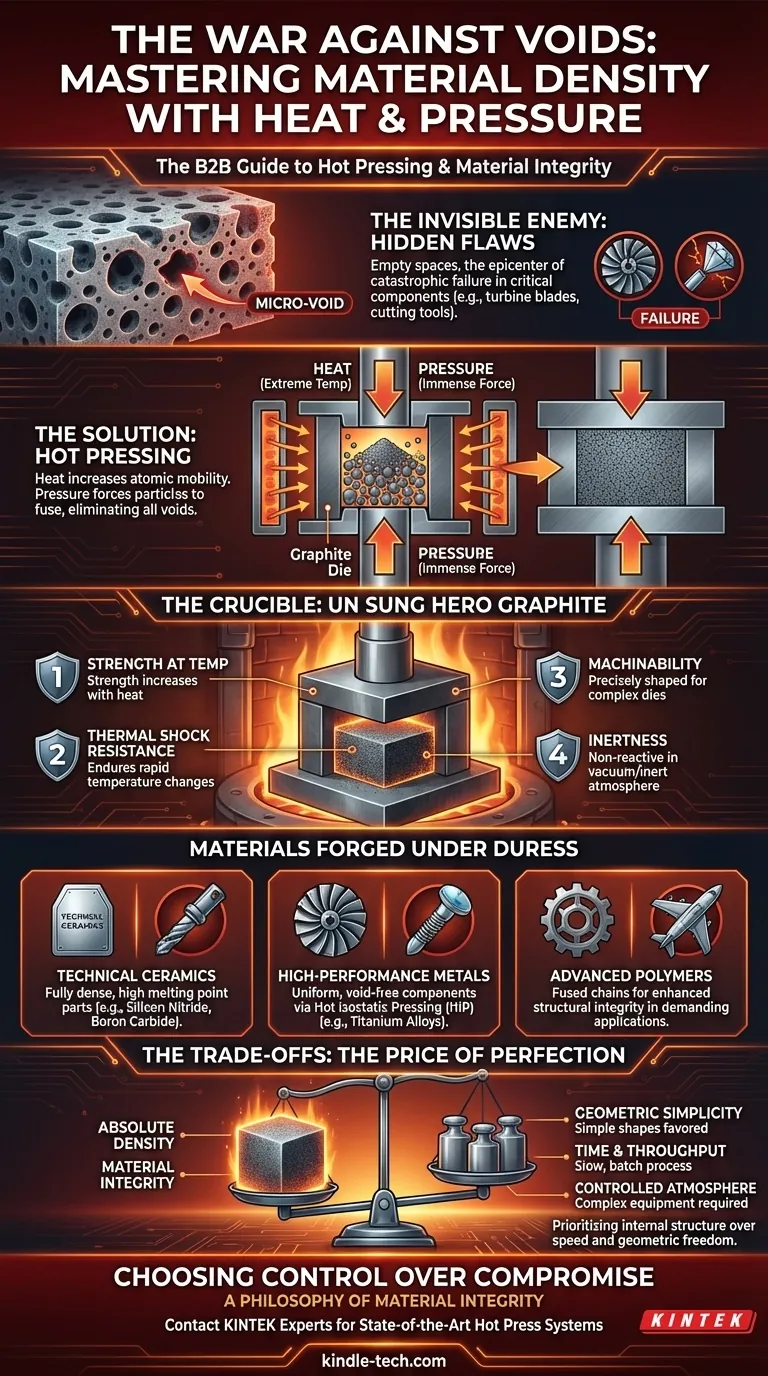
Imagine a critical turbine blade spinning at 10,000 RPM, or a diamond-tipped cutting tool slicing through hardened steel. Failure doesn't start with a visible crack. It begins in a microscopic void, an empty space left between particles during manufacturing—a tiny pocket of nothing that becomes the epicenter of a catastrophic fracture.
This is the engineer's constant anxiety: the unseen imperfection. Overcoming it requires more than just better materials; it requires a fundamentally different way of creating them. It requires a process that wages a war on empty space itself.
That process is hot pressing.
A Controlled, Brutal Environment
At its heart, hot pressing is a simple principle executed under extreme conditions: apply immense pressure to a material while it is being heated to extreme temperatures.
Heat gives the atoms mobility, loosening the rigid bonds that lock them in place. Pressure provides the inescapable instruction: get closer. There is no room for voids. The particles are forced together, their boundaries diffusing until they merge into a single, unified, and near-perfectly dense solid.
This isn't merely shaping a material. It's a forced reorganization at the atomic level, an act of controlled violence against the randomness and imperfection inherent in powdered materials.
The Crucible: Why Graphite Is the Unsung Hero
To forge materials in such an extreme environment, you need a tool that can withstand it. What can contain thousands of degrees of heat and tons of pressure without melting, cracking, or contaminating the very material it is trying to perfect?
The answer, surprisingly, is graphite.
The die assembly—the mold and punches that cradle the raw powder—is almost always machined from high-purity graphite. This material is a paradox. It’s soft enough to write with, yet it maintains its structural integrity at temperatures that would turn steel into a puddle.
Graphite is chosen for a unique combination of traits:
- Strength at Temperature: Unlike metals, its strength increases with temperature up to a certain point.
- Thermal Shock Resistance: It can endure rapid heating and cooling cycles without shattering.
- Machinability: It can be precisely shaped into complex dies.
- Inertness: In the required vacuum or inert atmosphere, it acts as a silent guardian, refusing to react with the material it holds.
The graphite die is the crucible where raw potential is transformed into unflawed performance.
Materials Forged Under Duress
Hot pressing is reserved for materials that are too stubborn for conventional methods. Its goal is not just consolidation, but the achievement of maximum theoretical density, which unlocks a material's true potential.
Technical Ceramics: From Powder to Armor
Materials like silicon nitride or boron carbide have incredibly high melting points and are inherently brittle. Simply heating them (sintering) leaves behind significant porosity. Hot pressing forces these particles together, creating fully dense ceramic parts used for everything from industrial armor to diamond-metal composite cutting tools that slice through rock.
High-Performance Metals: Eliminating Microscopic Weakness
For critical applications in aerospace or medical implants, even high-performance alloys like titanium are processed from powder. A method related to hot pressing, Hot Isostatic Pressing (HIP), applies pressure from all directions to eliminate any internal voids. This ensures the final component is a uniform, fully dense metal part with no hidden weaknesses that could lead to failure under stress.
Advanced Polymers: Creating Flawless Solids
Even high-performance polymers benefit from this process. Hot pressing fuses polymer chains and composite fillers into a solid, void-free component, dramatically enhancing its structural integrity for demanding applications.
The Inescapable Trade-Offs: The Price of Perfection
This level of control does not come without costs. Hot pressing is a deliberate choice, and it involves accepting certain constraints.
| Trade-Off | Implication |
|---|---|
| Geometric Simplicity | The rigid die favors simple shapes like discs and blocks. Intricate geometries are difficult to produce. |
| Time and Throughput | It is a slow, batch process. Each cycle takes hours, making it unsuitable for mass production. |
| Controlled Atmosphere | The process requires a vacuum or inert gas to prevent oxidation, adding significant equipment complexity. |
These are not failures of the process, but reflections of its purpose. You trade geometric freedom and speed for absolute certainty in the material's internal structure. It is a technique chosen when the cost of failure is infinitely higher than the cost of production.
Choosing Control Over Compromise
Ultimately, hot pressing is more than a manufacturing technique; it's a philosophy. It is the decision to prioritize material integrity above all else. It's for applications where "good enough" is simply not an option and where performance and safety depend on eliminating the invisible threat of the void.
Achieving this level of material perfection requires not only the right principles but also the right equipment. KINTEK provides state-of-the-art laboratory hot press systems designed to give researchers and engineers precise control over these demanding processes. Whether you are developing next-generation ceramics, advanced alloys, or high-strength composites, our solutions provide the foundation for creating materials without compromise.
To explore how to bring this level of material integrity to your work, Contact Our Experts.
Visual Guide
Related Products
- Automatic Heated Hydraulic Press Machine with Heated Plates for Laboratory Hot Press 25T 30T 50T
- Manual High Temperature Heated Hydraulic Press Machine with Heated Plates for Lab
- Touchscreen Automatic Vacuum Heat Press
- 30T 40T Split Automatic Heated Hydraulic Press Machine with Heated Plates for Laboratory Hot Press
- Vacuum Hot Press Furnace Machine Heated Vacuum Press
Related Articles
- Why Your Composite and Polymer Parts Keep Failing: The Secret Is Simultaneous Heat and Pressure
- The Physics of Flawless Materials: Deconstructing the Hydraulic Hot Press
- Precision Under Pressure: The Physics and Psychology of the Hydraulic Hot Press
- Hydraulic Hot Press: Principles, Components, Features, Advantages, and Applications
- Comprehensive Guide to Hydraulic Hot Press: Function, Features and Applications