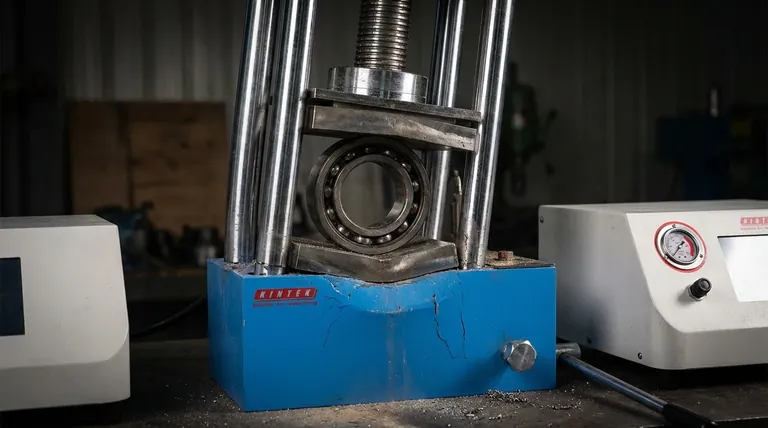
It's a moment of truth in any workshop or lab: a stubborn bearing, a tight-fitting component, a material sample that needs pressing. You position the workpiece in your new hydraulic press, pump the handle, and watch the pressure build. But instead of the satisfying pop of success, you see something terrifying: the steel frame of the press itself is visibly bending under the load.
You immediately back off the pressure. The project is stalled, the component is still stuck, and you're left staring at a tool that failed you, wondering if your "bargain" was a bargain at all.
The Cycle of Frustration: Why "More Tons" Isn't the Answer
If this scenario sounds familiar, you're not alone. Many technicians and researchers fall into the trap of choosing a hydraulic press based on two simple metrics: its tonnage rating and its price tag. This often leads to a frustrating cycle of failed attempts and risky workarounds.
When a press fails to do the job, the common reactions are:
- Blaming the workpiece: "This bearing must be fused on."
- Trying dangerous alternatives: Resorting to hammers, heat torches, or other uncontrolled methods that risk damaging the component or, worse, causing injury.
- Buying another "stronger" press: Simply purchasing a press with a higher tonnage rating, without understanding why the first one failed.
This approach doesn't just waste time; it has real business consequences. A stalled project means delayed production or R&D milestones. A damaged prototype means starting over, incurring extra material and labor costs. And most critically, an overloaded, flexing press frame is a catastrophic failure waiting to happen, posing a serious safety risk to your team.
The Real Culprit: It's Not Tonnage, It's Engineering
Here is the fundamental truth that is often overlooked: a press's tonnage rating is meaningless if its frame cannot safely and effectively deliver that force.
The problem isn't a lack of power from the hydraulic jack. The problem is a fundamental mismatch between the force being generated and the structure designed to contain it.
The Mismatch Between Power and Containment
Think of it like this: putting a high-performance race car engine into a go-kart chassis. The engine can produce immense power, but the frame isn't built to handle it. The moment you hit the accelerator, the chassis will twist, flex, and likely break apart.
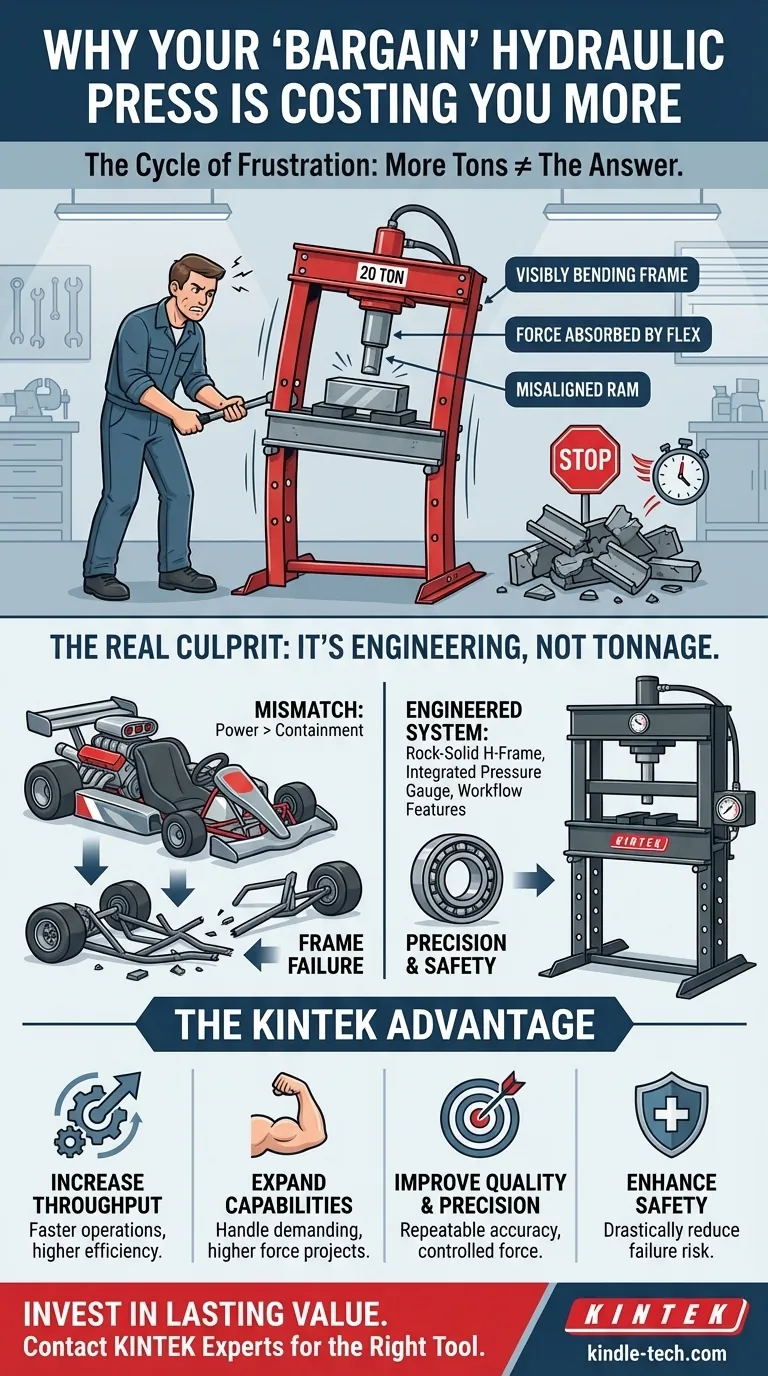
Many low-cost hydraulic presses do exactly this. They pair a powerful 12-ton or 20-ton jack with a lightweight "A-frame" or a flimsily built "H-frame" made of thin steel with weak welds. When you apply force:
- The frame flexes: The steel beams bend, absorbing the energy that should be going into your workpiece.
- The force is misaligned: As the frame twists, the ram is no longer perfectly perpendicular to the press bed, leading to off-center pressing that can damage your component.
- You're working blind: Without a pressure gauge, you are simply guessing how much force you're applying. This makes it impossible to perform precise, repeatable work or to know when you are approaching the structural limit of the press itself.
The common "solutions" fail because they don't address this core engineering principle. They only treat the symptom (a stuck part) instead of the disease (an inadequate tool).
The Right Tool for the Job: Choosing a Press Designed for Performance
To truly solve this problem, you don't just need more tons of force. You need a tool that is engineered as a complete system to deliver force with precision, stability, and safety.
This philosophy is at the heart of how we design and select equipment at KINTEK. A hydraulic press is more than a jack in a frame; it's a piece of precision machinery. Its value comes not from a sticker price, but from its ability to perform reliably under pressure.
How KINTEK Presses Address the Root Cause
Our curated selection of hydraulic presses is chosen specifically to overcome the common pitfalls of lesser designs.
-
Rock-Solid H-Frame Construction: We prioritize robust, H-frame presses built from heavy-gauge, fully-welded steel. This superior rigidity ensures that the force you generate is directed exactly where it needs to be—into your work—not into bending the tool itself.
-
Precision Through Measurement: Most of our models come standard with an integrated pressure gauge. This critical feature transforms pressing from a guessing game into a controlled process. You can apply the exact force required for a delicate assembly or know precisely how much pressure a sample withstood before deforming, ensuring repeatable and accurate results.
-
Engineered for Workflow: For environments that demand high throughput, features like an air-over-hydraulic power source allow for faster, effortless operation via a foot pedal. A sliding press head provides the versatility to handle off-center workpieces without compromising stability. These aren't just bells and whistles; they are features designed to solve real-world workflow challenges.
Beyond the Fix: Unlocking New Levels of Workshop Capability
When you have a reliable and precise hydraulic press, it does more than just solve one frustrating problem. It unlocks a new potential for what your lab or workshop can accomplish.
With a tool you can trust, you can now:
- Increase Throughput: Complete jobs faster and more efficiently, from pressing bearings to assembling prototypes.
- Expand Your Capabilities: Take on more demanding projects that require higher, controlled forces.
- Improve Quality and Precision: Assemble delicate components with confidence or conduct repeatable material strength tests for R&D.
- Enhance Safety: Drastically reduce the risk of equipment failure and create a safer working environment for your entire team.
Investing in the right tool means moving from a position of "I hope this works" to "I know this will work."
Your projects are too important to be derailed by inadequate equipment. If you're tired of fighting with your tools and are ready to invest in a solution that provides lasting value, our team is here to help. We can guide you through the technical specifications to find the exact press that matches the demands of your unique applications. Contact Our Experts to discuss your project needs.
Visual Guide
Related Products
- Heated Hydraulic Press Machine with Heated Plates for Vacuum Box Laboratory Hot Press
- Automatic High Temperature Heated Hydraulic Press Machine with Heated Plates for Lab
- Manual High Temperature Heated Hydraulic Press Machine with Heated Plates for Lab
- 24T 30T 60T Heated Hydraulic Press Machine with Heated Plates for Laboratory Hot Press
- Heated Hydraulic Press Machine with Integrated Manual Heated Plates for Lab Use
Related Articles
- Why Your Composite and Polymer Parts Keep Failing: The Secret Is Simultaneous Heat and Pressure
- The Physics of Flawless Materials: Deconstructing the Hydraulic Hot Press
- Hydraulic Hot Press: Principles, Components, Features, Advantages, and Applications
- More Than a Squeeze: The Physics and Psychology of the Hydraulic Hot Press
- Comprehensive Guide to Hydraulic Hot Press: Function, Features and Applications



















