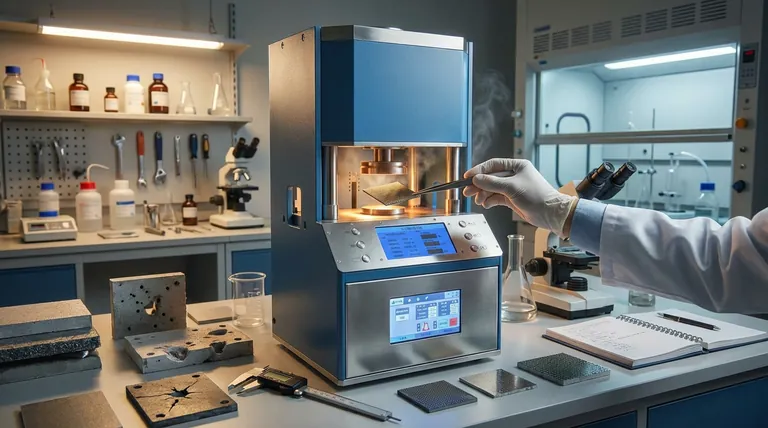
You’ve spent weeks developing a new composite formula. The design is flawless, the materials are top-grade. You place it in the heated press, run the cycle, and pull out the finished part. But instead of perfection, you find a subtle warp along one edge. Or worse, a post-process scan reveals internal voids that compromise its structural integrity. It’s almost perfect, but "almost" means it’s a failure.
What went wrong?
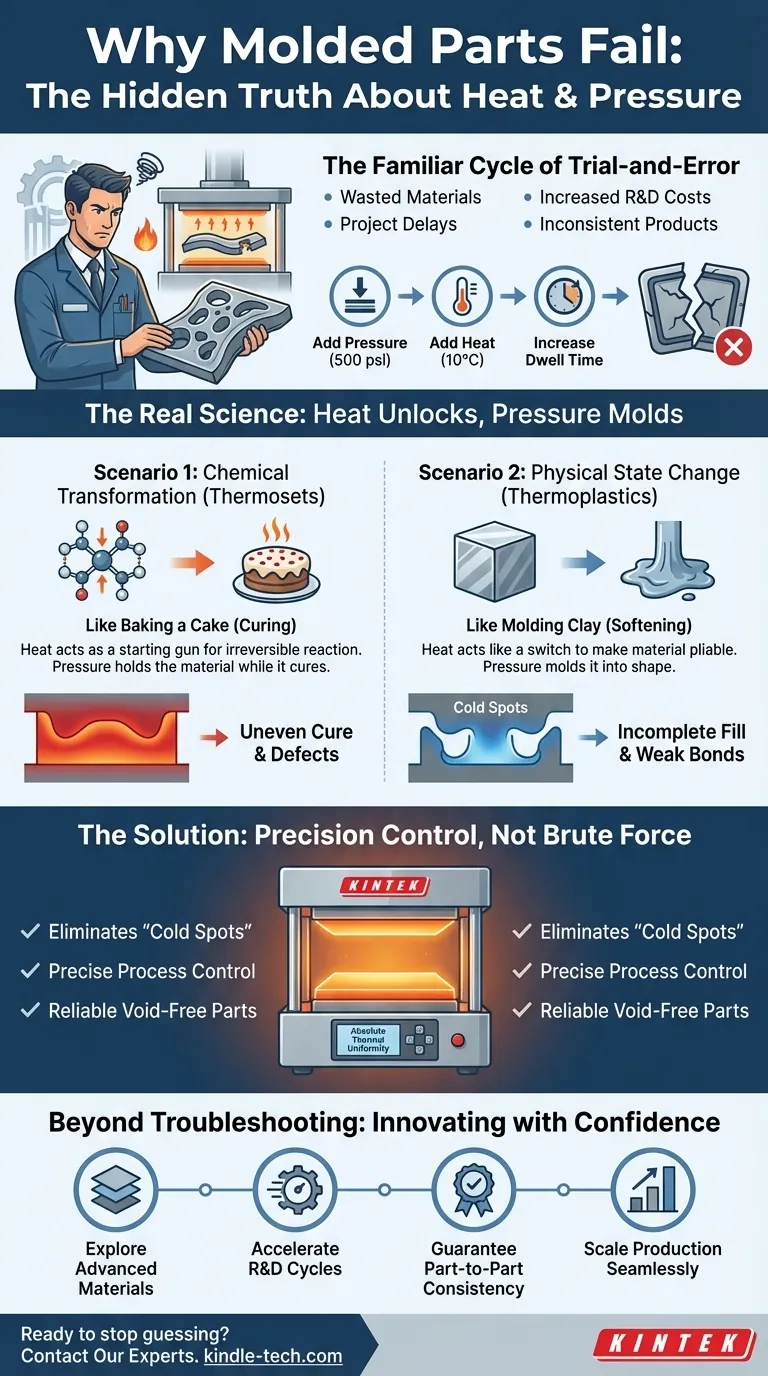
The Familiar Cycle of Trial-and-Error
If this scenario sounds familiar, you’re not alone. In labs and production facilities worldwide, teams face a frustrating guessing game when parts come out of the press with defects like warping, delamination, or inconsistent density.
The immediate reaction is often to tweak the most obvious variables:
- "Let's add another 500 psi of pressure. That should force it into shape."
- "Maybe we need more heat. Let's raise the platen temperature by 10°C."
- "Let's increase the dwell time. A few more minutes under pressure should do it."
Sometimes, these adjustments yield a slight improvement. More often, they lead to a new, different kind of failure, or they simply don't work at all. This cycle of trial-and-error isn't just frustrating; it has serious business consequences. Every failed part represents wasted high-value materials, from expensive carbon fiber pre-pregs to specialized polymer resins. Project timelines slip, R&D costs balloon, and your ability to deliver consistent, reliable products to your customers comes into question.
The core problem is that these "solutions" are treating a symptom, not the underlying cause. The real issue isn't a simple lack of force or heat; it's a fundamental misunderstanding of how they must work together.
The Real Science: Heat Unlocks, Pressure Molds
The common perception is that a heated press simply applies two forces—thermal and mechanical—at the same time. The truth is far more nuanced. In advanced material fabrication, heat’s primary role is not just to soften a material, but to unlock its potential for transformation. Pressure then acts on the material while it's in this unlocked state.
Depending on your material, this "unlocking" happens in one of two ways.
Scenario 1: Triggering a Chemical Transformation (Thermosets)
For materials like thermoset composites (e.g., epoxy and carbon fiber) or rubber, heat acts as the starting gun for an irreversible chemical reaction. This process is called curing or vulcanization.
Think of it like baking a cake. Heat doesn't just melt the batter; it triggers chemical reactions that turn it into a solid, stable sponge. You can't "un-bake" it. In the same way, the heat in your press initiates molecular cross-linking that gives the material its final strength and thermal stability.
In this context, the pressure’s job is simply to hold the material perfectly in the mold and eliminate any voids while this chemical race is run. If the heat isn't perfectly uniform, one part of your material will "bake" faster than another, causing internal stresses that lead to warping and defects. Simply adding more pressure won't fix an uneven chemical reaction.
Scenario 2: Inducing a Physical State Change (Thermoplastics)
For materials like thermoplastics or laminates with thermal adhesives, heat acts like a switch, flipping the material from a rigid solid into a pliable, clay-like state. The polymer chains become mobile, allowing the material to flow and be reshaped.
Here, the pressure’s job is to mold that "clay" into its new form or ensure a perfect bond. Once the material cools, it becomes rigid again, locking in the new shape.
The problem arises when heat is inconsistent. If you have "cold spots" on your platens, parts of your material will remain too rigid to flow properly under pressure. This results in an incomplete fill, weak bond lines, or high-stress areas. No amount of extra force can make a cold, rigid section of plastic behave like a hot, pliable one.
The Solution: From Brute Force to Precision Control
This reveals the fundamental flaw in the "more pressure" approach. It's like trying to shout louder at someone who speaks a different language. You're not solving the communication barrier.
To achieve consistent, perfect parts, you don't just need a press that gets hot. You need an instrument engineered for absolute thermal precision and uniformity. You need a tool that ensures every square centimeter of your material reaches the exact right temperature at the exact right time, unlocking its properties for the pressure to do its work flawlessly.
This principle is the very foundation of KINTEK’s heated hydraulic presses. They are not designed as simple machines that apply force and heat; they are engineered as integrated systems for precise thermal-mechanical control.
- Eliminating "Cold Spots": Our presses utilize advanced platen heating technology to guarantee exceptional temperature uniformity across the entire surface, eliminating the root cause of uneven cures and inconsistent melts.
- Precise Process Control: With responsive thermal management and programmable cycles, you gain the power to precisely direct the chemical reaction or physical transition within your material, moving from guesswork to predictable science.
- Reliability Under Pressure: By ensuring the material is perfectly prepared by the heat, the press's force can be applied efficiently and effectively, resulting in void-free, dimensionally accurate parts, every single time.
Beyond Troubleshooting: Innovating with Confidence
When you stop fighting with your equipment and can trust your process, a fundamental shift occurs. Your team’s valuable time is freed from endless troubleshooting and re-directed toward what truly matters: innovation.
With the reliability of a precision-controlled process, you can now:
- Explore More Ambitious Materials: Confidently work with more sensitive, high-performance polymers and composites that are unforgiving of process variations.
- Accelerate R&D Cycles: Move from concept to reliable prototype faster than ever before, knowing your results are repeatable.
- Guarantee Part-to-Part Consistency: Deliver on the promise of quality to your customers with every single part you produce, strengthening your reputation for excellence.
- Scale with Confidence: Seamlessly transition from lab-scale success to pilot production, knowing your process parameters are robust and reliable.
Solving your molding challenges is more than just a technical fix—it’s a strategic advantage that accelerates your entire development and production workflow. If you are ready to move beyond the frustrating cycle of "almost perfect" and start producing flawless parts with confidence, our team is here to help. Let's talk about the specific challenges you face with your materials and projects.
Visual Guide
Related Products
- Automatic High Temperature Heated Hydraulic Press Machine with Heated Plates for Lab
- Heated Hydraulic Press Machine with Heated Plates for Vacuum Box Laboratory Hot Press
- Manual High Temperature Heated Hydraulic Press Machine with Heated Plates for Lab
- 24T 30T 60T Heated Hydraulic Press Machine with Heated Plates for Laboratory Hot Press
- Laboratory Hydraulic Press Split Electric Lab Pellet Press
Related Articles
- Why Your Composite and Polymer Parts Keep Failing: The Secret Is Simultaneous Heat and Pressure
- Precision Under Pressure: The Physics and Psychology of the Hydraulic Hot Press
- More Than a Squeeze: The Physics and Psychology of the Hydraulic Hot Press
- Comprehensive Guide to Hydraulic Hot Press: Function, Features and Applications
- Hydraulic Hot Press: Principles, Components, Features, Advantages, and Applications



















