Knowledge thermal elements Can graphite be used as a heating element? Discover Its High-Temp Power in Controlled Environments
Author avatar

Tech Team · Kintek Solution

Updated 2 months ago

Can graphite be used as a heating element? Discover Its High-Temp Power in Controlled Environments


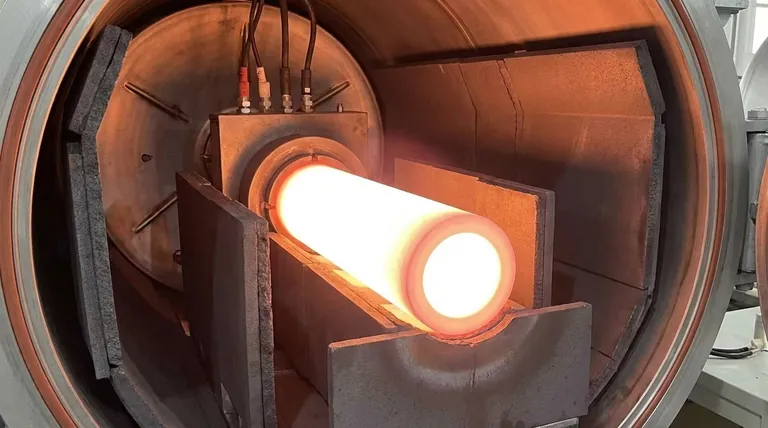
Yes, graphite is an excellent and widely used material for heating elements, particularly in high-temperature applications. It is often chosen for its high efficiency, cost-effectiveness, and superior performance in specific, controlled environments like vacuum or inert gas furnaces.

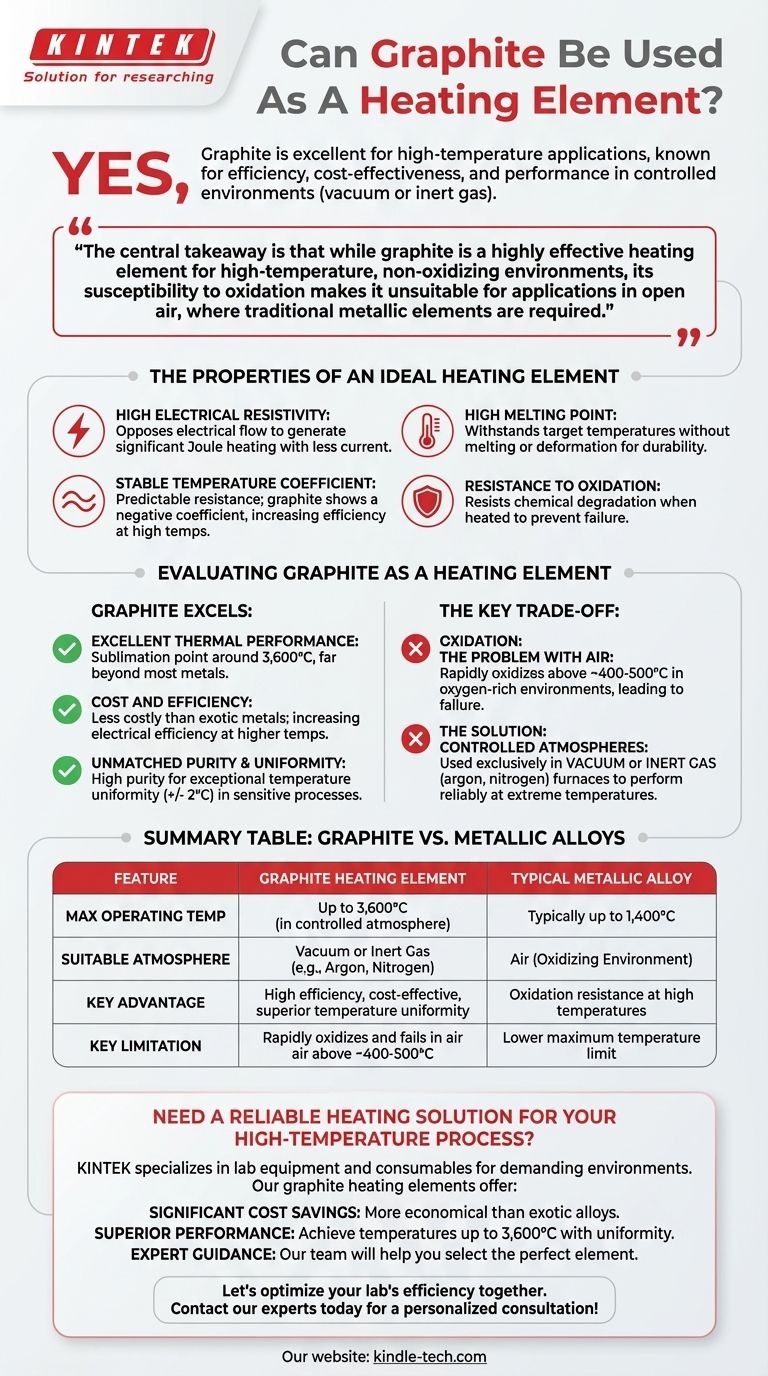
The central takeaway is that while graphite is a highly effective heating element for high-temperature, non-oxidizing environments, its susceptibility to oxidation makes it unsuitable for applications in open air, where traditional metallic elements are required.
Can graphite be used as a heating element? Discover Its High-Temp Power in Controlled Environments

The Properties of an Ideal Heating Element

To understand where graphite fits, we must first define what makes any material a good heating element. The choice of material is critical for longevity, efficiency, and the reliability of the entire heating process.

High Electrical Resistivity

A heating element works by converting electrical energy into heat as current passes through it, a phenomenon known as Joule heating. A material with high resistivity opposes the flow of electricity, generating significant heat with less current.

High Melting Point

The material must be able to withstand the target operating temperatures without melting or deforming. A high melting point is a fundamental requirement for durability and safety in high-temperature applications.

Stable Temperature Coefficient

The material's resistance should remain relatively stable as its temperature changes. This ensures predictable and controllable heat output. Interestingly, graphite exhibits a negative temperature coefficient, meaning its resistance decreases by about 20% as it heats up, making it more electrically efficient at high temperatures.

Resistance to Oxidation

The element must resist chemical degradation, primarily oxidation, when heated. Oxidation weakens the material, leading to premature failure and the need for frequent replacement.

Evaluating Graphite as a Heating Element

Graphite excels in several key areas, making it a superior choice for certain demanding processes. However, it also has one critical limitation.

Excellent Thermal Performance

Graphite has an exceptionally high melting point (or more accurately, sublimation point) of around 3,600°C, allowing it to operate at temperatures far beyond the limits of most metallic alloys.

Cost and Efficiency

Graphite elements are generally less costly than those made from exotic metals like molybdenum or tungsten. Combined with its increasing electrical efficiency at higher temperatures, it presents a very economical solution.

Unmatched Purity and Uniformity

Graphite can be manufactured to very high purity levels. When used in a furnace, it provides exceptional temperature uniformity, often within +/- 2°C, which is critical for sensitive processes in electronics and material science.

Understanding the Key Trade-off: Oxidation

Graphite's primary limitation is its behavior in the presence of oxygen. This single factor defines where it can and cannot be used.

The Problem with Air

When heated above approximately 400-500°C in an oxygen-rich environment (like open air), graphite will rapidly oxidize. This process converts the solid carbon into carbon dioxide gas, causing the element to degrade and quickly fail.

The Solution: Controlled Atmospheres

Because of its susceptibility to oxidation, graphite heating elements are used exclusively in vacuum furnaces or furnaces filled with a protective, inert gas (like argon or nitrogen). In these controlled environments, the lack of oxygen allows the graphite to perform reliably up to extremely high temperatures without degrading.

Making the Right Choice for Your Application

Selecting the correct heating element material comes down to the operating environment of your process.

  • If your primary focus is high-temperature operation (>1200°C) in a vacuum or inert gas: Graphite is the ideal choice due to its superior temperature capabilities, efficiency, and cost-effectiveness.
  • If your primary focus is heating in an open-air environment: Graphite is unsuitable and will fail quickly; you must use an oxidation-resistant metallic alloy like Kanthal (FeCrAl) or Nichrome (NiCr).

Ultimately, matching the material's properties to the operational atmosphere is the key to designing an effective and reliable heating system.

Summary Table:

Feature Graphite Heating Element Typical Metallic Alloy
Max Operating Temp Up to 3,600°C (in controlled atmosphere) Typically up to 1,400°C
Suitable Atmosphere Vacuum or Inert Gas (e.g., Argon, Nitrogen) Air (Oxidizing Environment)
Key Advantage High efficiency, cost-effective, superior temperature uniformity Oxidation resistance at high temperatures
Key Limitation Rapidly oxidizes and fails in air above ~400-500°C Lower maximum temperature limit

Need a reliable heating solution for your high-temperature process?

KINTEK specializes in lab equipment and consumables, providing robust heating systems for demanding environments. If your application involves high-temperature operations in a vacuum or inert gas atmosphere, our graphite heating elements can offer you:

  • Significant Cost Savings: More economical than exotic metal alloys.
  • Superior Performance: Achieve temperatures up to 3,600°C with excellent uniformity.
  • Expert Guidance: Our team will help you select the perfect element for your specific furnace and process requirements.

Let's optimize your lab's efficiency together. Contact our experts today for a personalized consultation!

Visual Guide
Can graphite be used as a heating element? Discover Its High-Temp Power in Controlled Environments Visual Guide

Related Products

People Also Ask

Related Products

2200 ℃ Graphite Vacuum Heat Treat Furnace

2200 ℃ Graphite Vacuum Heat Treat Furnace

Discover the power of the KT-VG Graphite Vacuum Furnace - with a maximum working temperature of 2200℃, it's perfect for vacuum sintering of various materials. Learn more now.

Ultra-High Temperature Graphite Vacuum Graphitization Furnace

Ultra-High Temperature Graphite Vacuum Graphitization Furnace

The ultra-high temperature graphitization furnace utilizes medium frequency induction heating in a vacuum or inert gas environment. The induction coil generates an alternating magnetic field, inducing eddy currents in the graphite crucible, which heats up and radiates heat to the workpiece, bringing it to the desired temperature. This furnace is primarily used for graphitization and sintering of carbon materials, carbon fiber materials, and other composite materials.

Graphite Vacuum Furnace High Thermal Conductivity Film Graphitization Furnace

Graphite Vacuum Furnace High Thermal Conductivity Film Graphitization Furnace

The high thermal conductivity film graphitization furnace has uniform temperature, low energy consumption and can operate continuously.

Vertical High Temperature Graphite Vacuum Graphitization Furnace

Vertical High Temperature Graphite Vacuum Graphitization Furnace

Vertical high temperature graphitization furnace for carbonization and graphitization of carbon materials up to 3100℃.Suitable for shaped graphitization of carbon fiber filaments and other materials sintered in a carbon environment.Applications in metallurgy, electronics, and aerospace for producing high-quality graphite products like electrodes and crucibles.

Horizontal High Temperature Graphite Vacuum Graphitization Furnace

Horizontal High Temperature Graphite Vacuum Graphitization Furnace

Horizontal Graphitization Furnace: This type of furnace is designed with the heating elements placed horizontally, allowing for uniform heating of the sample. It's well-suited for graphitizing large or bulky samples that require precise temperature control and uniformity.

Large Vertical Graphite Vacuum Graphitization Furnace

Large Vertical Graphite Vacuum Graphitization Furnace

A large vertical high-temperature graphitization furnace is a type of industrial furnace used for the graphitization of carbon materials, such as carbon fiber and carbon black. It is a high-temperature furnace that can reach temperatures of up to 3100°C.

Graphite Vacuum Furnace IGBT Experimental Graphitization Furnace

Graphite Vacuum Furnace IGBT Experimental Graphitization Furnace

IGBT experimental graphitization furnace, a tailored solution for universities and research institutions, with high heating efficiency, user-friendliness, and precise temperature control.

Graphite Vacuum Continuous Graphitization Furnace

Graphite Vacuum Continuous Graphitization Furnace

High-temperature graphitization furnace is a professional equipment for graphitization treatment of carbon materials. It is a key equipment for the production of high-quality graphite products. It has high temperature, high efficiency and uniform heating. It is suitable for various high-temperature treatments and graphitization treatments. It is widely used in metallurgy, electronics, aerospace, etc. industry.

Graphite Vacuum Furnace Negative Material Graphitization Furnace

Graphite Vacuum Furnace Negative Material Graphitization Furnace

Graphitization furnace for battery production has uniform temperature and low energy consumption. Graphitization furnace for negative electrode materials: an efficient graphitization solution for battery production and advanced functions to enhance battery performance.

Graphite Vacuum Furnace Bottom Discharge Graphitization Furnace for Carbon Materials

Graphite Vacuum Furnace Bottom Discharge Graphitization Furnace for Carbon Materials

Bottom-out graphitization furnace for carbon materials, ultra-high temperature furnace up to 3100°C, suitable for graphitization and sintering of carbon rods and carbon blocks. Vertical design, bottom discharging, convenient feeding and discharging, high temperature uniformity, low energy consumption, good stability, hydraulic lifting system, convenient loading and unloading.

Silicon Carbide SiC Thermal Heating Elements for Electric Furnace

Silicon Carbide SiC Thermal Heating Elements for Electric Furnace

Experience the advantages of Silicon Carbide (SiC) Heating Element: Long service life, high corrosion and oxidation resistance, fast heating speed, and easy maintenance. Learn more now!

Molybdenum Vacuum Heat Treat Furnace

Molybdenum Vacuum Heat Treat Furnace

Discover the benefits of a high-configuration molybdenum vacuum furnace with heat shield insulation. Ideal for high-purity, vacuum environments like sapphire crystal growth and heat treatment.

Molybdenum Disilicide (MoSi2) Thermal Elements Electric Furnace Heating Element

Molybdenum Disilicide (MoSi2) Thermal Elements Electric Furnace Heating Element

Discover the power of Molybdenum Disilicide (MoSi2) Heating Element for high-temperature resistance. Unique oxidation resistance with stable resistance value. Learn more about its benefits now!

Vacuum Heat Treat and Molybdenum Wire Sintering Furnace for Vacuum Sintering

Vacuum Heat Treat and Molybdenum Wire Sintering Furnace for Vacuum Sintering

A vacuum molybdenum wire sintering furnace is a vertical or bedroom structure, which is suitable for withdrawal, brazing, sintering and degassing of metal materials under high vacuum and high temperature conditions. It is also suitable for dehydroxylation treatment of quartz materials.

High Purity Pure Graphite Crucible for Evaporation

High Purity Pure Graphite Crucible for Evaporation

Vessels for high temperature applications, where materials are kept at extremely high temperatures to evaporate, allowing thin films to be deposited on substrates.

Vacuum Heat Treat Furnace with Ceramic Fiber Liner

Vacuum Heat Treat Furnace with Ceramic Fiber Liner

Vacuum furnace with polycrystalline ceramic fiber insulation liner for excellent heat insulation and uniform temperature field. Choose from 1200℃ or 1700℃ max. working temperature with high vacuum performance and precise temperature control.

Small Vacuum Heat Treat and Tungsten Wire Sintering Furnace

Small Vacuum Heat Treat and Tungsten Wire Sintering Furnace

The small vacuum tungsten wire sintering furnace is a compact experimental vacuum furnace specially designed for universities and scientific research institutes. The furnace features a CNC welded shell and vacuum piping to ensure leak-free operation. Quick-connect electrical connections facilitate relocation and debugging, and the standard electrical control cabinet is safe and convenient to operate.

2200 ℃ Tungsten Vacuum Heat Treat and Sintering Furnace

2200 ℃ Tungsten Vacuum Heat Treat and Sintering Furnace

Experience the ultimate refractory metal furnace with our Tungsten vacuum furnace. Capable of reaching 2200℃, perfect for sintering advanced ceramics and refractory metals. Order now for high-quality results.

Vacuum Heat Treat Sintering Brazing Furnace

Vacuum Heat Treat Sintering Brazing Furnace

A vacuum brazing furnace is a type of industrial furnace used for brazing, a metalworking process that joins two pieces of metal using a filler metal that melts at a lower temperature than the base metals. Vacuum brazing furnaces are typically used for high-quality applications where a strong, clean joint is required.

High Purity Pure Graphite Crucible for Electron Beam Evaporation

High Purity Pure Graphite Crucible for Electron Beam Evaporation

A technology mainly used in the field of power electronics. It is a graphite film made of carbon source material by material deposition using electron beam technology.


Leave Your Message