Knowledge Does induction heating work on graphite? Achieve High-Temperature Precision and Efficiency
Author avatar

Tech Team · Kintek Solution

Updated 1 week ago

Does induction heating work on graphite? Achieve High-Temperature Precision and Efficiency


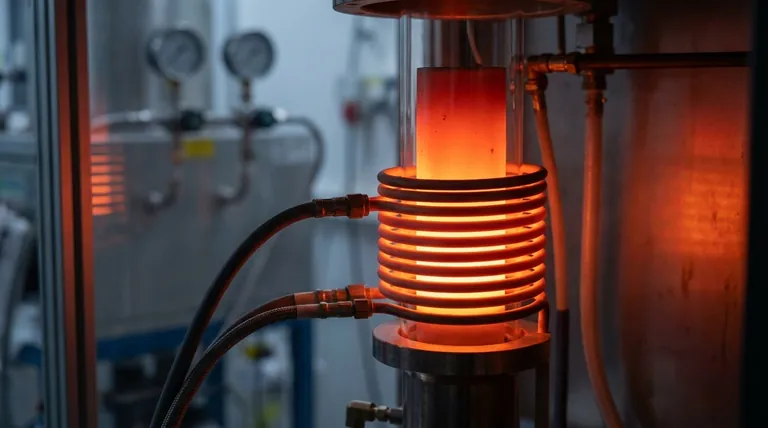
Yes, induction heating works exceptionally well on graphite. While often associated with metals, the core principle of induction heating applies to any electrically conductive material, and graphite is an effective conductor of electricity. It is widely used for applications like graphite crucibles and heating elements in high-temperature furnaces.

The key to understanding this is to separate the idea of "metal" from "electrically conductive." Induction heating induces electrical currents in a material; graphite's conductivity allows these currents to form, and its natural resistance causes it to heat up rapidly and efficiently.
Does induction heating work on graphite? Achieve High-Temperature Precision and Efficiency

How Induction Heating Works with Graphite

Induction heating is a non-contact process. It uses a high-frequency alternating magnetic field, generated by a copper coil, to induce electrical currents within a target material.

The Principle of Electrical Conductivity

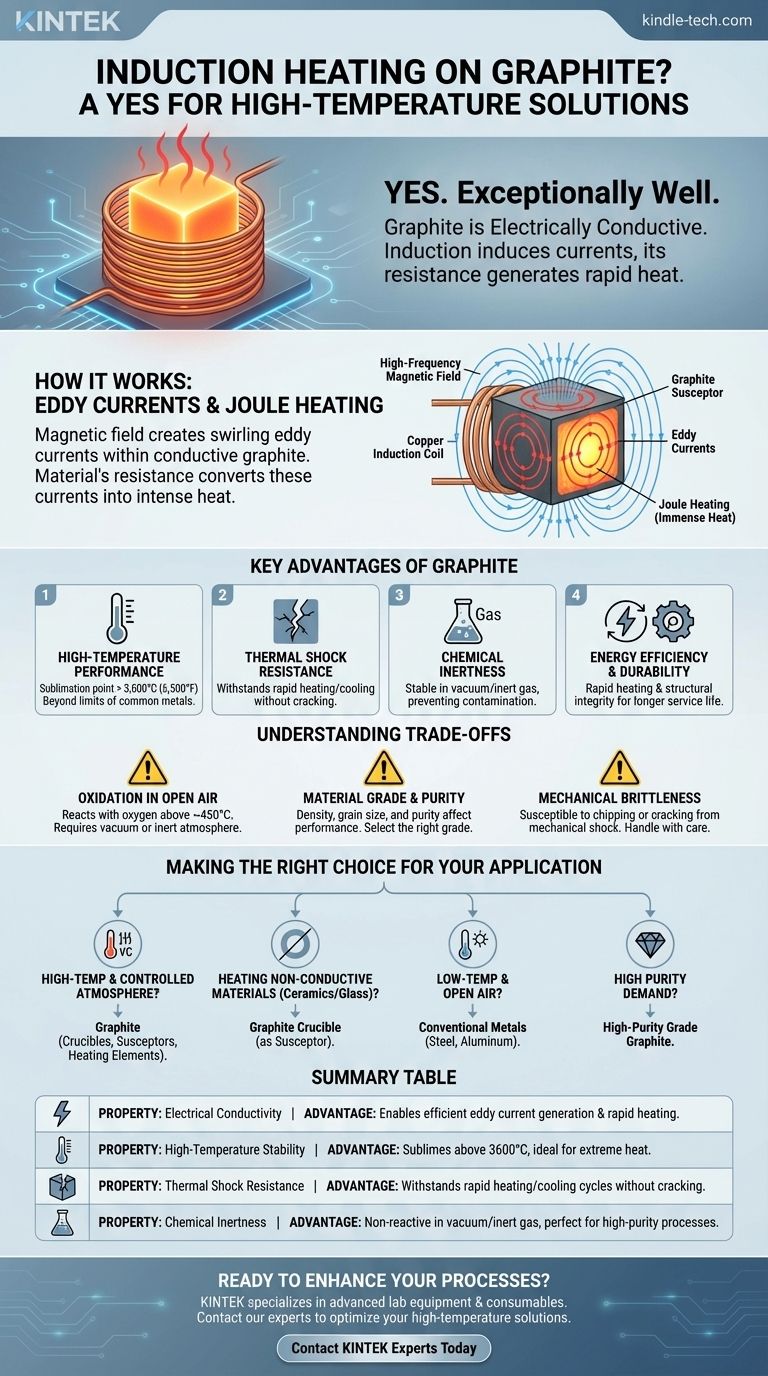
The magnetic field creates swirling electrical currents inside the material, known as eddy currents. The material's inherent resistance to the flow of these currents generates immense heat through a process called Joule heating.

Because graphite is electrically conductive, it readily supports the formation of these eddy currents. This allows it to be heated directly, quickly, and with precise control, without any physical contact from the induction coil.

Graphite as an Ideal Susceptor

In induction terminology, a material that is heated directly by the magnetic field is called a susceptor. Graphite is an excellent susceptor, not just because it's conductive, but because of its other unique properties that make it superior to many metals in specific applications.

Key Advantages of Using Graphite

Engineers and scientists choose graphite for induction heating for several critical reasons, especially in demanding, high-temperature environments.

High-Temperature Performance

Unlike most metals that melt, graphite has an extremely high sublimation point (over 3,600°C or 6,500°F). This allows it to be used in furnaces for processes that operate at temperatures far beyond the limits of common metals.

Thermal Shock Resistance

Graphite can withstand rapid changes in temperature without cracking or failing. This makes it perfect for applications with quick heating and cooling cycles, increasing furnace turnaround times and productivity.

Chemical Inertness

In vacuum or inert gas environments, graphite is chemically stable and will not react with the materials being processed. This is critical in the semiconductor industry or when melting high-purity alloys where contamination from a metal crucible is unacceptable.

Energy Efficiency and Durability

Graphite's ability to heat up quickly translates to greater energy efficiency. Furthermore, its structural integrity at high temperatures gives it a longer service life compared to many alternative materials, increasing furnace uptime.

Understanding the Trade-offs and Considerations

While powerful, graphite is not a universal solution. Understanding its limitations is critical for successful implementation.

Oxidation in Open Air

Graphite's most significant limitation is its reaction with oxygen at high temperatures. When heated above approximately 450°C (842°F) in the presence of air, it will begin to oxidize, or burn away.

For this reason, graphite is almost always used for high-temperature induction applications inside a vacuum or an inert gas atmosphere (like argon or nitrogen) to protect it.

Material Grade and Purity

Not all graphite is the same. The density, grain size, and purity of the graphite will affect its electrical conductivity, strength, and lifespan. Selecting the correct grade for your specific temperature and application is essential for predictable performance.

Mechanical Brittleness

Compared to metals, graphite is brittle. While it has high compressive strength, it can chip or crack if subjected to mechanical shock or mishandled. Care must be taken during the installation and loading of graphite components.

Making the Right Choice for Your Application

Choosing to use graphite depends entirely on the requirements of your process.

  • If your primary focus is high-temperature processing in a controlled atmosphere: Graphite is an industry-standard and often superior choice for crucibles, susceptors, and heating elements.
  • If your primary focus is heating non-conductive materials (like ceramics or glass): A graphite crucible is a perfect intermediary, acting as a clean, efficient susceptor that heats your material through conduction and radiation.
  • If your primary focus is low-temperature heating in open air: A conventional metal like steel or aluminum is likely a more practical and cost-effective choice.
  • If your application demands high purity: Ensure you use high-purity grade graphite to avoid contaminating the material you are heating.

When its properties are understood and leveraged correctly, graphite is an incredibly powerful and efficient material for induction heating applications.

Summary Table:

Property Advantage for Induction Heating
Electrical Conductivity Enables efficient eddy current generation and rapid heating.
High-Temperature Stability Sublimes above 3600°C, ideal for extreme heat applications.
Thermal Shock Resistance Withstands rapid heating/cooling cycles without cracking.
Chemical Inertness Non-reactive in vacuum/inert gas, perfect for high-purity processes.

Ready to enhance your high-temperature processes with precision induction heating?

KINTEK specializes in advanced lab equipment and consumables, providing robust solutions for your most demanding thermal applications. Our expertise in materials like graphite ensures you get the right components for superior performance, energy efficiency, and long-term durability.

Contact our experts today to discuss how our graphite solutions can optimize your laboratory's efficiency and results.

Visual Guide
Does induction heating work on graphite? Achieve High-Temperature Precision and Efficiency Visual Guide

Related Products

People Also Ask

Related Products

Graphite Vacuum Continuous Graphitization Furnace

Graphite Vacuum Continuous Graphitization Furnace

High-temperature graphitization furnace is a professional equipment for graphitization treatment of carbon materials. It is a key equipment for the production of high-quality graphite products. It has high temperature, high efficiency and uniform heating. It is suitable for various high-temperature treatments and graphitization treatments. It is widely used in metallurgy, electronics, aerospace, etc. industry.

Ultra-High Temperature Graphite Vacuum Graphitization Furnace

Ultra-High Temperature Graphite Vacuum Graphitization Furnace

The ultra-high temperature graphitization furnace utilizes medium frequency induction heating in a vacuum or inert gas environment. The induction coil generates an alternating magnetic field, inducing eddy currents in the graphite crucible, which heats up and radiates heat to the workpiece, bringing it to the desired temperature. This furnace is primarily used for graphitization and sintering of carbon materials, carbon fiber materials, and other composite materials.

Graphite Vacuum Furnace High Thermal Conductivity Film Graphitization Furnace

Graphite Vacuum Furnace High Thermal Conductivity Film Graphitization Furnace

The high thermal conductivity film graphitization furnace has uniform temperature, low energy consumption and can operate continuously.

Vertical High Temperature Graphite Vacuum Graphitization Furnace

Vertical High Temperature Graphite Vacuum Graphitization Furnace

Vertical high temperature graphitization furnace for carbonization and graphitization of carbon materials up to 3100℃.Suitable for shaped graphitization of carbon fiber filaments and other materials sintered in a carbon environment.Applications in metallurgy, electronics, and aerospace for producing high-quality graphite products like electrodes and crucibles.

Graphite Vacuum Furnace IGBT Experimental Graphitization Furnace

Graphite Vacuum Furnace IGBT Experimental Graphitization Furnace

IGBT experimental graphitization furnace, a tailored solution for universities and research institutions, with high heating efficiency, user-friendliness, and precise temperature control.

Laboratory Quartz Tube Furnace Tubular RTP Heating Furnace

Laboratory Quartz Tube Furnace Tubular RTP Heating Furnace

Get lightning-fast heating with our RTP Rapid Heating Tube Furnace. Designed for precise, high-speed heating and cooling with convenient sliding rail and TFT touch screen controller. Order now for ideal thermal processing!

1700℃ Muffle Oven Furnace for Laboratory

1700℃ Muffle Oven Furnace for Laboratory

Get superior heat control with our 1700℃ Muffle Furnace. Equipped with intelligent temperature microprocessor, TFT touch screen controller & advanced insulation materials for precise heating up to 1700C. Order now!

Vacuum Heat Treat and Molybdenum Wire Sintering Furnace for Vacuum Sintering

Vacuum Heat Treat and Molybdenum Wire Sintering Furnace for Vacuum Sintering

A vacuum molybdenum wire sintering furnace is a vertical or bedroom structure, which is suitable for withdrawal, brazing, sintering and degassing of metal materials under high vacuum and high temperature conditions. It is also suitable for dehydroxylation treatment of quartz materials.

Molybdenum Vacuum Heat Treat Furnace

Molybdenum Vacuum Heat Treat Furnace

Discover the benefits of a high-configuration molybdenum vacuum furnace with heat shield insulation. Ideal for high-purity, vacuum environments like sapphire crystal growth and heat treatment.

Dental Porcelain Zirconia Sintering Ceramic Furnace Chairside with Transformer

Dental Porcelain Zirconia Sintering Ceramic Furnace Chairside with Transformer

Experience top-notch sintering with Chairside Sintering Furnace with Transformer. Easy to operate, noise-free pallet, and automatic temperature calibration. Order now!

Vacuum Dental Porcelain Sintering Furnace

Vacuum Dental Porcelain Sintering Furnace

Get precise and reliable results with KinTek's Vacuum Porcelain Furnace. Suitable for all porcelain powders, it features hyperbolic ceramic furnace function, voice prompt, and automatic temperature calibration.

Small Vacuum Heat Treat and Tungsten Wire Sintering Furnace

Small Vacuum Heat Treat and Tungsten Wire Sintering Furnace

The small vacuum tungsten wire sintering furnace is a compact experimental vacuum furnace specially designed for universities and scientific research institutes. The furnace features a CNC welded shell and vacuum piping to ensure leak-free operation. Quick-connect electrical connections facilitate relocation and debugging, and the standard electrical control cabinet is safe and convenient to operate.

Vacuum Hot Press Furnace Machine for Lamination and Heating

Vacuum Hot Press Furnace Machine for Lamination and Heating

Experience clean and precise lamination with Vacuum Lamination Press. Perfect for wafer bonding, thin-film transformations, and LCP lamination. Order now!

Laboratory Test Sieves and Sieving Machines

Laboratory Test Sieves and Sieving Machines

Precision lab test sieves & sieving machines for accurate particle analysis. Stainless steel, ISO-compliant, 20μm-125mm range. Request specs now!

Laboratory Sterilizer Lab Autoclave Vertical Pressure Steam Sterilizer for Liquid Crystal Display Automatic Type

Laboratory Sterilizer Lab Autoclave Vertical Pressure Steam Sterilizer for Liquid Crystal Display Automatic Type

Liquid crystal display automatic vertical sterilizer is a safe, reliable and automatic control sterilization equipment, which is composed of heating system, microcomputer control system and overheating and overvoltage protection system.

Laboratory Sterilizer Lab Autoclave Pulse Vacuum Lifting Sterilizer

Laboratory Sterilizer Lab Autoclave Pulse Vacuum Lifting Sterilizer

The pulse vacuum lifting sterilizer is a state-of-the-art equipment for efficient and precise sterilization. It uses pulsating vacuum technology, customizable cycles, and a user-friendly design for easy operation and safety.

HFCVD Machine System Equipment for Drawing Die Nano-Diamond Coating

HFCVD Machine System Equipment for Drawing Die Nano-Diamond Coating

The nano-diamond composite coating drawing die uses cemented carbide (WC-Co) as the substrate, and uses the chemical vapor phase method ( CVD method for short ) to coat the conventional diamond and nano-diamond composite coating on the surface of the inner hole of the mold.

Engineering Advanced Fine Ceramics Aluminum Oxide Al2O3 Heat Sink for Insulation

Engineering Advanced Fine Ceramics Aluminum Oxide Al2O3 Heat Sink for Insulation

The hole structure of the ceramic heat sink increases the heat dissipation area in contact with the air, which greatly enhances the heat dissipation effect, and the heat dissipation effect is better than that of super copper and aluminum.

Benchtop Laboratory Vacuum Freeze Dryer

Benchtop Laboratory Vacuum Freeze Dryer

Benchtop laboratory freeze dryer for efficient lyophilization of biological, pharmaceutical, and food samples. Features intuitive touchscreen, high-performance refrigeration, and durable design. Preserve sample integrity—consult now!

Three-dimensional electromagnetic sieving instrument

Three-dimensional electromagnetic sieving instrument

KT-VT150 is a desktop sample processing instrument for both sieving and grinding. Grinding and sieving can be used both dry and wet. The vibration amplitude is 5mm and the vibration frequency is 3000-3600 times/min.


Leave Your Message