Knowledge How are created diamonds made? Discover the Science Behind Lab-Grown Diamonds
Author avatar

Tech Team · Kintek Solution

Updated 6 days ago

How are created diamonds made? Discover the Science Behind Lab-Grown Diamonds


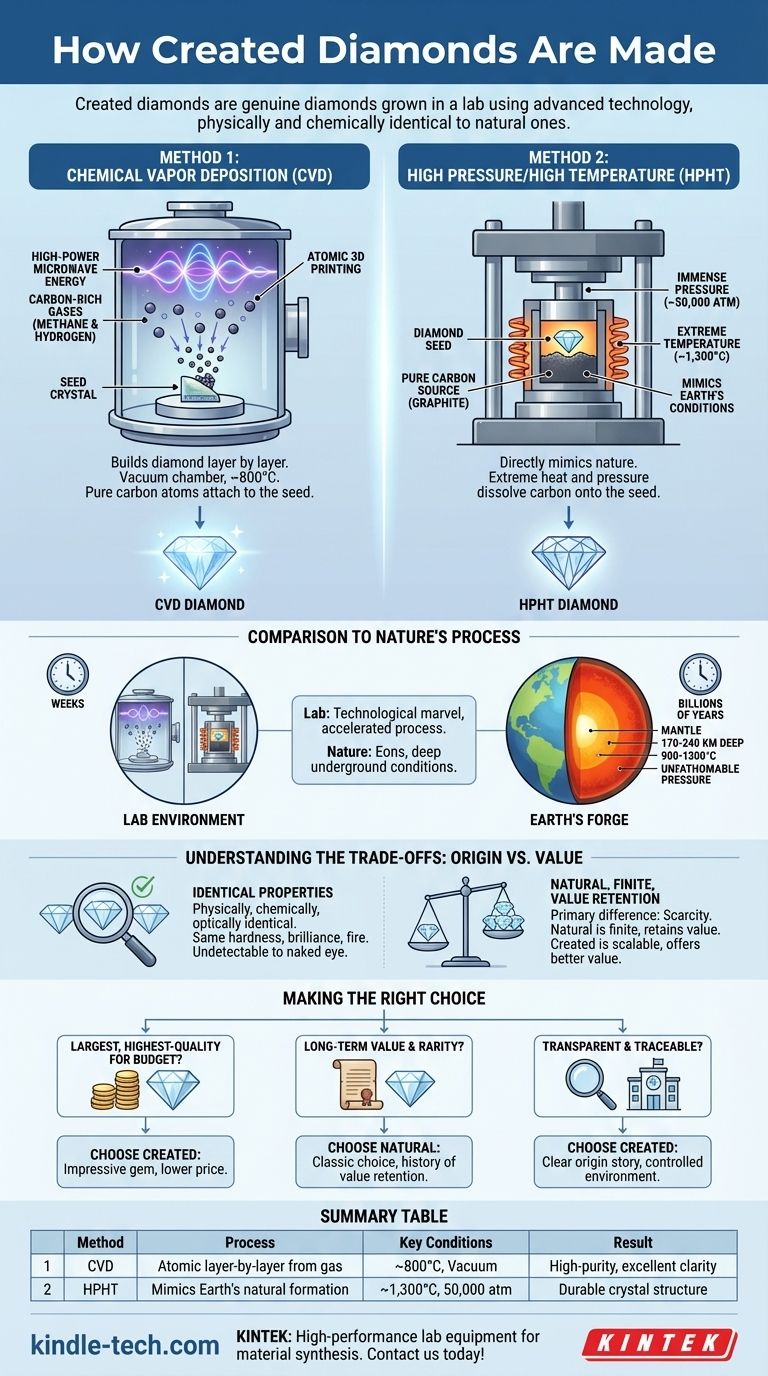
Created diamonds are not imitations; they are genuine diamonds grown in a laboratory environment using advanced technology that replicates the natural diamond-forming process. The two primary methods are Chemical Vapor Deposition (CVD) and High Pressure/High Temperature (HPHT), both of which start with a tiny "seed" diamond and build upon it to form a larger, chemically identical stone.

The core takeaway is that created diamonds are physically and chemically identical to mined diamonds. The only distinction lies in their origin: a controlled lab environment versus the immense, chaotic pressure deep within the Earth's mantle.
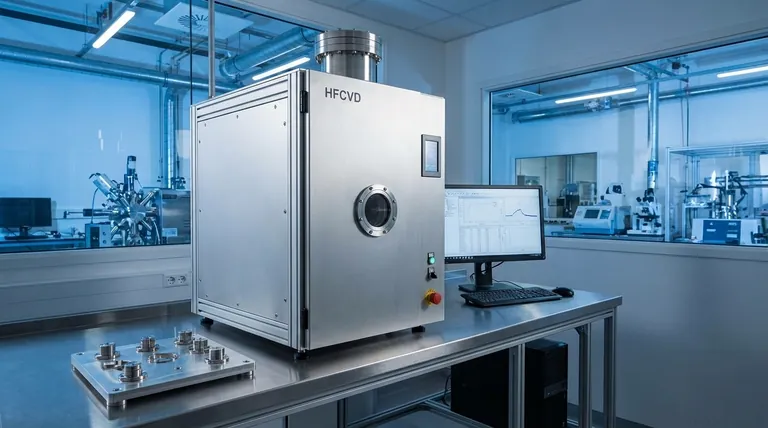
How are created diamonds made? Discover the Science Behind Lab-Grown Diamonds

The Two Paths to a Perfect Crystal

While a natural diamond takes billions of years to form, a created diamond can be grown in a matter of weeks. This is accomplished through two distinct but equally effective technological processes.

Method 1: Chemical Vapor Deposition (CVD)

Think of the CVD process as atomic 3D printing. It builds a diamond layer by layer.

A thin slice of a diamond, known as a seed crystal, is placed inside a sealed vacuum chamber.

The chamber is then heated to around 800°C and filled with a mixture of carbon-rich gases, typically methane and hydrogen.

High-power microwave energy ionizes these gases, breaking their molecular bonds. This causes pure carbon atoms to "rain" down and attach themselves to the diamond seed, replicating its crystal structure and growing a new, larger diamond.

Method 2: High Pressure/High Temperature (HPHT)

The HPHT method more directly mimics the conditions deep within the Earth.

A small diamond seed is placed into a chamber with a source of pure carbon, like graphite.

This chamber is then subjected to the same conditions that form diamonds in nature: extreme temperatures (around 1,300°C) and immense pressure (nearly 50,000 atmospheres).

Under these conditions, the carbon source melts and dissolves, crystallizing onto the diamond seed and forming a new, complete diamond crystal.

How This Compares to Nature's Process

The lab's controlled environment is a technological marvel that accelerates a process nature takes eons to complete.

The Earth's Diamond Forge

Natural diamonds form in a specific zone of the Earth's mantle, roughly 170 to 240 kilometers below the surface.

There, carbon is subjected to the same brutal conditions replicated by the HPHT process—unfathomable pressure and temperatures between 900°C and 1,300°C.

This intense environment forces carbon atoms into their most compact arrangement, creating the incredibly hard crystal structure of a diamond.

The Journey to the Surface

These diamonds are then brought to the surface in a geological instant through deep-source volcanic eruptions.

The magma travels rapidly, carrying the diamonds within rocks known as kimberlite, which then cool and form the pipes where diamonds are mined today.

Understanding the Trade-offs: Origin vs. Value

While they are identical in substance, the difference in origin creates important distinctions in perception and long-term value.

Identical Properties, Different Story

A lab-created diamond is physically, chemically, and optically identical to a natural diamond. They are both pure carbon crystals with the same hardness, brilliance, and fire.

Even a trained gemologist cannot tell the difference with the naked eye and requires specialized equipment to detect the subtle markers of a diamond's growth environment.

The Question of Rarity and Value

The primary difference is scarcity. Natural diamonds are a finite resource created by a geological process that cannot be replicated on a massive scale.

This rarity is why natural diamonds historically hold or increase their value over time. While created diamonds offer better value retention than simulants (like cubic zirconia), their ability to be produced on demand means they do not appreciate in the same way as their mined counterparts.

Making the Right Choice for Your Goal

The decision between a created and a natural diamond ultimately depends on your personal priorities and what you value most in a gemstone.

  • If your primary focus is obtaining the largest, highest-quality stone for your budget: Created diamonds offer a significant value proposition, allowing for a more impressive gem at a lower price point.
  • If your primary focus is long-term financial value and the tradition of rarity: Natural diamonds remain the classic choice, backed by a history of value retention and the allure of a finite natural resource.
  • If your primary focus is a transparent and traceable supply chain: Created diamonds provide a clear origin story from a controlled laboratory, avoiding the complexities of traditional mining.

Ultimately, both paths lead to a genuine diamond; the only difference is the story of its creation.

Summary Table:

Method Process Key Conditions Result
CVD Atomic layer-by-layer growth from carbon-rich gas ~800°C, vacuum chamber High-purity diamond with excellent clarity
HPHT Mimics Earth's natural diamond formation ~1,300°C, 50,000 atm pressure Durable diamond crystal structure

Need precise lab equipment for advanced material synthesis? KINTEK specializes in high-performance laboratory equipment and consumables, including systems for controlled environments like those used in diamond growth. Whether you're in research, manufacturing, or quality control, our solutions ensure accuracy and reliability. Contact our experts today to discuss how we can support your laboratory's specific needs!

Visual Guide
How are created diamonds made? Discover the Science Behind Lab-Grown Diamonds Visual Guide

Related Products

People Also Ask

Related Products

HFCVD Machine System Equipment for Drawing Die Nano-Diamond Coating

HFCVD Machine System Equipment for Drawing Die Nano-Diamond Coating

The nano-diamond composite coating drawing die uses cemented carbide (WC-Co) as the substrate, and uses the chemical vapor phase method ( CVD method for short ) to coat the conventional diamond and nano-diamond composite coating on the surface of the inner hole of the mold.

915MHz MPCVD Diamond Machine Microwave Plasma Chemical Vapor Deposition System Reactor

915MHz MPCVD Diamond Machine Microwave Plasma Chemical Vapor Deposition System Reactor

915MHz MPCVD Diamond Machine and its multi-crystal effective growth, the maximum area can reach 8 inches, the maximum effective growth area of single crystal can reach 5 inches. This equipment is mainly used for the production of large-size polycrystalline diamond films, the growth of long single crystal diamonds, the low-temperature growth of high-quality graphene, and other materials that require energy provided by microwave plasma for growth.

CVD Diamond Domes for Industrial and Scientific Applications

CVD Diamond Domes for Industrial and Scientific Applications

Discover CVD diamond domes, the ultimate solution for high-performance loudspeakers. Made with DC Arc Plasma Jet technology, these domes deliver exceptional sound quality, durability, and power handling.

Laboratory CVD Boron Doped Diamond Materials

Laboratory CVD Boron Doped Diamond Materials

CVD boron-doped diamond: A versatile material enabling tailored electrical conductivity, optical transparency, and exceptional thermal properties for applications in electronics, optics, sensing, and quantum technologies.

CVD Diamond Cutting Tool Blanks for Precision Machining

CVD Diamond Cutting Tool Blanks for Precision Machining

CVD Diamond Cutting Tools: Superior Wear Resistance, Low Friction, High Thermal Conductivity for Non-Ferrous Materials, Ceramics, Composites Machining

Vacuum Hot Press Furnace Machine for Lamination and Heating

Vacuum Hot Press Furnace Machine for Lamination and Heating

Experience clean and precise lamination with Vacuum Lamination Press. Perfect for wafer bonding, thin-film transformations, and LCP lamination. Order now!

Small Vacuum Heat Treat and Tungsten Wire Sintering Furnace

Small Vacuum Heat Treat and Tungsten Wire Sintering Furnace

The small vacuum tungsten wire sintering furnace is a compact experimental vacuum furnace specially designed for universities and scientific research institutes. The furnace features a CNC welded shell and vacuum piping to ensure leak-free operation. Quick-connect electrical connections facilitate relocation and debugging, and the standard electrical control cabinet is safe and convenient to operate.

Vacuum Dental Porcelain Sintering Furnace

Vacuum Dental Porcelain Sintering Furnace

Get precise and reliable results with KinTek's Vacuum Porcelain Furnace. Suitable for all porcelain powders, it features hyperbolic ceramic furnace function, voice prompt, and automatic temperature calibration.

Lab Scale Rotary Single Punch Tablet Press Machine TDP Tablet Punching Machine

Lab Scale Rotary Single Punch Tablet Press Machine TDP Tablet Punching Machine

This machine is a single-pressure automatic rotating, continuous tableting machine that compresses granular raw materials into various tablets. It is mainly used for tablet production in the pharmaceutical industry, and is also suitable for chemical, food, electronics and other industrial sectors.

Ring Press Mold for Lab Applications

Ring Press Mold for Lab Applications

Ring Press Dies, also known as Circular Pellet Press Die Sets, are integral components in various industrial and laboratory processes.

High Energy Vibratory Laboratory Ball Mill Grinding Mill Single Tank Type

High Energy Vibratory Laboratory Ball Mill Grinding Mill Single Tank Type

High-energy vibration ball mill is a small desktop laboratory grinding instrument.It can be ball-milled or mixed with different particle sizes and materials by dry and wet methods.

Anti-Cracking Press Mold for Lab Use

Anti-Cracking Press Mold for Lab Use

The anti-cracking press mold is a specialized equipment designed for molding various shapes and sizes of film using high pressure and electric heating.

Laboratory Test Sieves and Sieving Machines

Laboratory Test Sieves and Sieving Machines

Precision lab test sieves & sieving machines for accurate particle analysis. Stainless steel, ISO-compliant, 20μm-125mm range. Request specs now!

Benchtop Laboratory Freeze Dryer for Lab Use

Benchtop Laboratory Freeze Dryer for Lab Use

Premium benchtop laboratory freeze dryer for lyophilization, preserving samples with ≤ -60°C cooling. Ideal for pharmaceuticals & research.

High Energy Planetary Ball Mill Milling Machine for Laboratory

High Energy Planetary Ball Mill Milling Machine for Laboratory

Experience fast and effective sample processing with the F-P2000 high-energy planetary ball mill. This versatile equipment offers precise control and excellent grinding capabilities. Perfect for laboratories, it features multiple grinding bowls for simultaneous testing and high output. Achieve optimal results with its ergonomic design, compact structure, and advanced features. Ideal for a wide range of materials, it ensures consistent particle size reduction and low maintenance.

High Energy Planetary Ball Mill Milling Machine for Laboratory

High Energy Planetary Ball Mill Milling Machine for Laboratory

The biggest feature is that the high energy planetary ball mill can not only perform fast and effective grinding, but also has good crushing ability

High-Energy Omnidirectional Planetary Ball Mill Milling Machine for Laboratory

High-Energy Omnidirectional Planetary Ball Mill Milling Machine for Laboratory

The KT-P4000E is a new product derived from the vertical high-energy planetary ball mill with a 360° swivel function. Experience faster, uniform, and smaller sample output results with 4 ≤1000ml ball mill jars.

High-Energy Omnidirectional Planetary Ball Mill Machine for Laboratory

High-Energy Omnidirectional Planetary Ball Mill Machine for Laboratory

The KT-P2000E is a new product derived from the vertical high-energy planetary ball mill with a 360°rotation function. The product not only has the characteristics of the vertical high-energy ball mill, but also has a unique 360°rotation function for the planetary body.

Laboratory Planetary Ball Mill Cabinet Planetary Ball Milling Machine

Laboratory Planetary Ball Mill Cabinet Planetary Ball Milling Machine

The vertical cabinet structure combined with ergonomic design enables users to obtain the best comfortable experience in standing operation. The maximum processing capacity is 2000ml, and the speed is 1200 revolutions per minute.

Laboratory Sterilizer Lab Autoclave Vertical Pressure Steam Sterilizer for Liquid Crystal Display Automatic Type

Laboratory Sterilizer Lab Autoclave Vertical Pressure Steam Sterilizer for Liquid Crystal Display Automatic Type

Liquid crystal display automatic vertical sterilizer is a safe, reliable and automatic control sterilization equipment, which is composed of heating system, microcomputer control system and overheating and overvoltage protection system.


Leave Your Message