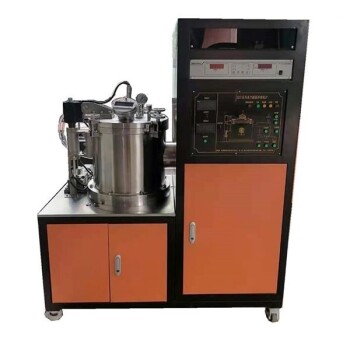
High-performance vacuum furnaces act as precise thermal activation environments for post-implantation analysis. Specifically, they are used to subject helium-implanted alloy samples to a temperature of 500°C for a duration of 10 minutes. This controlled heating process is the catalyst that transforms trapped helium atoms into observable physical features for study.
By providing the necessary thermal activation energy, this short-term annealing process forces helium atoms to migrate and aggregate. The furnace effectively converts minute, invisible lattice defects into detectable helium bubbles, allowing researchers to evaluate how well materials like high-entropy alloys suppress inert gas damage.
The Mechanism of Bubble Formation
Thermal Activation Energy
The primary role of the vacuum furnace is to introduce a specific amount of thermal activation energy into the alloy lattice.
Following implantation, helium atoms are often trapped within the metal's crystal structure. The 500°C environment provides the kinetic energy required to dislodge these atoms from their initial traps.
Aggregation and Nucleation
Once liberated by the heat, the helium atoms begin to migrate through the material.
Driven by the thermal energy, these atoms seek each other out and clump together. This process creates bubble nuclei, which serve as the foundation for larger defects.
Defect Conversion and Growth
The 10-minute duration allows the process to progress from nucleation to growth.
The furnace treatment converts what were originally minute, atomic-scale defects into larger, detectable helium bubbles. This renders the helium behavior visible for characterization tools, enabling precise measurement of the material's response.
Critical Process Controls and Trade-offs
Precision vs. Over-Processing
The short-term nature of this process (10 minutes) is a critical variable.
Annealing for too long could lead to excessive bubble coalescence, potentially obscuring the initial nucleation sites researchers aim to study. The process is tuned to grow bubbles just enough to be detectable without altering the fundamental material structure excessively.
The Role of the Vacuum Environment
While the reference highlights the temperature and time, the use of a vacuum furnace is implicit but vital.
At 500°C, many alloys are susceptible to oxidation or surface contamination from the atmosphere. A high-performance vacuum ensures that the sample remains pure, guaranteeing that any observed changes are due solely to helium behavior and not environmental reactions.
Application in Material Science
Evaluating Suppression Effects
The ultimate goal of this furnace application is to test material resilience.
By forcing bubbles to form, researchers can observe how effectively a material resists this degradation. This is particularly relevant for high-entropy alloys, which are being studied for their ability to suppress inert gas swelling.
Understanding Inert Gas Behavior
This process provides a window into the behavior of inert gases within solid metals.
It allows scientists to move beyond theoretical models and observe actual gas aggregation. This data is essential for designing materials that can withstand radiation environments where helium implantation naturally occurs.
Making the Right Choice for Your Goal
If your primary focus is Defect Visualization: Ensure strict adherence to the 500°C threshold for the full 10 minutes to guarantee sufficient energy for bubble growth to detectable levels.
If your primary focus is Material Purity: Prioritize the integrity of the furnace's vacuum seal to prevent high-temperature oxidation from interfering with the surface analysis of the alloy.
If your primary focus is Alloy Comparison: Maintain identical annealing profiles across all sample batches to accurately benchmark the suppression capabilities of different high-entropy alloys.
Controlled thermal activation is the bridge between invisible atomic defects and actionable material insights.
Summary Table:
| Process Parameter | Specification | Purpose in Helium Analysis |
|---|---|---|
| Annealing Temp | 500°C | Provides thermal activation energy for helium migration |
| Process Time | 10 Minutes | Ensures bubble growth without excessive coalescence |
| Environment | High Vacuum | Prevents oxidation and surface contamination of alloys |
| Target Output | Bubble Nucleation | Converts invisible lattice defects into detectable features |
Elevate Your Materials Research with KINTEK Precision
At KINTEK, we specialize in providing high-performance laboratory equipment tailored for advanced material science. Whether you are conducting short-term high-temperature annealing or complex gas implantation studies, our comprehensive range of vacuum furnaces, CVD/PECVD systems, and high-temperature reactors ensures the thermal precision and atmosphere control your research demands.
From high-entropy alloy analysis to battery research and crushing systems, KINTEK delivers the durability and accuracy required for world-class laboratories. Contact us today to discover how our specialized equipment can enhance your lab's efficiency and experimental outcomes.
References
- І.V. Kolodiy, G.D. Tolstolutska. EFFECT OF INERT GAS IONS IRRADIATION ON RADIATION DAMAGE OF HIGH-ENTROPY ALLOY CrFe2MnNi AND 18Cr10NiTi STEEL. DOI: 10.46813/2025-156-003
This article is also based on technical information from Kintek Solution Knowledge Base .
Related Products
- Vacuum Hot Press Furnace Heated Vacuum Press Machine Tube Furnace
- 600T Vacuum Induction Hot Press Furnace for Heat Treat and Sintering
- Vacuum Hot Press Furnace Machine Heated Vacuum Press
- Vacuum Heat Treat Furnace and Levitation Induction Melting Furnace
- 2200 ℃ Tungsten Vacuum Heat Treat and Sintering Furnace
People Also Ask
- What advantages does a vacuum hot press furnace provide for LSLBO ceramic electrolytes? Achieve 94% Relative Density
- What role does a Vacuum Hot Press (VHP) furnace play in the densification of austenitic stainless steel 316 composites?
- What are the advantages of using a vacuum hot pressing furnace? Superior Densification for 2024Al/Gr/SiC Composites
- What are the advantages of a vacuum hot press furnace for LTPO solid electrolytes? Boost Density and Conductivity
- What core processing conditions does a vacuum hot press furnace provide? Achieve High-Density Cu-SiC/Diamond Composites